Global environmental problems

Global contaminants such as Persistent Organic Pollutants (POPs) or mercury are regulated by Multilateral Environmental Agreements (MEAs), namely the Stockholm and Minamata Conventions respectively. A number of additional ‘Emerging Policy Issues’ (EPIs) have been nominated for voluntary, cooperative risk reduction actions by countries through the Strategic Approach for International Chemicals Management (SAICM). These EPIs are:

The SAICM GEF 9771 project focuses on two EPIs: Lead in paint and Chemicals in products, which generate particular environmental and health challenges. The project also addresses the need for knowledge management, information exchange and strategic planning to ensure concerted and coordinated action on all EPIs. 

The project objective is to accelerate adoption of national and value chain initiatives to control Emerging Policy Issues (EPIs), and contribute to the 2020 SAICM goal and 2030 Agenda for Sustainable Development.


The project focuses on 3 components:
Lead in paint

Working with governments to develop laws that restrict the use of lead paint and working with SMEs to promote the phase-out of lead additives.

Chemicals in products

Increasing the ambition of different stakeholders to track and control chemicals of concern in products along the value chains of electronics, toys and building products sectors.

Knowledge and stakeholder engagement

improving access to information and knowledge on chemicals management amongst SAICM stakeholders.


The map below showcases the 40 countries where the SAICM GEF 9771 project is supporting activities to address lead in paint and chemicals in products:
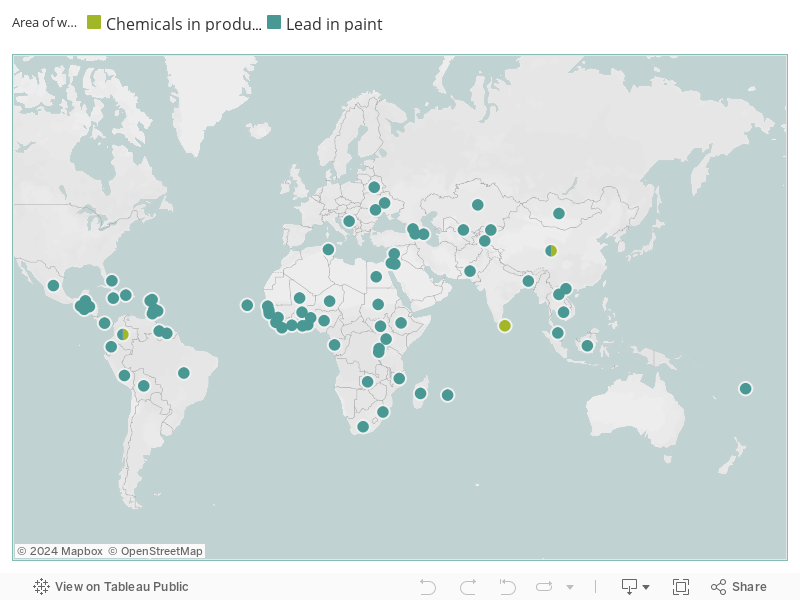
*Map tooltip indicates 6 stages of drafting lead in paint laws: #1 No progress; #2 Government interest; #3 First steps taken; #4 Early stages of drafting; #5 Final stages of drafting, and #6 Final lead paint law.


Block id is component-1--lead-in-paint

Component 1 Lead in paint 

The lead in paint component promotes regulatory and voluntary action by government and industry to phase out lead in paint.

Key targets already achieved on lead in paint:
  • 15 new countries have adopted legislation to establish legal limits to Lead in Paint
  • 14 paint manufacturers have completed paint reformulation demonstration projects to produce lead-free paint
  • 90 registered awareness-raising events at the International Lead Poisoning Prevention Week (ILPPW) 2020

Outcome 1

At least 40 countries to legislate and implement legislation to restrict the use of lead in paint.
Outcome 1: At least 40 countries to legislate and implement legislation to restrict the use of lead in paint.

The first project output will address the technical barriers in the manufacture of paints with no lead additives. The second project output will address the barrier on lack of capacities in developing countries to introduce and enforce lead paint limits. The main activity is advocacy with governments for policy development and assistance in drafting lead paint laws.

Outcome 1.1: Paint reformulation demonstrations with paint manufacturers in Small and Medium Sized enterprises (SMEs) executed in seven countries.
Output 1.2: Policy support and awareness raising generate support for lead phase out.
  • Regional workshops to provide an overview of the Lead Paint Alliance, the recommended actions and available advice to support the establishment of lead paint laws
  • Provision of technical assistance by the project execution partners to over 60 countries.
  • Interactive visualization of the status of lead paint laws
Block id is component-2--chemicals-in-products

Component 2 Chemicals in products

toy image

Component 2 on "life cycle management of chemicals present in products", focuses on chemicals of concern in three sectors (building products, electronics and toys) and how to minimize the adverse effects of chemicals of concern

Key targets already achieved on chemicals in products:

  • Tools in development for governments and value chain actors to manage chemicals of concern in products
  • 40 value chain and government actors trained on the use of new tools and guidance to manage chemicals of concern in products

Outcome 2

Governments and value chain actors in the building products, toys, and electronics sectors to track and manage chemicals of concern (CoC) in their products

The component is developing new tools and guidance to reduce the use of chemicals of concern in the building products, electronics and toys sectors and provides training and support for government and value chain actors to trial and adopt new guidance and tools.

The component is guided by a value chain approach and the Component Summary Document provides an overview of the approach and the interventions in the three sectors.

Output 2.1: New tools and guidance to reduce the use of chemicals of concern (CoC) in the building, electronics and toys sectors.

Guidance/tools for building sector

Guidance/tools for electronics sector

Guidance/tools for toys sector

Output 2.2: Training and support for government and value chain actors to trial and adopt new guidance and tools.
  • Training on USEtox model for companies of building products and toy sectors in Sri Lanka and China
  • Eco-innovation and/or Sustainable Public Procurement pilot projects in Colombia and Sri Lanka
  • Sustainable finance pilot project in Sri Lanka
  • Training and consultations on regulatory and compliance approaches for toys and electronics sectors

Additional documents

Project-sponsored events on Chemicals in Products:

Overview and lessons learnt on Chemicals in Products:

Block id is component-3--knowledge-management-and-stakeholder-engagement

Component 3 Knowledge Management and stakeholder engagement

meeting image

The third component explores ways to create, manage and disseminate knowledge on chemicals of concern. 

Key targets already achieved on knowledge management and stakeholder engagement:

  • Over 400 scientific and policy knowledge resources shared with policy members on EPIs and SDGs through the new SAICM Knowledge platform
  • More than 800 active members registered in the new SAICM communities of practice

Outcome 3

A broad group of SAICM stakeholders access information and participate in communities of practice for peer-to-peer learning exchanges.

This project component supports the development and dissemination of knowledge on chemicals of concern. The knowledge platform saicmknowledge.org is a key tool developed within this component.

Output 3.1: Collaboration and engagement with the SDG agenda and scientific community to promote Emerging Policy Issues (EPIs).

• Production of publications on chemicals-related topics:

Policy briefs on chemicals and SDGs

Thematic papers

• Gender Review Mapping with a Focus on Women and Chemicals: Impact of Emerging Policy Issues and the Relevance for the Sustainable Development Goals

• Presentations on SAICM at scientific community events and related policy events.

• Convening of side-events to raise awareness on emerging policy issues.

Output 3.2: Development of a Knowledge Management platform provides a repository of information and forum for exchange of scientific and policy information.
  • SAICM Knowledge Management Strategy.
  • The development of a new dynamic platform to facilitate knowledge sharing on the sound management of chemicals and waste – saicmknowledge.org
  • Establishment of four Communities of Practice to enable dialogues amongst SAICM stakeholders on relevant chemical issues.

Info

Project status
Active
Date
29 Dec 2018 - 29 Dec 2023
Team
Hover for more details

Partners

American Bar Association
CEDEAO ECOWAS
CEDEAO ECOWAS
Green Electronics Council
GGKP
Green Policy Platform
IPEN
IPEN
ISC3
ISC3
National Cleaner Production Centres (NCPCs)
One planet
One planet
UNEP
UN Environment Programme
University of Cape Town
US Environmental Protection Agency
USEtox
USEtox
World Coatings Council
WHO
World Health Organization
Like Cycle Initiative
Life Cycle Initiative
IISD
International Institute for Sustainable Development

Stakeholders

The project involves the following groups of stakeholders for a successful implementation:

Government

  • Local policy makers
  • National policy makers
  • Public R&B Organisations (some text for testing)
  • Development banks
  • Regional governmental organizations

Civil society

Private sector

  • Entrepreneurs R&D
  • Retails
  • Private Research & Development Organisations
  • Trade associations
  • Alternative suppliers
  • Chemical importers
  • Chemical suppliers (not-SME)
  • Chemical waste disposal companies
  • Weste managements & recycling compoanies
  • Private testing laboratories
  • Procurement agencies
  • Paint SMEs
  • Large companies (non-SME)
  • Building materials SMEs
  • Electronics SMEs
  • Toy SMEs
  • Insureres
  • Private equity banks

61 resources found

SAICMUCT CDSG CoP Discussion 4 2022 digest
Community of practice summary of discussions

Environmental Injustice Issues to Consider for Chemical Risk

by |
November 2022
copied to clipboard

The Secretariat of the Strategic Approach to Chemicals Management (SAICM) and the University of Cape Town (UCT) have launched a Community of Practice (CoP) on Chemicals and SDGs to bring representatives from different sectors together and to create a learning network around issues related to addressing Chemicals and the Sustainable Development Goals (SDGs). This is a summary of the discussion on Environmental Injustice Issues to Consider for Chemical Risk, which took place on 23 November 2022.

Presenters: Rico Euripidou (groundWork)

SAICMUCT CDSG CoP Discussion 3 2022 digest
Community of practice summary of discussions

Plastic pollution: ideas for addressing chemicals in plastics

by |
October 2022
copied to clipboard

The Secretariat of the Strategic Approach to Chemicals Management (SAICM) and the University of Cape Town (UCT) have launched a Community of Practice (CoP) on Chemicals and SDGs to bring representatives from different sectors together and to create a learning network around issues related to addressing Chemicals and the Sustainable Development Goals (SDGs). This is a summary of the discussion on Plastic pollution: ideas for addressing chemicals in plastics, which took place on 19 October 2022.

Presenters: Brenda Koekkoek (UNEP), Jost Dittkrist (UNEP), Dr. Eeva Leinala (OECD), Mochamad Adi Septiono (Nexus3 Foundation)

Policy document

A review of PFAS as a Chemical Class in the Textiles Sector - Policy Brief

For over a decade, under both SAICM and the Stockholm Convention on Persistent Organic Pollutants (POPs), the class of chemicals known as PFAS is gaining increasing international attention. Since 2009, chemicals in products have been identified as an Emerging Policy Issue and PFAS as an Issue of Concern by the SAICM. The textiles sector is currently considered in the SAICM context through the ‘Chemicals in Products Programme’, which focuses on four priority sectors: textiles, toys, building products and electronics. The
Factsheets and brochures

The Potential Key Role of SAICM Focal Points in Reducing Harm from HHPs

by |
August 2022
copied to clipboard
The factsheet entitled "The potential key role of SAICM Focal Points in reducing harm from Highly Hazardous Pesticides (HHPs)" was produced by stakeholders from the University of Cape Town, the Strategic Approach to International Chemicals Management, the Food and Agriculture Organization and Umweltbundesamt. This factsheet was developed to ensure information about HHPs reaches all SAICM National Focal Points and other relevant stakeholders for them to make effective and informed decisions and play an active role in facilitating the reduction of
Emerging Policy Issues: Highly Hazardous Pesticides
Community of practice summary of discussions

Capacity building – tools that are used

The Secretariat of the Strategic Approach to Chemicals Management (SAICM) and the University of Cape Town (UCT) have launched a Community of Practice (CoP) on Chemicals and SDGs to bring representatives from different sectors together and to create a learning network around issues related to addressing Chemicals and the Sustainable Development Goals (SDGs). This is a summary of the discussion on Capacity building – tools that are used, which took place on 6 July 2022.Presenters: Olivier Wootton (UNITAR), Dr. Olga
Community of practice summary of discussions

Transitioning to paints without added lead: guidance and experience in reformulation

The Secretariat of the Strategic Approach to Chemicals Management (SAICM) and the University of Cape Town (UCT) have established a Community of Practice (CoP) on Lead in Paint to bring representatives from different sectors together and to create a learning network around issues related to the elimination of Lead Paint. This is a summary of the discussion on Transitioning to paints without added lead: guidance and experience in reformulation, which took place on 25 May 2022.Presenters: Dr Branko Dunjic (NCPC
Emerging Policy Issues: Lead in paint
Community of practice summary of discussions

The role and importance of national and regional Highly Hazardous Pesticides strategies

The SAICM Secretariat, in partnership with the University of Cape Town, established a community of practice on Highly Hazardous Pesticides (HHPs) to foster discussions, exchange of best practices, and recommendations to address HHPs amongst relevant stakeholders. This is a summary of the discussion on The role and importance of national and regional Highly Hazardous Pesticides strategies, which took place on 18 May 2022.Presenters: Fredrick Otieno (CEJAD), Mark Davis (FAO)The need for action on highly hazardous pesticides (HHPs) has received attention
Emerging Policy Issues: Highly Hazardous Pesticides
Community of practice summary of discussions

Traceability tools across supply chains

The SAICM Secretariat, in partnership with the University of Cape Town, established a community of practice on Chemicals in Products to bring representatives from different sectors together and to create a learning network around issues related to addressing Chemicals in Products (CiP). This is a summary of the discussion on Traceability tools across supply chains, which took place on 12 May 2022.Presenters: Virginia Cram-Martos (UNECE), Lorenzo Zullo (Chemchain), Deborah Taylor (UNECE)With increasing pressure for environmental and social due diligence in
Emerging Policy Issues: Chemicals in products
Avatar