Safe or scary? The use of pesticides in modern agriculture has brought gains but also risks for human health and the environment. Addressing the use of chemicals, including highly hazardous pesticides (HHPs), in our modern world is especially important in the context of the triple planetary crisis of climate change, biodiversity loss, and pollution, which jeopardizes decades of progress in human development. Current trends showing that the SDGs are off track illustrate the gravity of the situation. While blurred by complexity and distrust, the sound management of chemicals and waste is central for more resilient and healthier food systems.
The Food and Agriculture Organization of the UN (FAO) and the World Health Organization (WHO) 2013 International Code of Conduct on Pesticide Management and the 2016 Guidelines on Highly Hazardous Pesticides adopt the following definition of highly hazardous pesticides (HHPs): “pesticides that are acknowledged to present particularly high levels of acute or chronic hazards to health or environment according to internationally accepted classification systems such as WHO or Global Harmonized System (GHS) or their listing in relevant binding international agreements or conventions.”
Chemicals, such as pesticides, fertilizers, and food additives, are widely used in food production to increase crop yields, prevent pest damage, and enhance food’s appearance, taste, and shelf life. However, exposure to certain chemicals can harm human health, including by causing cancer, reproductive and developmental problems, and neurological issues. In particular, the UN Environment Programme’s (UNEP) latest Global Chemicals Outlook warns about the growing risks associated with the use of hazardous chemicals and other pollutants.
This Policy Brief aims to provide a comprehensive overview of current challenges related to food systems, focusing on the impact of HHPs on the health of people and the planet. It concludes with policy recommendations that can support decision makers in implementing integrated approaches to pesticide management, notably in the context of the new Global Framework on Chemicals, adopted in September 2023.
Food systems transformation: The need for bold and urgent action
Our current food systems are not fit-for-purpose. This is because despite the successful growth of global production and a growing population, several new challenges emerged due to how we produce and consume food in our modern era.
First, paradoxically, all forms of malnutrition are on the rise. The 2023 edition of the State of Food Security and Nutrition in the World (SOFI) shows that about 29.6% of the global population – 2.4 billion people – were moderately or severely food insecure in 2022. Among them, about 900 million (11.3% of people in the world) were severely food insecure. Second, food production and unsustainable consumption patterns challenge the wellbeing of future generations. Around 828 million, or 1 in 9, people go to bed hungry every night. This happens at the same time that 931 million tons of food, or 17% of the total food available to consumers, goes to waste. Food loss and waste are estimated to account for 8-10% of greenhouse gas (GHG) emissions, exacerbating climate change, pollution, and biodiversity loss. Third, rising inequalities contribute to negative trends in food security. For example, the gender gap in food insecurity continued to rise in 2021, with 31.9% of women in the world being moderately or severely food insecure, compared to 27.6% of men – a gap of more than four percentage points, compared with three percentage points in 2020. Finally, unsustainable food systems, coupled with the cost-of-living crisis, primarily due to the COVID-19 pandemic and ongoing conflicts worldwide, risk exposing populations to increasingly insecure food and energy supplies.
With the burden of malnutrition disproportionately affecting the most vulnerable with low incomes, deep health disparities will continue delaying progress in poverty reduction under a business-as-usual (BAU) scenario. The SOFI 2023 report also projects that almost 600 million people will still be facing hunger in 2030 – even if global economic recovery is achieved. This is the same as in 2015, when the goal of ending hunger, food insecurity, and malnutrition by the end of this decade was launched under the 2030 Agenda for Sustainable Development and its 17 SDGs.
In sum, more is needed to achieve a genuinely equitable food system that delivers nutritious and healthy diets for all. Recognizing these challenges, the UN Food Systems Summit 2021 and its follow-up actions set the stage for a transformation that can support the achievement of the SDGs by 2030.
Food systems and chemicals management: Challenges for people and the planet
A more resilient, healthier, and more equitable and sustainable environment is a core piece of the food systems transformation puzzle. And yet, the excessive use of pesticides contaminates soil, water, wildlife, and habitats. This is especially critical in the context of HHPs. As noted, HHPs are pesticides that must be handled differently, given their high toxicity. They are considered too dangerous for standard risk reduction measures, such as labeling and personal protective equipment (PPE).
HHP residues are also found in food. This is not only dangerous for farmers and other workers directly handling those chemicals but raises risks for consumers as well. Developing countries shoulder these risks disproportionately, as only 35% of them have pesticide regulations. Moreover, even with regulations, a lack of capacity to enforce the rules creates implementation gaps. With the global population growing, food safety remains a rising challenge worldwide, given that pesticide residues are found in high concentrations in fresh agriculture. Recent statistical results show that the most problematic hazard classifications for food safety are antibacterial substances and pesticides.
Figure 1. Percentage of pesticides considered as highly hazardous, by country
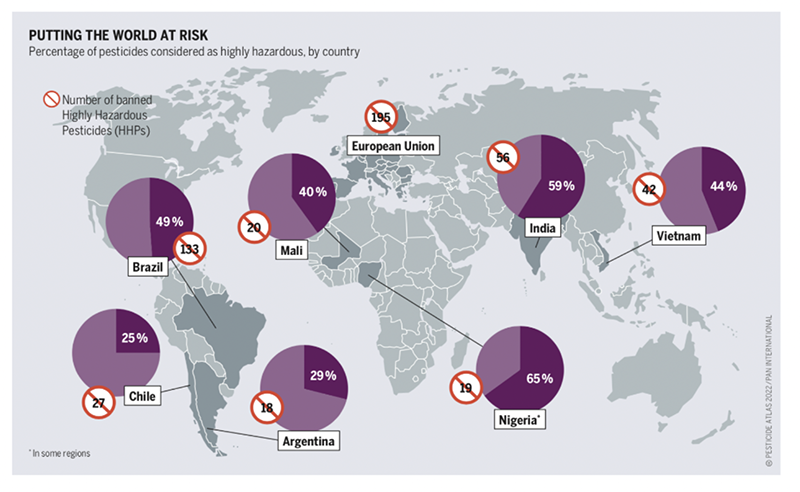
Source: Pesticide Atlas 2022, Heinrich-Böll-Stiftung & others Eimermacher/stockmarpluswalter, CC BY 4.0
Moreover, according to WHO, three million cases of pesticide poisoning occur annually, resulting in an estimated 220,000 deaths, with HHPs being responsible for many poisoning incidents. In addition, about 20% of the approximately 800,000 people who die by suicide yearly do so by ingesting pesticides (WHO, 2019). HHPs harmful effects are particularly notable in low- and middle- income countries (LMICs), where the lack of regulations or disposal centers cause great damage. In total, 95% of 385 million people who suffer from unintended pesticide poisoning every year are in the Global South.
Global chemical pollution levels have crossed planetary boundaries
Already in 1962, the famous ‘Silent Spring’ by Rachel Carson alerted the world to the harmful effects of pesticides. This milestone work influenced the ban of highly toxic chemicals such as DDT in many countries. Despite this success, nowadays, the use of chemicals is at its record high. To safeguard our planet’s habitability, countries must work with and not against nature. And yet, harmful impacts of HHPs on ecosystems have historically been neglected.
The use of agrochemicals comes with the promise that they will minimize losses by protecting crops, increasing productivity, and maintaining the quality of products. They are also defended for the chance to save labor costs, which allows for price reduction of global commodities. Pesticides have been used to keep harmful pests away from the fields, including rats, mice, ticks, and mosquitoes. Although there have been advantages in terms of productivity, exposure to HHPs is problematic. According to WHO, the most significant exposure to HHPs occurs among agricultural and public health workers during handling, diluting, mixing, and applying pesticides. HHPs have been linked to immunologic abnormalities and reproductive and developmental consequences.
A highly contentious debate linked to this theme is the expansion of genetically modified crops. A study shows that, currently, 74% of soybeans grown worldwide are genetically modified. The same analysis shows that Brazil and Argentina are now among the countries with the highest herbicide consumption in the world, just after China and the US.
Pesticides are ubiquitous. They contaminate groundwater, rivers, lakes, and coastal waters, representing a threat to the environment. Healthy soils are considered an essential natural element for human security. And yet, population growth and rapid urbanization are putting soils at risk, and agricultural intensification is making soils more prone to erosion. Allowing unrestricted use of chemicals exacerbates this challenge. The importance of healthy soils, which are fundamental to the future of food, is underestimated. Diverse species, including invertebrates, bacteria, and fungi, that are essential for ecosystem services because they help filter water, recycle nutrients, sequester greenhouse gases (GHGs), regulate climate, and support healthy soils, are threatened by abundant use of dangerous chemicals. Insects, too, are in danger, and this is bad news for us. This is because they offer pollinating services, allowing fruits, flowers, and vegetables to grow. Honey, silk, and beeswax are other products that insects offer, besides contributing to recycling of nutrients and pest control.
Organochlorine Pesticides (OCPs) concentrations, measured in air and human milk, showed a general declining trend. However, OCPs are still found in the environment, including in some remote places showing high values, even though these substances have been banned decades ago. DDT, one of the initially listed persistent organic pollutant (POPs) under the Stockholm Convention, was detected in high values in both core matrices air and human milk. DDT has been the dominant POP out of all the POPs analyzed in the framework of the UNEP/GEF Global Monitoring Plan (GMP) projects. Further, other OCPs like dieldrin, heptachlor, and endosulfan showed scattered values depending on the country.
The use of synthetic chemicals and the expansion of monocultures cause biodiversity loss and erode the basis for a healthy future. The intensification of the triple planetary crisis of climate change, biodiversity loss, and pollution could increase the use of pesticides, creating a vicious cycle: the decreasing number of beneficial insects justifies and calls for more pesticide use, further reducing all types of biodiversity. Moreover, pesticides are constantly on the move. Wind can move dangerous particles from agricultural areas to residential zones. Called “pesticide drift,” this phenomenon has often been overlooked.
In addition, pesticides threaten people’s right to live in dignity, the right to bodily integrity, and the right to a healthy environment. Only around 4% of all pesticides used globally are regulated by binding international conventions. Moreover, indirect effects on food chains and biodiversity remain little understood, with negative effects hard to predict. Responding to all these challenges calls for an accelerated transition toward more resilient, sustainable, nutritious, and inclusive food systems.
Regulatory shortcomings and the need for multilateral coordination
Several international, national, and regional regulations are in place to minimize chemical exposure throughout the food supply, benefiting people and the planet.
Prior to the adoption of the Global Framework on Chemicals, for more than 15 years, SAICM served as a global policy framework aimed at enhancing the management of chemicals and improving the health of human beings and the environment. Efforts to agree on a chemicals management approach have a long history, starting at the 2002 World Summit on Sustainable Development (WSSD), where countries agreed to achieve, by 2020, the use and production of chemicals in ways that lead to the minimization of significant adverse effects on human health and the environment. That led to the launch, in 2006, of the SAICM at the first ICCM in Dubai, United Arab Emirates (UAE). A flexible, voluntary, non-binding, multi-stakeholder, multi-sectoral initiative dedicated to promoting collaboration, SAICM, recognized the importance of ensuring safety, calling for developing and implementing policies and measures to minimize exposure to hazardous chemicals through the food supply and improving the overall safety of the food system.
To continue this work, in September 2023, the Fifth International Conference on Chemicals Management (ICCM5) adopted a successor agreement to SAICM – the Global Framework on Chemicals. Among others, the new framework calls for the prevention of illegal trade and trafficking of chemicals and waste, the implementation of national legal frameworks, and the phase out, by 2035, of HHPs in agriculture. The adoption of this new framework on chemicals, pollution, and waste recognizes these challenges at the same level as the crises of climate change and nature and biodiversity loss.
This enhanced global cooperation complements other multilateral efforts. For example, the Joint FAO/WHO Meeting on Pesticide Residues (JMPR) conducts risk assessments for pesticide residues in food. With an independent international expert scientific group, these assessments are based on all data submitted to national registries of pesticides worldwide, complemented by peer-reviewed articles. JMPR sets safety limits to ensure that the amount of exposure to pesticide residue when consuming food over lifetime does not result in adverse health effects. These are used by governments and other regulatory bodies such as the Codex Alimentarius Commission, which establishes maximum residue limits (MRLs) in food standards.
At the national level, countries have established food safety agencies to oversee the implementation of food safety regulations, such as the Food and Drug Administration (FDA) in the US and the European Food Safety Authority (EFSA) in the EU. In addition, the EU’s Registration, Evaluation, Authorisation and Restriction of Chemicals (REACH) Regulation aims to protect human health and the environment from the potential risks associated with chemicals.
Despite local and global efforts, a significant gap remains in ensuring the safety of food systems and protecting public health, as evidenced by ongoing food contamination incidents. To reduce this risk, international, national, and regional regulations, policies, and objectives such as those established by the Codex Alimentarius Commission, the FDA, EFSA, and SAICM and its successor framework, are in place to ensure the safety of the food we consume. Continued efforts are needed to improve the safety of the food supply and minimize chemical exposure to protect the health of people and the environment.
Stakeholders continue to call for stronger actions to address HHPs to combat short- and long-term impacts on planetary health, and, with governments, they have signaled their determination to minimize the adverse impacts of pesticides on health and the environment. The political commitment expressed in the 2023 Bonn Declaration for a Planet Free of Harm from Chemicals and Waste is significant, but progress, has been slow. From the perspective of corporations, one common argument in defense of the continued use of pesticides is that they are needed to ensure food security and that local laws decided upon by sovereign countries are followed. However, there is a discrepancy between regulations in developed countries and those in LMICs.
With the emergence of the Green Deal, the EU’s Farm to Fork Strategy asks Member States to reduce by 50% the use of more hazardous pesticides by 2030. And yet, despite being banned for sale in high-income countries (HICs), companies based in these countries can legally produce and export HHPs to LMICs. While the burden of HHPs is mostly carried by the Global South, some of the hazardous pesticides exported from Europe find their way back in when food is imported and contains residues. Two countries in Europe have been leading by example – Luxembourg and Denmark. Luxembourg has banned the use of all products containing the herbicide glyphosate from 1 January 2021, while Denmark has implemented taxes according to the toxicity of pesticides to humans and the environment and used the money to reinvest in the agricultural sector, easing resistance from farmers.
Figure 2. Destinations of pesticides banned for use in the EU and exported to developing countries
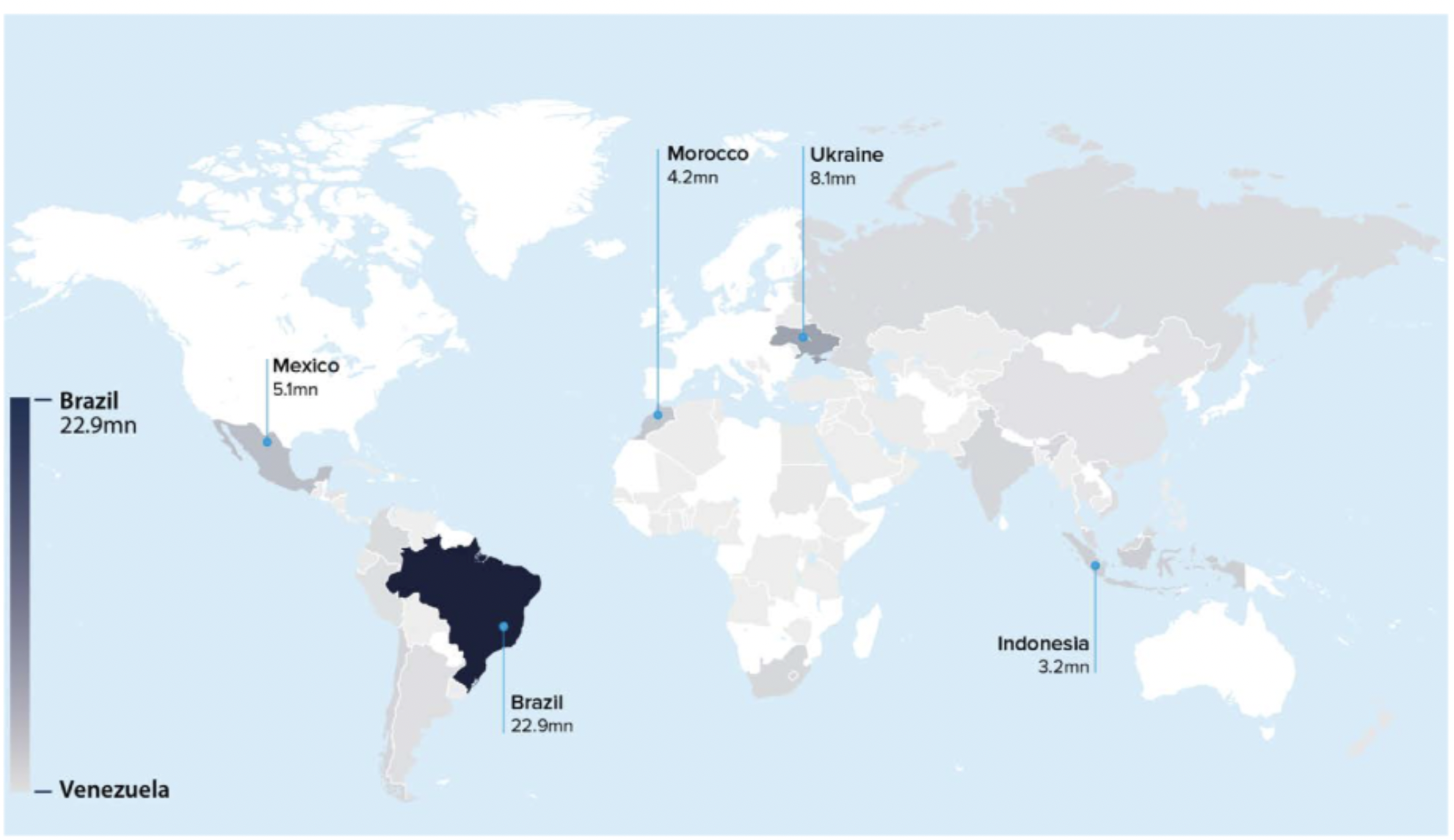
Source: Unearthed and Public Eye (2020)
The way forward
We know that regulations to ban the use of HHPs have saved lives. Food systems must evolve to include strong social and ecological management of fields. While solutions to combat adverse impacts of dangerous chemicals and wastes exist, more ambitious regulations and knowledge dissemination are needed.
Whereas the success of reining in pesticides has been limited due to, among other reasons, the lack of regulations and asymmetry of power among regulators and large companies, there are examples of approaches to chemicals management that inspired positive change. The best known one is the Montreal Protocol to the Vienna Convention for the Protection of the Ozone Layer, which has reduced the use of hazardous pesticides by replacing methyl bromide with less hazardous alternatives. The Stockholm Convention’s early action to restrict 12 POPs, and the Rotterdam Convention, which facilitates information sharing between states about hazardous chemicals entering international trade and about the regulatory actions taken, are good examples of efforts improving informed collective decision making.
There is enough scientific evidence to inform bold decision making in the sphere of food systems transformation and sound chemicals management. However, more work needs to be done to ensure that identified solutions are reaching decision makers, especially in the Global South. In this context, two opportunities for decision makers to demonstrate progress and commitment emerged in 2023.
First, the UN Food Systems Summit +2 in July 2023 built on the UN Secretary-General-led 2021 UN Food Systems Summit, which attested to both the urgency and the political will to do better to overcome all forms of malnutrition. The 2023 Summit was the first-ever opportunity for decision makers and practitioners to disseminate solutions about food systems transformation, overcoming coordination and implementation gaps. As of July 2023, 125 countries had designed or were implementing national pathways to achieve more sustainable food systems. Addressing the use of hazardous pesticides deserves more attention in this conversation. Outcomes from this global gathering deserve to be included in deliberations on how to tackle HHPs, and better alignment between public health and environmental protection policies should also be encouraged.
ICCM5 was another important milestone where countries and multiple stakeholders successfully negotiated a post-2020 platform for the sound management of chemicals and waste to succeed SAICM. The new Global Framework on Chemicals sets the 2035 target for stakeholders to “have taken measures” to phase out HHPs. ICCM5 also launched a Global Alliance on HHPs, a collaborative multistakeholder initiative to scale up global action on HHPs. This target complements the recently agreed Kunming-Montreal Global Biodiversity Framework (GBF). In its Target 7, countries agree, among other aspects, to reduce the “the overall risk from pesticides and highly hazardous chemicals by at least half including through integrated pest management, based on science, taking into account food security and livelihoods; and also preventing, reducing, and working towards eliminating plastic pollution.”
As argued, dangerous chemical exposure affects the most vulnerable disproportionately. Although there has been progress, international agreements remain insufficient to cope with the adverse environmental and health impacts of pesticides and fertilizers. Stakeholders have thus recommended a set of priorities and transformative actions to minimize these impacts:
- Incentivize healthy and sustainable consumer choices and consumption;
- Fundamentally change crop management and adopt ecosystem-based approaches;
- Promote circularity and resource efficiency;
- Use economic instruments to create a level playing field for greener products and approaches;
- Adopt integrated and life cycle approaches for sound pesticide and fertilizer management; and
- Strengthen standards and adopt corporate policies for sustainable supply chain management.
Reducing inequalities will require decision makers to scale up options that allow for a replacement of HHPs. The Guidelines on Alternatives to HHPs, for example, offers options, including agroecology, crop rotation, microbial and semiochemical agents, and botanical pesticides. Moreover, beyond investing in agricultural robotics, drones, and algorithm-driven technologies, which are often benefiting big business but not necessarily the most vulnerable, countries must invest more in educating specialists, infrastructure, and reducing costs of implementation based on true cost accounting of food.
No country or discipline alone can drive the needed change at scale. The need for food system transformation is irrefutable, and chemicals management must be part of the menu of solutions.
While much remains to be done, several countries and cities are leading the transition towards more ecological and healthier options. Examples can be found in the 2018 decision of Kyrgyzstan’s parliament calling for all agriculture to transition to organic production within the next ten years. Over 550 German cities and municipalities have decided to manage their urban greenery partially or completely without pesticides. These examples prove that a healthier and more ecologically friendly future is possible. Thus, it is time to scale political momentum to deliver access to healthy diets, while safeguarding our environment and promoting equitable livelihoods. The incoming Presidency of the UN Climate Change Conference (UNFCCC COP 28) taking place later this year has put forward an action agenda that places nature, people, lives, and livelihoods at the heart of climate action. It has also proposed a leader-level Emirates Declaration on Sustainable Agriculture, Resilient Food Systems, and Climate Action, which could help scale political will to help steer the necessary transformation. It remains to be seen whether and how many countries will support the Presidency’s initiative.
* * *
This Policy Brief is the tenth in a series featuring cross-cutting topics relating to the sound management of chemicals and waste. It was written by Nicole de Paula, Ph.D, Earth Negotiations Bulletin (ENB) contributor and author of ‘Breaking the Silos for Planetary Health – A Roadmap for a Resilient Post-Pandemic World.’ The series editor is Elena Kosolapova, Senior Policy Advisor, Tracking Progress Program, IISD.
RELATED EVENTS