Global environmental problems

Global contaminants such as Persistent Organic Pollutants (POPs) or mercury are regulated by Multilateral Environmental Agreements (MEAs), namely the Stockholm and Minamata Conventions respectively. A number of additional ‘Emerging Policy Issues’ (EPIs) have been nominated for voluntary, cooperative risk reduction actions by countries through the Strategic Approach for International Chemicals Management (SAICM). These EPIs are:

The SAICM GEF 9771 project focuses on two EPIs: Lead in paint and Chemicals in products, which generate particular environmental and health challenges. The project also addresses the need for knowledge management, information exchange and strategic planning to ensure concerted and coordinated action on all EPIs. 

The project objective is to accelerate adoption of national and value chain initiatives to control Emerging Policy Issues (EPIs), and contribute to the 2020 SAICM goal and 2030 Agenda for Sustainable Development.


The project focuses on 3 components:
Lead in paint

Working with governments to develop laws that restrict the use of lead paint and working with SMEs to promote the phase-out of lead additives.

Chemicals in products

Increasing the ambition of different stakeholders to track and control chemicals of concern in products along the value chains of electronics, toys and building products sectors.

Knowledge and stakeholder engagement

improving access to information and knowledge on chemicals management amongst SAICM stakeholders.


The map below showcases the 40 countries where the SAICM GEF 9771 project is supporting activities to address lead in paint and chemicals in products:
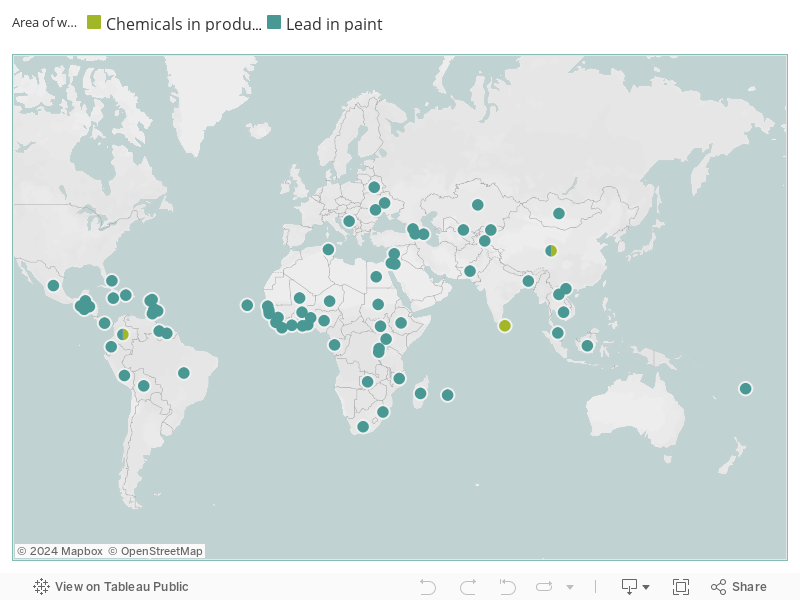
*Map tooltip indicates 6 stages of drafting lead in paint laws: #1 No progress; #2 Government interest; #3 First steps taken; #4 Early stages of drafting; #5 Final stages of drafting, and #6 Final lead paint law.


Block id is component-1--lead-in-paint

Component 1 Lead in paint 

The lead in paint component promotes regulatory and voluntary action by government and industry to phase out lead in paint.

Key targets already achieved on lead in paint:
  • 15 new countries have adopted legislation to establish legal limits to Lead in Paint
  • 14 paint manufacturers have completed paint reformulation demonstration projects to produce lead-free paint
  • 90 registered awareness-raising events at the International Lead Poisoning Prevention Week (ILPPW) 2020

Outcome 1

At least 40 countries to legislate and implement legislation to restrict the use of lead in paint.
Outcome 1: At least 40 countries to legislate and implement legislation to restrict the use of lead in paint.

The first project output will address the technical barriers in the manufacture of paints with no lead additives. The second project output will address the barrier on lack of capacities in developing countries to introduce and enforce lead paint limits. The main activity is advocacy with governments for policy development and assistance in drafting lead paint laws.

Outcome 1.1: Paint reformulation demonstrations with paint manufacturers in Small and Medium Sized enterprises (SMEs) executed in seven countries.
Output 1.2: Policy support and awareness raising generate support for lead phase out.
  • Regional workshops to provide an overview of the Lead Paint Alliance, the recommended actions and available advice to support the establishment of lead paint laws
  • Provision of technical assistance by the project execution partners to over 60 countries.
  • Interactive visualization of the status of lead paint laws
Block id is component-2--chemicals-in-products

Component 2 Chemicals in products

toy image

Component 2 on "life cycle management of chemicals present in products", focuses on chemicals of concern in three sectors (building products, electronics and toys) and how to minimize the adverse effects of chemicals of concern

Key targets already achieved on chemicals in products:

  • Tools in development for governments and value chain actors to manage chemicals of concern in products
  • 40 value chain and government actors trained on the use of new tools and guidance to manage chemicals of concern in products

Outcome 2

Governments and value chain actors in the building products, toys, and electronics sectors to track and manage chemicals of concern (CoC) in their products

The component is developing new tools and guidance to reduce the use of chemicals of concern in the building products, electronics and toys sectors and provides training and support for government and value chain actors to trial and adopt new guidance and tools.

The component is guided by a value chain approach and the Component Summary Document provides an overview of the approach and the interventions in the three sectors.

Output 2.1: New tools and guidance to reduce the use of chemicals of concern (CoC) in the building, electronics and toys sectors.

Guidance/tools for building sector

Guidance/tools for electronics sector

Guidance/tools for toys sector

Output 2.2: Training and support for government and value chain actors to trial and adopt new guidance and tools.
  • Training on USEtox model for companies of building products and toy sectors in Sri Lanka and China
  • Eco-innovation and/or Sustainable Public Procurement pilot projects in Colombia and Sri Lanka
  • Sustainable finance pilot project in Sri Lanka
  • Training and consultations on regulatory and compliance approaches for toys and electronics sectors

Additional documents

Project-sponsored events on Chemicals in Products:

Overview and lessons learnt on Chemicals in Products:

Block id is component-3--knowledge-management-and-stakeholder-engagement

Component 3 Knowledge Management and stakeholder engagement

meeting image

The third component explores ways to create, manage and disseminate knowledge on chemicals of concern. 

Key targets already achieved on knowledge management and stakeholder engagement:

  • Over 400 scientific and policy knowledge resources shared with policy members on EPIs and SDGs through the new SAICM Knowledge platform
  • More than 800 active members registered in the new SAICM communities of practice

Outcome 3

A broad group of SAICM stakeholders access information and participate in communities of practice for peer-to-peer learning exchanges.

This project component supports the development and dissemination of knowledge on chemicals of concern. The knowledge platform saicmknowledge.org is a key tool developed within this component.

Output 3.1: Collaboration and engagement with the SDG agenda and scientific community to promote Emerging Policy Issues (EPIs).

• Production of publications on chemicals-related topics:

Policy briefs on chemicals and SDGs

Thematic papers

• Gender Review Mapping with a Focus on Women and Chemicals: Impact of Emerging Policy Issues and the Relevance for the Sustainable Development Goals

• Presentations on SAICM at scientific community events and related policy events.

• Convening of side-events to raise awareness on emerging policy issues.

Output 3.2: Development of a Knowledge Management platform provides a repository of information and forum for exchange of scientific and policy information.
  • SAICM Knowledge Management Strategy.
  • The development of a new dynamic platform to facilitate knowledge sharing on the sound management of chemicals and waste – saicmknowledge.org
  • Establishment of four Communities of Practice to enable dialogues amongst SAICM stakeholders on relevant chemical issues.

Info

Project status
Active
Date
29 Dec 2018 - 29 Dec 2023
Team
Hover for more details

Partners

American Bar Association
CEDEAO ECOWAS
CEDEAO ECOWAS
Green Electronics Council
GGKP
Green Policy Platform
IPEN
IPEN
ISC3
ISC3
National Cleaner Production Centres (NCPCs)
One planet
One planet
UNEP
UN Environment Programme
University of Cape Town
US Environmental Protection Agency
USEtox
USEtox
World Coatings Council
WHO
World Health Organization
Like Cycle Initiative
Life Cycle Initiative
IISD
International Institute for Sustainable Development

Stakeholders

The project involves the following groups of stakeholders for a successful implementation:

Government

  • Local policy makers
  • National policy makers
  • Public R&B Organisations (some text for testing)
  • Development banks
  • Regional governmental organizations

Civil society

Private sector

  • Entrepreneurs R&D
  • Retails
  • Private Research & Development Organisations
  • Trade associations
  • Alternative suppliers
  • Chemical importers
  • Chemical suppliers (not-SME)
  • Chemical waste disposal companies
  • Weste managements & recycling compoanies
  • Private testing laboratories
  • Procurement agencies
  • Paint SMEs
  • Large companies (non-SME)
  • Building materials SMEs
  • Electronics SMEs
  • Toy SMEs
  • Insureres
  • Private equity banks

17 resources found

Newsletter

SAICM Secretariat Newsletter

by |
December 2022
copied to clipboard

We would like to extend our sincere appreciation to the ICCM5 President, members of the ICCM5 Bureau, and to all our partners for the ongoing commitment and support extended to the Secretariat as it continues to deliver on its mandate.

Season’s Greetings, as we look forward to greater collaboration in 2023!

Newsletter

Lead Paint Alliance Newsletter

The Global Alliance to Eliminate Lead Paint is working to achieve the phase-out of the manufacture, sale and import of paints containing lead through the establishment of laws. The Lead Paint Alliance publishes a regular newsletter to inform its partners and interested stakeholders on the latest achievements and progress towards its goal.In the newsletter, you will find news articles on lead paint, updates about global efforts to address the issue, progress towards law, and update about our partners.

Emerging Policy Issues: Lead in paint
Policy document

Eliminating Lead Paint: The Role of the Paint Industry

by |
October 2020
copied to clipboard
The Strategic Approach to International Chemicals Management (SAICM) is a global policy framework which aims to protect human health and the environment from the unsound management of chemicals and waste. Since its inception in 2006, the voluntary and multisectoral and multistakeholder nature of SAICM has been viewed as one of its core strengths. SAICM provided a space for government and non-government actors alike to discuss and deliberate on the management of chemicals and waste.A key obstacle that has been limiting
Emerging Policy Issues: Lead in paint
Policy document

Global elimination of lead paint: why and how countries should take action - Policy brief

Lead has toxic effects on almost all body systems and is especially harmful for children and pregnant women. Lead paint is an avoidable source of exposure to lead. “Lead paint” or “lead-based paint” is paint to which one or more lead compounds have been intentionally added by the manufacturer to obtain specific characteristics. One important way to prevent exposure is for countries to establish legally binding regulatory measures prohibiting the addition of lead to paint.This policy brief summarizes key information
Emerging Policy Issues: Lead in paint
Policy document

Global elimination of lead paint: why and how countries should take action - Technical brief

This document has been developed for officials in government who have a role in regulating lead paint, to provide them with concise technical information on the rationale and steps required to phase out lead paint. “Lead paint” or “lead-based paint” is paint to which one or more lead compounds have been intentionally added by the manufacturer to obtain specific characteristics. This document explains the health and economic importance of preventing lead exposure by establishing legally binding controls to stop the
Emerging Policy Issues: Lead in paint
Policy document

Plastics and Chemicals of Concern In Consumer Products

Plastics are used across the economy and in diverse downstream sectors such as packaging, construction, transportation, healthcare, textiles, and electronics. Durable products, ranging from construction materials to medical devices make up nearly half of the global plastics market, while packaging products are the largest uses of single-use plastics. Some plastics contain chemicals that are considered to be harmful for health and the environment. Phthalates, poly-fluorinated chemicals, bisphenol A (BPA), brominated flame retardants and antimony trioxide are considered most harmful for
Emerging Policy Issues: Chemicals in products
Topics: Circularity
E-learning

Introduction to Life Cycle Thinking

This is one of the Life Cycle Initiative E-learning modules, with courses in English, French, Arabic and Spanish. This E-Learning Module Kit draws on materials from the Life Cycle Initiative and it is aimed at helping give all participants an overview of life cycle approaches while developing understanding as to how to assess the impacts of any given sustainability issue considering all of its life cycle stages. The module is also intended as a guide to which kind of LCT

Emerging Policy Issues: Chemicals in products
Topics: Life Cycle
Website

International Lead Poisoning Prevention Week (ILPPW)

The International Lead Poisoning Prevention Week of action (ILPPW) takes place every year at the end of October. The objectives of the campaign are to raise awareness about health effects of lead poisoning; highlight countries and partners' efforts to prevent particularly childhood lead poisoning; and urge further action to eliminate lead paint through regulatory action at country level.The campaign website presents a multilingual campaign resource package, including posters, flyers, infographics, graphics and web banners in various formats, including an editable
Emerging Policy Issues: Lead in paint
Avatar