SAICM Knowledge Management activities are supported by the GEF 9771 project on Global Practices on Emerging Chemical Policy Issues of Concern under the Strategic Approach to International Chemicals Management (SAICM).
Within this framework, the SAICM Secretariat explores ways to create, manage and disseminate knowledge on chemicals of concern. The implementation follows a Knowledge Management Strategy that is being constantly revised and updated. It explores different tools and processes to better manage knowledge cycles, aiming at interlinking knowledge from multiple stakeholders. Communities of practice have been established to support collaborative and innovative exchanges.
Rebecca is an Environmental and Occupational Health Specialist focusing on children’s environmental health, public health, management of hazardous chemicals in products, exposure assessment, chemical risk assessment and management, risk communicat
I am the SAICM Programme Officer in charge of the overall management of SAICM GEF funded projects on emerging chemical policy issues. I am also the Knowledge Management Officer who coordinates the development of knowledge and information on chemicals management and responsible for the SAICM knowledge management platform/clearinghouse.My work contributes to ensuring that information is available, accessible, user-friendly, adequate, and appropriate amongst SAICM stakeholders so that policy and decision-makers can take action for the sound management of chemicals towards a healthier environment.I have over twelve years of experience in project management, capacity building, and policy advisory at the United Nations
My work on training farmers on proper agrochemical use keeps the levels of chemicals in the food chain at minimum residual levels because the farmers are in position to access knowledge on the good agricultural practices that relate to chemical us
Lynn M. Wagner is the Senior Director of the SDG Knowledge program at the International Institute for Sustainable Development (IISD). In this role, she oversees projects that seek to increase the accountability of decision making for the Sustainable Development Goals (SDGs), enhance engagement in SDG implementation, develop SDG indicator and reporting tools, and support SDG implementation. Wagner began working with IISD in 1994 as a writer for the Earth Negotiations Bulletin, and she continues to observe and analyze multilateral environmental negotiations with IISD’s flagship publication. She also served as the Senior Manager of IISD Reporting Services’ Knowledge Management Projects from
I am currently supporting the establishment of an online knowledge management system (KMS) for a GEF-funded "Financing Agrochemical Reduction and Management (FARM)" project which aims to tackle the reduction of using highly hazardous pesticides an
Global trade in illegal pesticides has been steadily growing in recent years, posing serious threats to agriculture, the environment, human health, and the economy. Evidence of this trend can be found in the increasing number of seizures of counterfeit, fake, and unauthorised pesticides, as well as their growing share in the global pesticide market. This paper identifies the main drivers and enablers of this illicit trade, and explores the potential of digital technologies, such as blockchain, to support policies to
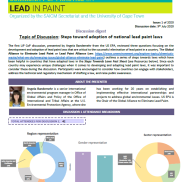
The Secretariat of the Strategic Approach to Chemicals Management (SAICM) and the University of Cape Town (UCT) are launching a new Community of Practice (CoP) on Lead in Paint to bring representatives from different sectors together and to create a learning network around issues related to the elimination of Lead Paint. This is a summary of the discussion on Steps toward adoption of national lead paint laws, which took place on 9 July 2020.Presenter: Angela Bandemehr (US EPA)The first LiP
Free online courses on the Multilateral Environmental Agreements in various topics: biological diversity, chemicals and waste, climate and atmosphere, environmental governance, marine and freshwater, land and agriculture.These courses are hosted by the United Nations Information Portal on Multilateral Environmental Agreements (InforMEA)
Suite of online Massive Open Online Courses (MOOCs), developed by the UN Environment Programme and partners on different topics:Marine litterUrban metabolism for policy makersIntroduction to life cycle thinkingEnvironmental security and sustaining peaceDisasters and ecosystems: Resilience in a changing climateWheels of metals: Urban mining for a circular economyFood and our future: Sustainable Food Systems in Southeast AsiaGreening consumption and productionClose the Loop - SDG 12 Introduction to Sustainable Consumption and production in LACAll courses are available here