SAICM Knowledge Management activities are supported by the GEF 9771 project on Global Practices on Emerging Chemical Policy Issues of Concern under the Strategic Approach to International Chemicals Management (SAICM).
Within this framework, the SAICM Secretariat explores ways to create, manage and disseminate knowledge on chemicals of concern. The implementation follows a Knowledge Management Strategy that is being constantly revised and updated. It explores different tools and processes to better manage knowledge cycles, aiming at interlinking knowledge from multiple stakeholders. Communities of practice have been established to support collaborative and innovative exchanges.
Rebecca is an Environmental and Occupational Health Specialist focusing on children’s environmental health, public health, management of hazardous chemicals in products, exposure assessment, chemical risk assessment and management, risk communicat
My work on training farmers on proper agrochemical use keeps the levels of chemicals in the food chain at minimum residual levels because the farmers are in position to access knowledge on the good agricultural practices that relate to chemical us
I am the SAICM Programme Officer in charge of the overall management of SAICM GEF funded projects on emerging chemical policy issues. I am also the Knowledge Management Officer who coordinates the development of knowledge and information on chemicals management and responsible for the SAICM knowledge management platform/clearinghouse.My work contributes to ensuring that information is available, accessible, user-friendly, adequate, and appropriate amongst SAICM stakeholders so that policy and decision-makers can take action for the sound management of chemicals towards a healthier environment.I have over twelve years of experience in project management, capacity building, and policy advisory at the United Nations
I am currently supporting the establishment of an online knowledge management system (KMS) for a GEF-funded "Financing Agrochemical Reduction and Management (FARM)" project which aims to tackle the reduction of using highly hazardous pesticides an
Lynn M. Wagner is the Senior Director of the SDG Knowledge program at the International Institute for Sustainable Development (IISD). In this role, she oversees projects that seek to increase the accountability of decision making for the Sustainable Development Goals (SDGs), enhance engagement in SDG implementation, develop SDG indicator and reporting tools, and support SDG implementation. Wagner began working with IISD in 1994 as a writer for the Earth Negotiations Bulletin, and she continues to observe and analyze multilateral environmental negotiations with IISD’s flagship publication. She also served as the Senior Manager of IISD Reporting Services’ Knowledge Management Projects from
IW:LEARN is the Global Environment Facility's (GEF) International Waters Learning Exchange and Resource Network. The IW:LEARN project was established to strengthen transboundary water management around the globe by collecting and sharing best practices, lessons learned, and innovative solutions to common problems across the GEF International Waters portfolio. It promotes learning among project managers, country official, implementing agencies, and other partners.
The Lead in Paint Laboratory Database lists laboratories from all UN regions capable of identifying and quantifying lead in paint samples.It is established by UNEP in close cooperation with the United States Environmental Protection Agency and the World Health Organization as part of an activity of the Global Alliance to Eliminate Lead Paint. For each listed laboratory, the databank offers publicly available information of interest, such as contact details, number of staff, instrumentation, analytical techniques, accreditation, etc. This database of
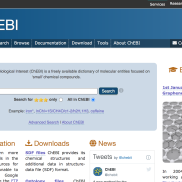
Chemical Entities of Biological Interest, also known as ChEBI is a chemical database and ontology of molecular entities focused on 'small' chemical compounds, that is part of the Open Biomedical Ontologies (OBO) effort at the European Bioinformatics Institute (EBI).The term "molecular entity" refers to any "constitutionally or isotopically distinct atom, molecule, ion, ion pair, radical, radical ion, complex, conformer, etc., identifiable as a separately distinguishable entity". The molecular entities in question are either products of nature or synthetic products which
What is CAt and where does all the data come from?The Chemical Awareness toolkit (CAt) is a free web application that provides rapid access to chemical information for product stewards, risk assessors, toxicologists, chemists, microbiologists, engineers, and other researchers. It includes screening tools that provide chemical information including toxicological hazards, environmental fate, persistence & bioaccumulation, occupational exposure limits, government regulations, and public perception.CAt utilizes an integrated database containing information from key lists provided by Verisk 3E, publicly available lists, databases