SAICM Knowledge Management activities are supported by the GEF 9771 project on Global Practices on Emerging Chemical Policy Issues of Concern under the Strategic Approach to International Chemicals Management (SAICM).
Within this framework, the SAICM Secretariat explores ways to create, manage and disseminate knowledge on chemicals of concern. The implementation follows a Knowledge Management Strategy that is being constantly revised and updated. It explores different tools and processes to better manage knowledge cycles, aiming at interlinking knowledge from multiple stakeholders. Communities of practice have been established to support collaborative and innovative exchanges.
My work on training farmers on proper agrochemical use keeps the levels of chemicals in the food chain at minimum residual levels because the farmers are in position to access knowledge on the good agricultural practices that relate to chemical us
I am the SAICM Programme Officer in charge of the overall management of SAICM GEF funded projects on emerging chemical policy issues. I am also the Knowledge Management Officer who coordinates the development of knowledge and information on chemicals management and responsible for the SAICM knowledge management platform/clearinghouse.My work contributes to ensuring that information is available, accessible, user-friendly, adequate, and appropriate amongst SAICM stakeholders so that policy and decision-makers can take action for the sound management of chemicals towards a healthier environment.I have over twelve years of experience in project management, capacity building, and policy advisory at the United Nations
Estrategias dinámicas y pluriculturales sobre el recurso humano que este interactuando en el ambiente, para brindar acciones más amenas a la manipulación de los insumos provenientes de la naturaleza o fabricados por el ser humano, a fin de salvagu
My activities envisaged the involvement in a sound management of chemicals at the national level. My professional interests are dedicated to health and environment.
I am currently serving as the Knowledge Management Officer for the GEF-funded the Implementing Sustainable Low and Non-Chemical Development in Small Island Developing States (ISLANDS) Programme which supports Small Islands Developing States (SIDS)
I am currently supporting the establishment of an online knowledge management system (KMS) for a GEF-funded "Financing Agrochemical Reduction and Management (FARM)" project which aims to tackle the reduction of using highly hazardous pesticides an
The factsheet entitled "The potential key role of SAICM Focal Points in reducing harm from Highly Hazardous Pesticides (HHPs)" was produced by stakeholders from the University of Cape Town, the Strategic Approach to International Chemicals Management, the Food and Agriculture Organization and Umweltbundesamt. This factsheet was developed to ensure information about HHPs reaches all SAICM National Focal Points and other relevant stakeholders for them to make effective and informed decisions and play an active role in facilitating the reduction of
Following a collaborative study by UNEP and the International Council of Chemical Associations (ICCA), which provided a comprehensive inventory of the publicly available databases on industrial chemicals in commerce, SAICM coordinated the development of an e-learning course to bridge the information gap by improving accessibility to environment, health, and safety (EHS) information for industrial chemicals.In an interactive and engaging way, this course provides guidance on locating and using information on industrial chemicals in commerce and identifies some barriers to identifying
The Lead in Paint Laboratory Database lists laboratories from all UN regions capable of identifying and quantifying lead in paint samples.It is established by UNEP in close cooperation with the United States Environmental Protection Agency and the World Health Organization as part of an activity of the Global Alliance to Eliminate Lead Paint. For each listed laboratory, the databank offers publicly available information of interest, such as contact details, number of staff, instrumentation, analytical techniques, accreditation, etc. This database of
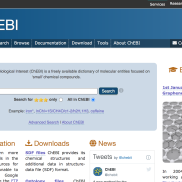
Chemical Entities of Biological Interest, also known as ChEBI is a chemical database and ontology of molecular entities focused on 'small' chemical compounds, that is part of the Open Biomedical Ontologies (OBO) effort at the European Bioinformatics Institute (EBI).The term "molecular entity" refers to any "constitutionally or isotopically distinct atom, molecule, ion, ion pair, radical, radical ion, complex, conformer, etc., identifiable as a separately distinguishable entity". The molecular entities in question are either products of nature or synthetic products which