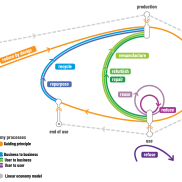
Circularity challenges the current economic model towards a sustainable future
Circular processes contributing to circularity can be grouped into 4 categories, from the most impactful to the least:
1. Reduce by design: reducing the amount of material used, particularly raw material, should be applied as an overall guiding principle from the earliest stages of design of products and services
2. From a user-to-user perspective: Refuse, Reduce and Re-use
3. From a user-to-business intermediary perspective: Repair, Refurbish and Remanufacture
4. From business-to-business: Repurpose and Recycle.
Read more about circularity at UNEP's Building Circularity platform.
Related EPIs
Related people
Angela Pinilla
Angela Pinilla works in the interface of science, business strategy, and safer chemicals.
Valerie Daniela Murcia Rojas
Waste electrical and electronic equipment (WEEE) has great potential for use and generation, taking into account the technological progress of recent decades, but also the implementation of concepts such as obsolescence.
Anteneh Abebe
I obtained MSc in Environmental Science and Management from Haramaya University.
Dhrumil Soni
As we strive towards a better world, we work to ensure chemistry’s contributions are realized. Chemistry can help us to understand, monitor, protect and improve the environment around us.
Llorenc Mila I Canals
Feng Wang
Related projects
Related Topics
Articles of interest
3 resources found
Eco-innovation (Eco-i) manual – Building Materials Supplement
UNEP's new Eco-innovation Building Materials Supplement was created to respond to the building material sector's need for more guidance in building resilient, competitive, and sustainable business models for SMEs. Designed together with Bioregional, pilot implementation support of the National Cleaner Production Centre (NCPC) Sri Lanka and to be read alongside UNEP's Eco-innovation Manual, the supplement provides specific examples, learning case studies, and advice on applying the eco-innovation methodology within the building materials value chain.
Eco-innovation (Eco-i) manual – Electronics Supplement
UNEP's new Eco-innovation Electronics Supplement was created to respond to the electronics sector's need for more guidance in building resilient, competitive, and sustainable business models for SMEs. Designed together with the World Resources Forum and to be read alongside UNEP's Eco-innovation (Eco-i) Manual, the supplement provides electronics specific examples, learning case studies, and advice on applying the eco-innovation methodology and its opportunities in the electronic sector.
This publication was prepared under the framework of the Global Environment Facility (GEF) full-sized project 9771: Global best practices on emerging chemical policy issues of concern under the Strategic Approach to International Chemicals Management (SAICM). This project is funded by the GEF, implemented by UNEP and executed by the SAICM Secretariat.