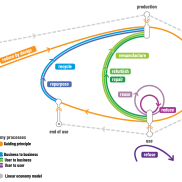
Circularity challenges the current economic model towards a sustainable future
Circular processes contributing to circularity can be grouped into 4 categories, from the most impactful to the least:
1. Reduce by design: reducing the amount of material used, particularly raw material, should be applied as an overall guiding principle from the earliest stages of design of products and services
2. From a user-to-user perspective: Refuse, Reduce and Re-use
3. From a user-to-business intermediary perspective: Repair, Refurbish and Remanufacture
4. From business-to-business: Repurpose and Recycle.
Read more about circularity at UNEP's Building Circularity platform.
Related EPIs
Related people
Bettina Heller
Ndeye Fatou NDIAYE
Llorenc Mila I Canals
Anteneh Abebe
I obtained MSc in Environmental Science and Management from Haramaya University.
Feng Wang
Angela Pinilla
Angela Pinilla works in the interface of science, business strategy, and safer chemicals.
Related projects
Related Topics
Articles of interest
2 resources found
Initiating Circularity for electronic waste in Nigeria: A promising paradigm for treating e-waste globally
Over half a million tonnes of discarded electronic appliances are improperly processed in Nigeria every year, threatening the country's environment and the health of approximately 100,000 informal workers in the recycling industry.
With support from the Global Environment Facility (GEF), the Government of Nigeria has joined forces with the United Nations Environment Programme (UNEP) and partners to turn the tide on e-waste under the “Circular Economy Approaches for the Electronics Sector in Nigeria” project. Led by UNEP and supported by the National Environmental Standards and Regulations Enforcement Agency of Nigeria (NESREA), the $15-million initiative brought together players from the Government, the private sector, and civil society to design and operationalise a financially self-sustaining circular economy (CE) for electronics in Nigeria.
The project aims to stimulate a CE pilot through an Extended Producer Responsibility (EPR) scheme that serves as a model for countries facing similar challenges. EPR is an integrated waste management approach that extends the responsibility of manufacturers to the entire lifecycle of their product, particularly to the end-of-life treatment. By applying this approach, the producers will be obliged to commission for collecting, pre-treating and recycling their originated e-waste.
The project creates synergies among pre-existing elements of an EPR system in Nigeria to establish a sustainable management system and financing mechanism for EPR implementation. Establishing and enforcing a sustainable approach in Nigeria with supporting regulations and legally binding requirements is expected to recover and re-introduce usable materials into the value chain, dispose of hazardous e-waste streams in an environmentally sound manner, and create safe employment for Nigerian e-waste workers.