748 resources found

Factsheets and brochures

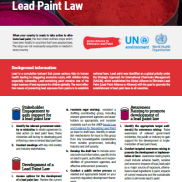
Suggested Steps for Establishing a Lead Paint Law

December 2019
copied to clipboard
This fact sheet outlines steps that have been helpful in countries that have adopted lead paint laws. The steps are not necessarily sequential or needed in every country.
Emerging Policy Issues: Lead in paint
Topics: Policymaking
EIT_RM_PARADE_Hazardous_substances_in_construction_Final_2019
Report

Hazardous Substances in Construction Products and Materials

December 2019
copied to clipboard

This guidance document aims to give an overview of potential hazardous substances that might occur in construction products and when appearing as waste need attention during renovation and demolition activities. Focus in this guideline is on hazardous substances regulated by EU or international agreements or national legislation.

Although the present legislation restricts the use of many hazardous substances in new building products, there is a considerable concern for compounds present in old construction products, since their presence in construction and demolition waste may limit the recyclability of the material and potentially cause waste management problems. One group of substances that has recently received attention are persistent organic pollutants (POP substances) such as e.g. some brominated flame retardants.

Important characteristic of the construction and building products is the relatively long life span. Because of long lifespan the restricted substances will enter the waste stream many decades after a ban has been placed on their use and they can therefore be found in renovation or demolition waste for a long time. Many of these substances provide important functionality in a wide range of products, e.g. flame retardants.

Besides hazardous substances also degradation in composition and quality aspects (e.g. mould) of construction products needs to be considered.

This document is part of the pre-demolition overall guidance document developed in the PARADE project.

Emerging Policy Issues: Chemicals in products
Factsheets and brochures

Lead Paint Factsheet

by |
November 2019
copied to clipboard
This factsheet presents the work of UNEP and the Lead Paint Alliance. The document also highlights its impacts and the SAICM GEF project Lead in paint component.
Emerging Policy Issues: Lead in paint
Policy document

Understanding chemicals in products: SAICM Policy Brief

by |
November 2019
copied to clipboard

The transparency of information about chemicals in global supply chains has been an emerging policy issue for the Strategic Approach to International Chemicals Management (SAICM) since 2009, leading to programmes such as the UNEP Chemicals in Products (CiP) Programme. The CiP programme focuses specifically on the textiles, toys, electronics and building materials sectors.Information exchange in the value chain is key in identifying and addressing any chemicals of concern1 in products. Brands and retailers frequently lack crucial knowledge about the properties

Tarkett-Case-Study
Case studies

Tarkett Sustainable Flooring Case Study

November 2019
copied to clipboard

Tarkett have introduced an eco-innovation programme with the aim of providing more comfortable, healthy and people-friendly indoor spaces without compromising performance and design experience. Key initiatives include:

  • Phthalate free technology in their New Generation Vinyl flooring;
  • Low VOC emissions in flooring;
  • ReStart Takeback and Recycling Programme, and use of recycled materials in new products.
Emerging Policy Issues: Chemicals in products
SAICM-USEtox_D2.1
Report

List of Chemicals of Concern and of potential alternatives for toys sector, with supporting information on criteria and selection

by |
September 2019
copied to clipboard

In this report, we present a list of Chemicals of Concern (CoCs) in plastic toys, with supporting information on the applied selection criteria. To identify the CoCs, we started from a literature review of available plastic toys compositions studies, and obtained the chemical mass fraction in plastic toy as well as the chemical functions. The chemical emissions from the plastic toys and subsequent human exposures were then estimated using a series of models and the coupled nearfield and far-field exposure assessment framework. Finally, the human exposure doses were compared to toxicity measures such as the reference dose (RfD), or median effective dose (ED50) for cancer effects, to evaluate the health risks on children. Chemical-material combinations that have a hazard quotient (HQ) > 10, a margin of exposure (MoE) < 100, or a lifetime cancer risk > 10-6 were included in the list of CoCs. In total, 35 (less than 10%) of all chemical-material combinations studied were identified as CoCs. The results indicate that a relevant amount of chemicals used in plastic toys may pose a non-negligible health risk to children, calling for more refined investigations and more human- and eco-friendly alternatives.

This document has been developed within the framework of the Global Environment Facility (GEF) project ID: 9771 on Global Best Practices on Emerging Chemical Policy Issues of Concern under the Strategic Approach to International Chemicals Management (SAICM). This project is funded by the GEF, implemented by UNEP and executed by the SAICM Secretariat.

Emerging Policy Issues: Chemicals in products
Policy document

Model Law and Guidance for Regulating Lead Paint

UN Environment, in cooperation with World Health Organization, United States Environment Protection Agency and other partners, has developed a model law and guidance in order to assist countries in establishing and implementing regulation on lead paint.The purpose of this guidance is to assist countries to enact new laws (or to modify their existing laws) to establish a single regulatory limit on the total lead content in paints. The guidance describes the key elements of effective and enforceable legal requirements. It

Emerging Policy Issues: Lead in paint
Topics: Policymaking

The Lancet
Academic article

Risk of cancer associated with residential exposure to asbestos insulation: a whole-population cohort study

November 2017
copied to clipboard

The health risks associated with living in houses insulated with asbestos are unknown. Loose-fill asbestos was used to insulate some houses in the Australian Capital Territory (ACT). This study published in The Lancet compared the incidence of mesothelioma and other cancers in residents of the ACT who did and did not live in these houses.

Avatar
