81 resources found

Database

PHARMS-UBA database

by
Umweltbundesamt
|
July 2021
copied to clipboard
Residues of pharmaceuticals are known to occur widely in the aquatic environment of industrialized countries. Even in developing and emerging countries, information on the occurrence of pharmaceutical residues in the environment has become more readily available in recent years. However, a concise and comprehensive overview of the relevant pharmaceuticals, their concentrations in the environment and their potential effects on human health and ecosystems is still pending. The information on worldwide exposure of pharmaceuticals is increasing and the German Environment Agency
Emerging Policy Issues: Pharmaceutical pollutants

Database

Lead in paint laboratory database

The Lead in Paint Laboratory Database lists laboratories from all UN regions capable of identifying and quantifying lead in paint samples.It is established by UNEP in close cooperation with the United States Environmental Protection Agency and the World Health Organization as part of an activity of the Global Alliance to Eliminate Lead Paint. For each listed laboratory, the databank offers publicly available information of interest, such as contact details, number of staff, instrumentation, analytical techniques, accreditation, etc. This database of
Emerging Policy Issues: Lead in paint
Database

Special programme projects database
by |
January 2021
copied to clipboard

The Special Programme has successfully processed three rounds of applications since its inception in 2015. The Programme is currently funding projects from 42 countries. You can explore the projects through our Projects Database.Use the tool below to discover more about projects that have been funded by the Special Programme. It provides an overview of the activities each project has been undertaking to implement the Basel, Rotterdam and Stockholm Conventions, the Minamata Convention and SAICM. It also categorizes the objectives of

Database

Chemical Entities of Biological Interest

by
European Bioinformatics Institute
|
January 2021
copied to clipboard
Chemical Entities of Biological Interest, also known as ChEBI is a chemical database and ontology of molecular entities focused on 'small' chemical compounds, that is part of the Open Biomedical Ontologies (OBO) effort at the European Bioinformatics Institute (EBI).The term "molecular entity" refers to any "constitutionally or isotopically distinct atom, molecule, ion, ion pair, radical, radical ion, complex, conformer, etc., identifiable as a separately distinguishable entity". The molecular entities in question are either products of nature or synthetic products which
Database

Chemical Awareness toolkit

What is CAt and where does all the data come from?The Chemical Awareness toolkit (CAt) is a free web application that provides rapid access to chemical information for product stewards, risk assessors, toxicologists, chemists, microbiologists, engineers, and other researchers. It includes screening tools that provide chemical information including toxicological hazards, environmental fate, persistence & bioaccumulation, occupational exposure limits, government regulations, and public perception.CAt utilizes an integrated database containing information from key lists provided by Verisk 3E, publicly available lists, databases
Emerging Policy Issues: Chemicals in products
Manuals and toolkits

Guidance on organizing an advocacy or awareness-raising campaign on lead paint

This document has been developed as part of a project to accelerate progress towards the establishment of legally binding controls on the manufacture, sale, distribution, import and use of lead paint in countries, funded by the Global Environment Facility (GEF) and executed by the Secretariat of the Strategic Approach to International Chemicals Management (SAICM). It is a contribution to the work of the Global Alliance to Eliminate Lead Paint (the Lead Paint Alliance). The Lead Paint Alliance is a voluntary
Emerging Policy Issues: Lead in paint
Manuals and toolkits

Brief guide to analytical methods for measuring lead in blood (Second edition)

Lead is a toxic metal whose widespread use has caused extensive environmental contamination and health problems in many parts of the world. Lead is a cumulative toxicant that affects multiple body systems, including the neurological, haematological, gastrointestinal, cardiovascular, musculoskeletal and renal systems. Long-term effects include increased risk of hypertension, ischaemic heart disease and renal disease. Children are particularly vulnerable to the neurotoxic effects of lead, and even low levels of exposure can impair cognitive development and cause behavioural disorders. These
Emerging Policy Issues: Lead in paint
Manuals and toolkits

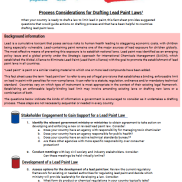
Process Considerations for Drafting Lead Paint Laws

In response to questions received by the Global Alliance to Eliminate Lead Paint on roadmaps for developing regulations on lead content in paint, the Alliance offers the following process considerations. Questions are illustrative, indicating the kinds of information a government might consider as it undertakes each component of a drafting process.
Emerging Policy Issues: Lead in paint
Topics: Policymaking

Avatar