48 resources found

Manuals and toolkits

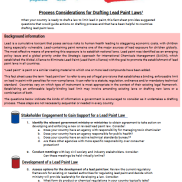
Process Considerations for Drafting Lead Paint Laws

In response to questions received by the Global Alliance to Eliminate Lead Paint on roadmaps for developing regulations on lead content in paint, the Alliance offers the following process considerations. Questions are illustrative, indicating the kinds of information a government might consider as it undertakes each component of a drafting process.
Emerging Policy Issues: Lead in paint
Topics: Policymaking
Manuals and toolkits

Brief guide to analytical methods for measuring lead in paint (Second edition)

Lead is a toxic metal whose widespread use has caused extensive environmental contamination and health problems in many parts of the world. Human exposure to lead in 2017 was estimated to account for 1.06 million deaths and the loss of 24.4 million disability-adjusted-life-years (DALYs) from long-term health effects, with the highest burden falling on low- and middle-income countries.This document provides a brief overview of analytical methods available for measuring lead in paint. It is primarily aimed at informing public health
Emerging Policy Issues: Lead in paint
Manuals and toolkits

Introduction to Endocrine Disrupting Chemicals (EDCs)

by
IPEN ,
|
June 2020
copied to clipboard
A guide for public interest organisations and policy-makersTo raise global awareness about endocrine-disrupting chemicals (EDCs) the Endocrine Society and IPEN have joined together to develop this EDC Guide. The guide draws from each organization’s strengths to present a more comprehensive picture of global EDC exposures and health risks than either could have done alone. Endocrine Society authors contributed the scientific and health-related content; IPEN provides knowledge of global policies and perspectives from developing and transition countries.
Emerging Policy Issues: Endocrine-Disrupting Chemicals
Manuals and toolkits

Guidance to Provide Footprint Information on Sustainable Alternatives

As there is an increase in communication of concrete recommendations for better solutions and alternatives to build a better economy that protects nature, there is an increased need to back these recommendations with facts and figures about how they contribute to reduce our impact on the planet.In this sense, the life cycle team has pulled together a very simple 2-page guidance on elements to consider when backing up your recommendations with strong life-cycle based science. The 2-pager also provides links
Emerging Policy Issues: Chemicals in products
Topics: Life Cycle
Newsletter

UNEP Science Alerts - March 2019

by |
March 2020
copied to clipboard

UNEP's newsletter from March 2020 on scientific articles, research and knowledge on selected topics.TopicTitleChemicals and Waste / PollutionAdvancing environmental exposure assessment science to benefit society / A. Caplin et al. 2019. Nature.Assessment of air pollution caused by illegal e-waste burning to evaluate the human health risk / C. Gangwar et al. Environment International 125, Pages 191-199, 2019. ScienceDirect.A Comparison of hourly to annual air pollutant emissions: Implications for estimating acute exposure and public health risk / M. Stewart et al

Manuals and toolkits

Handbook on Sustainable Public Procurement - Integration Sustainability Criteria into Public Procurement Procedures for Paints and Varnishes, Cleaning Products, Heat Insulation Materials

November 2017
copied to clipboard
Public Procurement is closely interconnected with an implementation of the sustainable development goals on the practice. Given priority to environmentally friendly products and environmentally safety services, which comply with green standards and rules, is an efficient tool in solving of many economic, environmental and social challenges at different levels.This handbook contains a basic information about benefits and advantages of the sustainable public procurement for government and public authorities; a step–by–step explanations how to transform a procurement process into sustainable one
Emerging Policy Issues: Chemicals in products
Manuals and toolkits

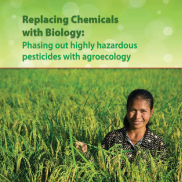
Replacing Chemicals with Biology: Phasing out highly hazardous pesticides with agroecology

September 2015
copied to clipboard
Adverse effects of highly hazardous pesticides (HHPs) on people and the environment have been a global concern for many years. In 2006, this was clearly expressed by the FAO Council when it recommended a progressive ban on HHPs. The concern crystallized at UNEP’s Fourth International Conference on Chemicals Management (ICCM4) in Nairobi in 2012, with the submission of a conference room paper supported by at least 65 countries and organizations. The proposed resolution included supporting “a progressive ban on HHPs
Emerging Policy Issues: Highly Hazardous Pesticides

Avatar