82 resources found

Manuals and toolkits

Chemicals of Concern in the Building and Construction Sector - Summary

by |
September 2021
copied to clipboard

This is the summary of the UNEP report on Chemicals of Concern in the Building and Construction Sector.The report aims at providing an overview of the challenge that chemicals of concern pose in the context of products relevant for the building and construction sector. It outlines the relevance and linkages of chemicals of concern with regards to a building life cycle and highlights existing gaps, challenges and opportunities regarding the imperative of increasing circularity in the building and construction sector.The

Emerging Policy Issues: Chemicals in products
Academic article

Exposure and toxicity characterization of chemical emissions and chemicals in products: global recommendations and implementation in USEtox

by
Springer Nature
|
April 2021
copied to clipboard
Reducing chemical pressure on human and environmental health is an integral part of the global sustainability agenda. Guidelines for deriving globally applicable, life cycle–based indicators are required to consistently quantify toxicity impacts from chemical emissions as well as from chemicals in consumer products. In response, we elaborate the methodological framework and present recommendations for advancing near-field/far-field exposure and toxicity characterization, and for implementing these recommendations into the scientific consensus model USEtox.The present work was supported by the “Global Best Practices
Emerging Policy Issues: Chemicals in products
Academic article

Blood lead levels in low-income and middle-income countries: a systematic review

by
Elsevier
|
March 2021
copied to clipboard
Since the global phase-out of leaded petrol, reports have suggested that lead exposure remains substantial or is increasing in some low-income and middle-income countries (LMICs). However, few studies have attempted to systematically assess blood lead levels over the full range of LMICs. This study is aimed to describe values for blood lead level in LMICs.In this systematic review, PubMed was searched for studies published between Jan 1, 2010, and Oct 31, 2019, that reported blood lead levels in the 137
Emerging Policy Issues: Lead in paint
Academic article

Chemicals of concern in plastic toys

by
ScienceDirect
|
October 2020
copied to clipboard
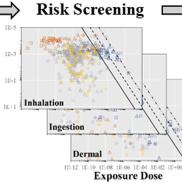
We present a list of Chemicals of Concern (CoCs) in plastic toys. We started from available studies reporting chemical composition of toys to group plastic materials, as well as to gather mass fractions and function of chemicals in these materials. Chemical emissions from plastic toys and subsequent human exposures were then estimated using a series of models and a coupled near-field and far-field exposure assessment framework. Comparing human doses with reference doses shows high Hazard Quotients of up to 387
Emerging Policy Issues: Chemicals in products
Manuals and toolkits

Guidance on organizing an advocacy or awareness-raising campaign on lead paint

This document has been developed as part of a project to accelerate progress towards the establishment of legally binding controls on the manufacture, sale, distribution, import and use of lead paint in countries, funded by the Global Environment Facility (GEF) and executed by the Secretariat of the Strategic Approach to International Chemicals Management (SAICM). It is a contribution to the work of the Global Alliance to Eliminate Lead Paint (the Lead Paint Alliance). The Lead Paint Alliance is a voluntary
Emerging Policy Issues: Lead in paint
Academic article

Alternative societal solutions to pharmaceuticals in the aquatic environment

by
ScienceDirect
|
September 2020
copied to clipboard
Environmental contamination with pharmaceuticals is widespread, inducing risks to both human health and the environment. This paper explores potential societal solutions to human and veterinary pharmaceuticals in the aquatic environment. To this end, we adopt transition research’s multi-level perspective framework, which allows us to understand the dynamics underlying pharmaceutical emissions and to recognize social and technical factors triggering change. The authors' qualitative analysis is based on data collected through literature research and interviews with actors from pharmaceutical industry, the health
Emerging Policy Issues: Pharmaceutical pollutants
Manuals and toolkits

Brief guide to analytical methods for measuring lead in blood (Second edition)

Lead is a toxic metal whose widespread use has caused extensive environmental contamination and health problems in many parts of the world. Lead is a cumulative toxicant that affects multiple body systems, including the neurological, haematological, gastrointestinal, cardiovascular, musculoskeletal and renal systems. Long-term effects include increased risk of hypertension, ischaemic heart disease and renal disease. Children are particularly vulnerable to the neurotoxic effects of lead, and even low levels of exposure can impair cognitive development and cause behavioural disorders. These
Emerging Policy Issues: Lead in paint
Manuals and toolkits

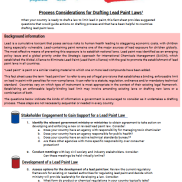
Process Considerations for Drafting Lead Paint Laws

In response to questions received by the Global Alliance to Eliminate Lead Paint on roadmaps for developing regulations on lead content in paint, the Alliance offers the following process considerations. Questions are illustrative, indicating the kinds of information a government might consider as it undertakes each component of a drafting process.
Emerging Policy Issues: Lead in paint
Topics: Policymaking

Avatar