111 resources found

Report

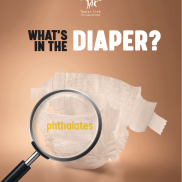
What's in the Diaper

Presence of Phthalates in Baby DiapersThe use of disposable diapers have been the standard for baby hygiene for many years.Among polymers used in diapers Phthalates are generally used as plasticizers and catalysts for the polymerization. Phthalates provide flexibility & durability to these polymers because of which they are used in the manufacturing of diapers.As Phthalates have been characterized as an endocrine disrupting chemical, the use of Phthalates in the diapers raises concern of possible health impacts on children.
Report

An Assessment Report on Issues of Concern: Chemicals and Waste Issues Posing Risks to Human Health and the Environment

by |
September 2020
copied to clipboard
Many countries and regions have set up regulatory and policy frameworks to achieve sound chemicals and waste management. In addition to national and regional efforts, the international community has taken concerted joint actions to address specific issues of concern, including chemicals that can be transported over long distances by wind and water, are transported through global trade in resources, products and waste, or are used or are present in many countries.Substantial progress has been made by the international community, including
Manuals and toolkits

Brief guide to analytical methods for measuring lead in blood (Second edition)

Lead is a toxic metal whose widespread use has caused extensive environmental contamination and health problems in many parts of the world. Lead is a cumulative toxicant that affects multiple body systems, including the neurological, haematological, gastrointestinal, cardiovascular, musculoskeletal and renal systems. Long-term effects include increased risk of hypertension, ischaemic heart disease and renal disease. Children are particularly vulnerable to the neurotoxic effects of lead, and even low levels of exposure can impair cognitive development and cause behavioural disorders. These
Emerging Policy Issues: Lead in paint
Manuals and toolkits

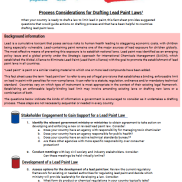
Process Considerations for Drafting Lead Paint Laws

In response to questions received by the Global Alliance to Eliminate Lead Paint on roadmaps for developing regulations on lead content in paint, the Alliance offers the following process considerations. Questions are illustrative, indicating the kinds of information a government might consider as it undertakes each component of a drafting process.
Emerging Policy Issues: Lead in paint
Topics: Policymaking
Manuals and toolkits

Brief guide to analytical methods for measuring lead in paint (Second edition)

Lead is a toxic metal whose widespread use has caused extensive environmental contamination and health problems in many parts of the world. Human exposure to lead in 2017 was estimated to account for 1.06 million deaths and the loss of 24.4 million disability-adjusted-life-years (DALYs) from long-term health effects, with the highest burden falling on low- and middle-income countries.This document provides a brief overview of analytical methods available for measuring lead in paint. It is primarily aimed at informing public health
Emerging Policy Issues: Lead in paint
Manuals and toolkits

Introduction to Endocrine Disrupting Chemicals (EDCs)

by
IPEN ,
|
June 2020
copied to clipboard
A guide for public interest organisations and policy-makersTo raise global awareness about endocrine-disrupting chemicals (EDCs) the Endocrine Society and IPEN have joined together to develop this EDC Guide. The guide draws from each organization’s strengths to present a more comprehensive picture of global EDC exposures and health risks than either could have done alone. Endocrine Society authors contributed the scientific and health-related content; IPEN provides knowledge of global policies and perspectives from developing and transition countries.
Emerging Policy Issues: Endocrine-Disrupting Chemicals
Report

Report of the 2019 International Lead poisoning Prevention Week

From 20 to 26 October 2019 the seventh International Lead Poisoning Prevention Week of action (ILPPW) took place in countries around the world. This report describes some of the activities held during the week. As with earlier years, the Global Alliance to Eliminate Lead Paint (the Lead Paint Alliance) provided a campaign resource package and a range of multilingual campaign materials. All the materials were made available from the World Health Organization (WHO) website.
Emerging Policy Issues: Lead in paint
Manuals and toolkits

Guidance to Provide Footprint Information on Sustainable Alternatives

As there is an increase in communication of concrete recommendations for better solutions and alternatives to build a better economy that protects nature, there is an increased need to back these recommendations with facts and figures about how they contribute to reduce our impact on the planet.In this sense, the life cycle team has pulled together a very simple 2-page guidance on elements to consider when backing up your recommendations with strong life-cycle based science. The 2-pager also provides links
Emerging Policy Issues: Chemicals in products
Topics: Life Cycle

Avatar