77 resources found

Infographic

Infographic on Lead Paint Laboratory Database

by |
October 2021
copied to clipboard
UNEP has created a database of laboratories undertaking lead paint testing, to to provide information on national laboratory capacity in the context of implementing limits on lead content in paint.As of May 2021, 101 laboratories have replied to the UNEP questionnaire and are included in the database.
Emerging Policy Issues: Lead in paint
Report

Report of the 2020 International Lead poisoning Prevention Week

The eighth International Lead Poisoning Prevention Week (ILPPW) was held on 25–31 October 2020, with more than 90 events in 60 countries organized by governments, civil society organizations, health partners, industry and other institutions.ILPPW is an ongoing initiative of the Global Alliance to Eliminate Lead Paint (the Lead Paint Alliance), led jointly by the United Nations Environment Programme (UNEP) and WHO. The aim of the Week is to raise awareness about the health effects of lead exposure, highlight the efforts
Emerging Policy Issues: Lead in paint
Report

Regional Electronics Study and Circularity Roadmap in the LAC Region: Mapping of Existing Initiatives

Technological development has made electrical and electronic equipment (EEE1) essential parts of contemporary life and indispensable products in today’s societies. Information technology (IT) combined with the technological advances in recent decades, has resulted in EEE having a great influence on the daily life of consumers in aspects such as health, safety, knowledge, comfort information, among others. The global consumption of electronics is growing 2.5 million metric tons per year (Forti, Baldé, Kuehr, & Bel, 2020), because technology increases the living

Report

Pharmaceuticals Residues in Hospital Wastewater (Europe)

The healthcare sector has a unique healing mission, yet hospitals are key point sources for specialised pharmaceutical residues entering the environment, a serious source of pollution that can threaten ecosystems and the environment, as well as drive the development of antimicrobial resistance (AMR) – a serious public health threat.Up to 90% of orally administered pharmaceuticals are excreted into wastewater as active substances in the faeces and urine of patients. Wastewater treatment plants widely vary in their capacity to eliminate these
Emerging Policy Issues: Pharmaceutical pollutants
Report

Mapping of Stakeholders for the Regional Electronics Study and Circularity Roadmap in the Latin America and The Caribbean

This document has been developed within the framework of the Global Environment Facility (GEF) project ID: 9771 on Global Best Practices on Emerging Chemical Policy Issues of Concern under the Strategic Approach to International Chemicals Management (SAICM). This project is funded by the GEF, implemented by UNEP and executed by the SAICM Secretariat.Under the project, UNEP is partnering with Universidad El Bosque to develop a Regional Electronics Study and Circularity Roadmap in the Latin America and the Caribbean (LAC) Region

Report

Market and Sector Analysis Report of the Chemical Supply Chain of the Construction Sector in Sri Lanka

This market and sector analysis report of the chemical supply chain of the construction sector in Sri Lanka was conducted according to the process outlined in UNEP’s eco-innovation (Eco-i) manual.The construction industry is one of the largest industries in Sri Lanka both in terms of contribution to GDP as well as the labour force involved. As a result, the construction material supply chain is also one of the largest sub sectors in the country. There is an emerging trend in
Emerging Policy Issues: Chemicals in products
Report

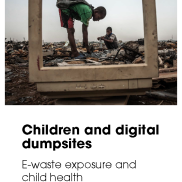
Children and digital dumpsites: e-waste exposure and child health

WHO launched the first comprehensive publication on e-waste, entitled ‘Children and digital dumpsites: e-waste exposure and child health’. The soaring global popularity of electronic and electrical devices, from computers to cell phones to heavy appliances, combined with ineffective waste management and disposal, is triggering a crisis of e-waste health risks to which millions of children, as well as women of childbearing age, are exposed.Informal processing of e-waste through open burning, heating and acid leaching (using cyanide salt, nitric acid or
Report

Chemicals of Concern in the Building and Construction Sector

This UNEP report aims at providing an overview of the challenge that chemicals of concern pose in the context of products relevant for the building and construction sector. It outlines the relevance and linkages of chemicals of concern with regards to a building life cycle and highlights existing gaps, challenges and opportunities regarding the imperative of increasing circularity in the building and construction sector.

Emerging Policy Issues: Chemicals in products
Avatar