639 resources found

Cover
Manuals and toolkits

Sustainable Procurement of Electronics: A Progressive Approach to Chemicals of Concern

by |
October 2022
copied to clipboard

This guidance addresses the role that sustainable procurement can play in managing chemicals of concern in electronic and electrical equipment procured across the public sector, during their entire lifecycle. It is primarily addressed to public procurers as well as those responsible for the procurement of waste management solutions at end-of-life for electronics equipment.

This guidance is aimed at helping procurement practitioners implement policies on chemicals management through sustainable procurement approaches and tools such as market dialogue, criteria and ecolabels.

SAICMUCT CDSG CoP Discussion 3 2022 digest
Community of practice summary of discussions

Plastic pollution: ideas for addressing chemicals in plastics

by |
October 2022
copied to clipboard

The Secretariat of the Strategic Approach to Chemicals Management (SAICM) and the University of Cape Town (UCT) have launched a Community of Practice (CoP) on Chemicals and SDGs to bring representatives from different sectors together and to create a learning network around issues related to addressing Chemicals and the Sustainable Development Goals (SDGs). This is a summary of the discussion on Plastic pollution: ideas for addressing chemicals in plastics, which took place on 19 October 2022.

Presenters: Brenda Koekkoek (UNEP), Jost Dittkrist (UNEP), Dr. Eeva Leinala (OECD), Mochamad Adi Septiono (Nexus3 Foundation)

chemical contamination
Policy document

Addressing Industry Involvement in the Funding of Sound Management of Chemicals and Waste

This Policy Brief outlines the history behind the SAICM agenda, puts in context the issue of financing the sound management of chemicals and waste, and highlights the main findings and proposals from the SAICM study.

gender-case-studies-cover
Case studies

Women Leaders: Addressing Chemicals and Waste Issues

by
IPEN ,
|
June 2022
copied to clipboard

People of all gender identities must have the same rights and opportunities to participate fully in their communities, free from the health threats posed by toxic chemicals. It is especially important to understand the factors that put women at risk from chemical health threats.

The IPEN report “Women Leaders: Addressing Chemicals and Waste Issues” highlights women’s leadership through ten organizations from around the world working to address chemical health threats. The report was developed within the framework of the United Nations Environment Program and its Global Environment Facility (GEF), under the Strategic Approach to International Chemicals Management (SAICM), executed by the SAICM Secretariat. It was produced with support from the Swedish Government.

Women face greater risks from chemical exposures and experience higher rates of adverse health outcomes because of their physiology, different types of occupational exposures, and differential exposures to chemicals, including from personal care and household products. Women are also exposed to chemicals — such as endocrine disrupting chemicals, lead in paint, and chemicals in toys — that pose health threats during pregnancy and to their developing children.

These toxic exposures can lead to serious health problems that impact women’s lives and their opportunities to participate in their communities fully and equally. This is especially so for women in low-income communities who are often managing multiple pathways for toxic exposures and multiple obstacles to gender equality.

Women cannot be empowered nor gender equality achieved while exposures to hazardous chemicals put them at risk for cancer, chronic illnesses, infertility, and damage to their nervous systems.

In 2015, the United Nations Member States adopted the 2030 Agenda for Sustainable Development, which includes 17 Sustainable Development Goals (SDGs). “Gender Equality” is one of the goals (Goal 5) and the SDGs also recognize that gender equality is a prerequisite for reaching most of the other goals. Reducing and eliminating chemical exposures will also be essential for achieving all of the 17 goals.

The stories that follow highlight women across the globe who are leading work in their communities, nations, and internationally for stronger protections from harmful chemicals. Supporting their work and the work of countless other women who are leading similar efforts will be critical for achieving the SDGs.

Lead_Paint_Guide
Manuals and toolkits

Lead Paint Reformulation Technical Guidelines

The Lead Paint Reformulation Technical Guidelines have developed by the United Nations Environment Programme (UNEP) and guided by the Global Alliance to Eliminate Lead Paint. The document provide a comprehensive starting point for all stakeholders to learn more about paint reformulation and best practices. They offer general information on processes and provide a step-by-step approach to reformulation, indicating where to find relevant information such as alternative raw materials and additional details such as standards for testing and in-depth case studies.The

Emerging Policy Issues: Lead in paint
Topics: Policymaking
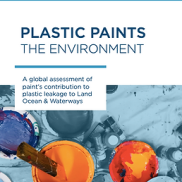
Plastic paints the Environment
Report

Plastic Paints the Environment

February 2022
copied to clipboard

This report provides a global assessment of the level of plastic paint leakage worldwide.

It is based on the baseline year 2019 with a global paint demand of 52 Mt, that included 19.5 Mt of plastics and distributed across different sectors: Architectural, Marine, Road Marking, General Industrial, Automotive and Industrial Wood and Others.

Emerging Policy Issues: Chemicals in products
HML-Cabinetry-Spectrum-Dec3
Manuals and toolkits

Healthier Cabinetry Guide

December 2021
copied to clipboard

At face value, cabinetry may seem to be made of one type of wood, but its construction is much more complex. Many prefabricated cabinets are built using a combination of three or more wood composites and veneers, which typically use toxic glues containing formaldehyde, a known human carcinogen.

By comparing the material contents and construction in prefabricated cabinets, we created a spectrum that indicates the relationship between affordability and health. We typically consider the health effects during all phases of product development, but these diagrams are focused on the health effects during installation and inhabitation.

Currently, prefabricated cabinets are composed of 5%-30% healthier materials. Designers can increase this percentage by requesting manufacturers to build with NAF (no added formaldehyde) composite woods. This often comes with an increased price. Our Composite Wood Product and Spec Guidance gives a range of healthier substitutions.

Emerging Policy Issues: Chemicals in products
GenChemRoadMap_Workbook_cover
Manuals and toolkits

The Gender and Chemicals Road Map + Workbook

The road map lays out actions and provides guidance on how to fully integrate gender in national chemicals management. These steps are meant to give support and direction to actors engaged in national chemicals management, especially SAICM National Focal Points. The accompanying workbook helps to prioritize and plan your activities step by step. Additionally, SAICM Focal Points and other stakeholders might be at different stages of capacity development, and priority actions and objectives will differ depending on the individual national context - the workbook, therefore, allows you to develop your specific process of integrating gender.

Avatar