29 resources found

building-code-fact-sheet-19-01-23
Factsheets and brochures

Building Insulation Code Change Fact Sheet

In January 2019, the California Building Standards Commission unanimously approved changes to the state building codes proposed by the California Office of the State Fire Marshal. The changes allow use of polystyrene insulation without flame retardants below a concrete slab-on-grade. These changes would maintain fire safety while improving human and environmental health.  This fact sheet details the key considerations for implementation of a policy on allowing flame retardant-free insulation within a building code, and the associated health and technical considerations.

Emerging Policy Issues: Chemicals in products
Factsheets and brochures

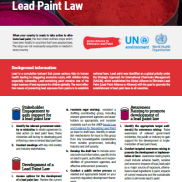
Suggested Steps for Establishing a Lead Paint Law

December 2019
copied to clipboard
This fact sheet outlines steps that have been helpful in countries that have adopted lead paint laws. The steps are not necessarily sequential or needed in every country.
Emerging Policy Issues: Lead in paint
Topics: Policymaking
Factsheets and brochures

Lead Paint Factsheet

by
UNEP ,
|
November 2019
copied to clipboard
This factsheet presents the work of UNEP and the Lead Paint Alliance. The document also highlights its impacts and the SAICM GEF project Lead in paint component.
Emerging Policy Issues: Lead in paint
Factsheets and brochures

The Potential Key Role of SAICM Focal Points in Reducing Harm from HHPs

by |
August 2022
copied to clipboard
The factsheet entitled "The potential key role of SAICM Focal Points in reducing harm from Highly Hazardous Pesticides (HHPs)" was produced by stakeholders from the University of Cape Town, the Strategic Approach to International Chemicals Management, the Food and Agriculture Organization and Umweltbundesamt. This factsheet was developed to ensure information about HHPs reaches all SAICM National Focal Points and other relevant stakeholders for them to make effective and informed decisions and play an active role in facilitating the reduction of
Emerging Policy Issues: Highly Hazardous Pesticides
Factsheets and brochures

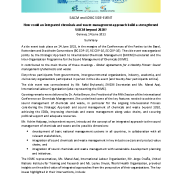
Summary of SAICM and IOMC side-event: How could an integrated chemicals and waste management approach build a strengthened SAICM beyond 2020?

A side event took place on 14 June 2022, in the margins of the Conferences of the Parties to the Basel, Rotterdam and Stockholm Conventions (BC COP-15, RC COP-10, SC COP-10). The side event was organized jointly by the Strategic Approach to International Chemicals Management (SAICM) Secretariat and the Inter-Organization Programme for the Sound Management of Chemicals (IOMC).It contributed to the main theme of these meetings - Global Agreements for a Healthy Planet: Sound management of chemicals and waste.
Factsheets and brochures

Launch of E-learning Course on Industrial Chemicals Databases and Information Sharing

by |
April 2022
copied to clipboard

Following a collaborative study by UNEP and the International Council of Chemical Associations (ICCA), which provided a comprehensive inventory of the publicly available databases on industrial chemicals in commerce, SAICM coordinated the development of an e-learning course to bridge the information gap by improving accessibility to environment, health, and safety (EHS) information for industrial chemicals.In an interactive and engaging way, this course provides guidance on locating and using information on industrial chemicals in commerce and identifies some barriers to identifying

Emerging Policy Issues: Chemicals in products

Factsheets and brochures

Addressing Chemicals of Concern in Electrical and Electronic Equipment - Options for Action for Policymakers

by |
December 2021
copied to clipboard
The global production and consumption of Electrical and Electronic Equipment (EEE) is growing rapidly and EEE has become indispensable in modern societies, enhancing living standards. Currently, the total weight of global EEE consumption (excluding photovoltaic panels) on average increases by 2.5 million metric tons annually. This increasing consumption and production leads to an increase in raw material extraction and accompanying pollution.The options for action proposed in this document are intended to inspire policymakers and to offer guidance on possible entry
Emerging Policy Issues: Chemicals in products
Factsheets and brochures

Using a value chain approach to reduce chemicals of concern

by |
October 2021
copied to clipboard
Chemicals of concern (CoCs) contained in everyday products can have harmful impacts on human health and the environment. While chemical-related impacts can often occur during a product’s use or end-of-life, decisions influencing product ingredients are taken further upstream of the value chain. Action to address CoCs in products thus need to consider the entire value chain and impactful interventions need to be made at upstream stages to protect human health and the environment from chemical pollution. UNEP is working on
Avatar