63 resources found

building-code-fact-sheet-19-01-23
Factsheets and brochures

Building Insulation Code Change Fact Sheet

In January 2019, the California Building Standards Commission unanimously approved changes to the state building codes proposed by the California Office of the State Fire Marshal. The changes allow use of polystyrene insulation without flame retardants below a concrete slab-on-grade. These changes would maintain fire safety while improving human and environmental health.  This fact sheet details the key considerations for implementation of a policy on allowing flame retardant-free insulation within a building code, and the associated health and technical considerations.

Emerging Policy Issues: Chemicals in products
T4%20size%20shutterstock
Website

OECD Substitution and Alternatives Assessment Toolbox

by |
December 2022
copied to clipboard

As interest in the substitution of harmful chemicals continues to grow in industry, NGOs and the public sector, organisations are seeking guidance on the conduction of alternatives assessment and for the selection of appropriate methods and tools. The OECD is responding to this need by developing guidance documents, sharing experiences through workshops and by collecting available resources.

Emerging Policy Issues: Chemicals in products
SIXCLASSES_LOGO
Website

Six Classes

December 2022
copied to clipboard

The Six Classes is a visionary program of the Green Science Policy Institute, whose aim is to reduce the use of harmful chemicals in consumer and other products. It focuses on entire classes or groups of chemicals of concern, rather than phasing out problematic chemicals one at a time.

This approach of tackling entire groups of chemicals is needed because more than 80,000 chemicals are used in the U.S. Many have not been well studied and their impacts on human and environmental health are not understood. Even so, some chemicals known to be harmful are commonly found in consumer products. Moreover, when a harmful chemical is phased out, often after years of research and advocacy, the replacement may be a “chemical cousin” with similar structure and potential for harm.

The Six Classes approach can prevent such “regrettable substitutions” and accelerate reductions in toxics use.

In its work on each of the Six Classes, the Green Science Policy Institute convenes scientific experts, motivates needed studies, and publishes research results in peer-reviewed journals. Its findings are communicated widely, as part of its work for science-based change and for moving towards safer chemicals and/or technologies. A key element of the approach is to bring together scientists and decision-makers from business, government, academia, and nonprofits to develop coordinated strategies for reducing the production and use of chemicals of concern.

Emerging Policy Issues: Chemicals in products
Website

Portal on Per and Poly Fluorinated Chemicals

This Portal serves to facilitate the exchange of information on per and poly-fluorinated chemicals, focusing specifically on per- and poly-fluoroalkyl substances (PFASs).In order to support a global transition towards safer alternatives, the Portal provides information on the following areas:What are PFASs?Risk reduction approachesAlternativesProduction and emissionsInformation from countriesInformation provided in this portal comes principally from the work done within the context of the OECD/UNEP Global PFC Group.
Emerging Policy Issues: Perfluorinated Chemicals
Factsheets and brochures

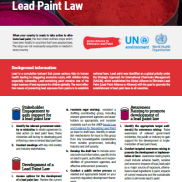
Suggested Steps for Establishing a Lead Paint Law

December 2019
copied to clipboard
This fact sheet outlines steps that have been helpful in countries that have adopted lead paint laws. The steps are not necessarily sequential or needed in every country.
Emerging Policy Issues: Lead in paint
Topics: Policymaking
Factsheets and brochures

Lead Paint Factsheet

by |
November 2019
copied to clipboard
This factsheet presents the work of UNEP and the Lead Paint Alliance. The document also highlights its impacts and the SAICM GEF project Lead in paint component.
Emerging Policy Issues: Lead in paint
Factsheets and brochures

The Potential Key Role of SAICM Focal Points in Reducing Harm from HHPs

by |
August 2022
copied to clipboard
The factsheet entitled "The potential key role of SAICM Focal Points in reducing harm from Highly Hazardous Pesticides (HHPs)" was produced by stakeholders from the University of Cape Town, the Strategic Approach to International Chemicals Management, the Food and Agriculture Organization and Umweltbundesamt. This factsheet was developed to ensure information about HHPs reaches all SAICM National Focal Points and other relevant stakeholders for them to make effective and informed decisions and play an active role in facilitating the reduction of
Emerging Policy Issues: Highly Hazardous Pesticides
Factsheets and brochures

Summary of SAICM and IOMC side-event: How could an integrated chemicals and waste management approach build a strengthened SAICM beyond 2020?

A side event took place on 14 June 2022, in the margins of the Conferences of the Parties to the Basel, Rotterdam and Stockholm Conventions (BC COP-15, RC COP-10, SC COP-10). The side event was organized jointly by the Strategic Approach to International Chemicals Management (SAICM) Secretariat and the Inter-Organization Programme for the Sound Management of Chemicals (IOMC).It contributed to the main theme of these meetings - Global Agreements for a Healthy Planet: Sound management of chemicals and waste.
Avatar