96 resources found

Factsheets and brochures

Potential Alternatives to PFASs in Carpets and Rugs

Safer Consumer Products (SCP) has compiled a list of alternatives to PFASs in carpets and rugs to assist manufacturers looking for substitutes. The alternatives have been grouped into two categories: non-chemical and chemical alternatives. Products and manufacturers are listed but they are not endorsed by SCP and the safety of the alternatives has not been assessed.

Emerging Policy Issues: Perfluorinated Chemicals
Circular_Economy_Electronics_LAC
Report

Toward a Circular Economy for the Electronics Sector in Latin America and the Caribbean (LAC): Overview, Actions and Recommendations

This report provides an overview of the current status and conditions of the Circular Economy in the electronics value chain in the Latin America and the Caribbean (LAC) region, identifies key areas of concern, provides appropriate recommendations, and proposes priority actions to improve circularity of the sector. The recommendations and roadmap focus on the individual life cycle stages of the electronics value chain, as well as on aspects that cut across the value chain. The transition towards a more circular electronics sector in Latin America and the Caribbean (LAC) would require a holistic and coordinated approach to progress toward a more circular electronics value chain in the CEE region.

This publication was prepared under the framework of the Global Environment Facility (GEF) full-sized project 9771: Global best practices on emerging chemical policy issues of concern under the Strategic Approach to International Chemicals Management (SAICM). This project is funded by the GEF, implemented by UNEP and executed by the SAICM Secretariat.

Hinkley employees dismantling a laptop
Factsheets and brochures

Initiating Circularity for electronic waste in Nigeria: A promising paradigm for treating e-waste globally

Over half a million tonnes of discarded electronic appliances are improperly processed in Nigeria every year, threatening the country's environment and the health of approximately 100,000 informal workers in the recycling industry.
With support from the Global Environment Facility (GEF), the Government of Nigeria has joined forces with the United Nations Environment Programme (UNEP) and partners to turn the tide on e-waste under the “Circular Economy Approaches for the Electronics Sector in Nigeria” project. Led by UNEP and supported by the National Environmental Standards and Regulations Enforcement Agency of Nigeria (NESREA), the $15-million initiative brought together players from the Government, the private sector, and civil society to design and operationalise a financially self-sustaining circular economy (CE) for electronics in Nigeria.
The project aims to stimulate a CE pilot through an Extended Producer Responsibility (EPR) scheme that serves as a model for countries facing similar challenges. EPR is an integrated waste management approach that extends the responsibility of manufacturers to the entire lifecycle of their product, particularly to the end-of-life treatment. By applying this approach, the producers will be obliged to commission for collecting, pre-treating and recycling their originated e-waste. 
The project creates synergies among pre-existing elements of an EPR system in Nigeria to establish a sustainable management system and financing mechanism for EPR implementation. Establishing and enforcing a sustainable approach in Nigeria with supporting regulations and legally binding requirements is expected to recover and re-introduce usable materials into the value chain, dispose of hazardous e-waste streams in an environmentally sound manner, and create safe employment for Nigerian e-waste workers.


building-code-fact-sheet-19-01-23
Factsheets and brochures

Building Insulation Code Change Fact Sheet

In January 2019, the California Building Standards Commission unanimously approved changes to the state building codes proposed by the California Office of the State Fire Marshal. The changes allow use of polystyrene insulation without flame retardants below a concrete slab-on-grade. These changes would maintain fire safety while improving human and environmental health.  This fact sheet details the key considerations for implementation of a policy on allowing flame retardant-free insulation within a building code, and the associated health and technical considerations.

Emerging Policy Issues: Chemicals in products
sustainable-chemicals-strategy
Report

A chemicals strategy for a sustainable chemicals revolution

December 2022
copied to clipboard

Chemicals production and consumption is set to double by 2030, from a $5 trillion industry globally in 2017, with production set to increase, mainly in emerging economies. If chemicals production is doubled, chemical pollution must not double as a consequence – rather we should aim to significantly reduce it from current levels.

Current international attempts at the massive undertaking of addressing chemical pollution are not working. For the world to solve the major environmental and health challenges we face, there must be a sustainable chemicals revolution. We can only achieve this through senior-level engagement with the chemical sciences community through an authoritative, intergovernmental science-policy interface.

The Royal Society of Chemistry engaged with scientists in their community to develop the vision for a chemicals strategy, relevant to any nation in principle.  Four pillars were identified on which any chemicals strategy has to be based: education, innovation, circular economy and regulation. National governments must invest in these areas and create a responsible framework of action for chemicals management.

Emerging Policy Issues: Chemicals in products
Country: United Kingdom
Circular_Economy_Electronics_Central_Eastern_Europe
Report

Toward a Circular Economy for the Electronics Sector in Central and Eastern Europe: Overview, Actions and Recommendations

by |
December 2022
copied to clipboard

This report provides an overview of the current status and conditions of the Circular Economy in the electronics value chain in the Central and Eastern Europe (CEE) region, identifies key areas of concern, provides appropriate recommendations, and proposes priority actions to improve circularity of the sector. The recommendations and roadmap focus on the individual life cycle stages of the electronics value chain, as well as on aspects that cut across the value chain. The transition towards a more circular electronics sector in Central and Easter Europe (CEE) would require a holistic and coordinated approach to progress toward a more circular electronics value chain in the CEE region.

This publication was prepared under the framework of the Global Environment Facility (GEF) full-sized project 9771: Global best practices on emerging chemical policy issues of concern under the Strategic Approach to International Chemicals Management (SAICM). This project is funded by the GEF, implemented by UNEP and executed by the SAICM Secretariat.

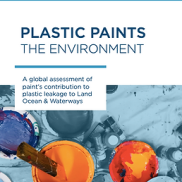
Plastic paints the Environment
Report

Plastic Paints the Environment

February 2022
copied to clipboard

This report provides a global assessment of the level of plastic paint leakage worldwide.

It is based on the baseline year 2019 with a global paint demand of 52 Mt, that included 19.5 Mt of plastics and distributed across different sectors: Architectural, Marine, Road Marking, General Industrial, Automotive and Industrial Wood and Others.

Emerging Policy Issues: Chemicals in products
Report

Chemicals of concern in electronics: Review of legislative and regulatory approach

by |
February 2021
copied to clipboard
This UNEP report provides a comprehensive but not necessarily exhaustive overview of the various regulatory approaches for CoC in EEE. Further inputs from the international community are welcomed to complement the research, especially with regards to relevant regulations that are not yet captured in the report.Chemicals in products and hazardous substances within the life cycle of electrical and electronic products have been longstanding emerging policy issues under the Strategic Approach to International Chemicals Management (SAICM). To further advance these issues
Emerging Policy Issues: Chemicals in products
Avatar