106 resources found

Report

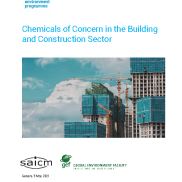
Chemicals of Concern in the Building and Construction Sector

This UNEP report aims at providing an overview of the challenge that chemicals of concern pose in the context of products relevant for the building and construction sector. It outlines the relevance and linkages of chemicals of concern with regards to a building life cycle and highlights existing gaps, challenges and opportunities regarding the imperative of increasing circularity in the building and construction sector.

Emerging Policy Issues: Chemicals in products
Report

Review of chemicals related Toy Safety Policies and Regulations in selected Low and Middle Income Countries

by |
April 2021
copied to clipboard
With a total revenue of more than 90 billion USD in 2018, the global toy market is an important sector of consumer products. Like many other products, toys are composed of a diverse range of materials. Many of these materials are made of, or contain manufactured chemicals. Most of these chemicals are intentionally added, but some can also be present as unintended contaminants.Many chemicals have properties that can make them hazardous to human health and/or the environment. The potential use
Emerging Policy Issues: Chemicals in products
Report

Commitment platforms and the global agenda for chemicals and waste management

Problem statementOne of functions of the of the Strategic Approach to International Chemicals Management (SAICM) is to call for appropriate action on emerging policy issues as they arise and to forge consensus on priorities for cooperative action as identified in the paragraph 24 of the Overarching Policy Strategy (OPS). In 2015, the Fourth International Conference on Chemicals Management (ICCM-4) initiated the development of the framework for sound management of chemicals and waste beyond 2020 that is envisaged to be adopted
Policy document

Guidance on key considerations for the identification and selection of safer chemical alternatives

by |
March 2021
copied to clipboard
The aim of the guidance is to advance broader agreement on a general approach and criteria for the selection of safer alternatives, with a focus on chemical substitution. It is intended to advance a consistent understanding of the minimum requirements needed to determine whether a chemical alternative is safer than the priority chemical, product, or technology for substitution, independent of the entity performing the assessment or the alternatives assessment framework being used.The guidance focuses on minimum assessment criteria and recommended
Emerging Policy Issues: Chemicals in products
Policy document

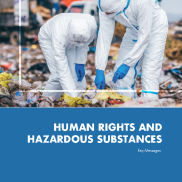
Key Messages on Human Rights and Hazardous Substances

Pollution is the largest source of premature death in the developing world, causing approximately three times more deaths than HIV/AIDS, tuberculosis and malaria combined (2018 Report of the Lancet Commission on pollution and health). It disproportionately affects persons, groups and peoples in vulnerable situations reflecting both historical and ongoing discrimination, racism, and power imbalances that have given rise to powerful social movements for environmental justice. Those responsible for the harmful impacts of hazardous substances must be held legally accountable for
Emerging Policy Issues: Chemicals in products
Report

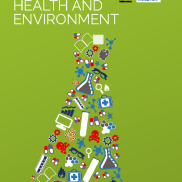
Chemicals of Concern for the Health Sector

Chemicals are widely used in daily life. They have a unique importance in the health-care sector, where they are used as disinfectants, cleaners, laboratory re­agents, sterilants, pesticides, medicines and pharma­ceuticals and in medical devices and equipment. The hazards of these chemicals are not well understood by health professionals nor incorporated into procure­ment decisions.To minimize these hazards, the health sector has been taking steps to promote and implement sustainable healthcare within their institutions and to collaborate externally with suppliers and manufactures
Report

Single-Use Plastic Products (SUPP) and their alternatives: Recommendations from Life Cycle Assessments

UN Environment Programme (UNEP) defines single use plastic products as “an umbrella term for different types of products that are typically used once before being thrown away or recycled” (UNEP 2018), which includes food packaging, bottles, straws, containers, cups, cutlery and shopping bags. It has been estimated that about 100-150 million tonnes of plastics are produced for single use products and about 8 million tonnes of plastics are dumped into the oceans every year (Plastics Oceans 2019)There is a need
Emerging Policy Issues: Chemicals in products
Topics: Life Cycle
Report

Plastics Pose a Threat to Human Health

Plastics Pose a Threat to Human Health: Authoritative Reports Shows Plastics and Microplastics are Pervasive Sources of Exposure to Dangerous Endocrine-disrupting ChemicalsPlastics contain and leach hazardous chemicals, including endocrine-disrupting chemicals (EDCs) that threaten human health. An authoritative new report, Plastics, EDCs, & Health, from the Endocrine Society and the IPEN (International Pollutants Elimination Network), presents a summary of international research on the health impacts of EDCs and describes the alarming health effects of widespread contamination from EDCs in plastics.EDCs are
Emerging Policy Issues: Endocrine-Disrupting Chemicals

Avatar