60 resources found

Project document

Baseline Information for the Lead Paint Country Situation in Nigeria

Lead in Nigerian paints is another route of lead into the environment and exposure can be caused as a result of inhalation or ingestion especially in children. In 2008, SRADeV Nigeria under the auspices of International Pollutants Elimination Network (IPEN) collected and analyzed decorative paints produced and/or marketed in Nigeria. All the sampled paint brands were found to contain lead higher than 90ppm, in fact up to an alarming level of 129,837ppm in one case. At that time, there were
Emerging Policy Issues: Lead in paint
Topics: Policymaking
Website

Health information about Lead

A range of documents provide information about the health impacts of lead, sources of lead exposure and methods for evaluating exposure. Key WHO risk assessment documents concerning lead are also provided. These resources can be used by governments and international and national organizations as the basis for taking preventive actions against adverse health and environmental impacts.
Emerging Policy Issues: Lead in paint
Project document

Market Analysis of the paint industry in Indonesia (English / Bahasa)

December 2019
copied to clipboard
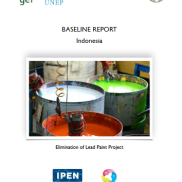
Elimination of Lead in Paint in Indonesia - Baseline Information - Indonesia’s paint marketIndonesia holds the first position as the biggest market in paint and coating in South East Asia with the 268 million population and high urbanization rate (57%). Indonesian paint and coating industry growth rate is 6% annually for the past five consecutive years. Paint and coating industry in Indonesia involves six multinational, four domestic, and large numbers of small-scale domestic producers, with the most demand from architectural
Emerging Policy Issues: Lead in paint
Topics: Policymaking
Academic article

Preventing disease through healthy environments: exposure to lead: a major public health concern

November 2019
copied to clipboard
This WHO policy brief presents the consequences of lead exposure on human health and details its toxicity in the body system explaining why it is important to reduce the use and releases of lead, and to reduce environmental and occupational exposures, particularly for children and women of childbearing age.The policy brief also lists the sources of lead releases and contamination in industrial process, drinking water and domestic sources. The brief also gives guidelines for tolerable intake levels of lead and
Emerging Policy Issues: Lead in paint
Website

International Lead Poisoning Prevention Week (ILPPW)

The International Lead Poisoning Prevention Week of action (ILPPW) takes place every year at the end of October. The objectives of the campaign are to raise awareness about health effects of lead poisoning; highlight countries and partners' efforts to prevent particularly childhood lead poisoning; and urge further action to eliminate lead paint through regulatory action at country level.The campaign website presents a multilingual campaign resource package, including posters, flyers, infographics, graphics and web banners in various formats, including an editable
Emerging Policy Issues: Lead in paint
Project document

National Baseline Survey of Paint Market in Peru

United Nations Environment Programme (UNEP) and the World Health Organization (WHO) have established the joint initiative Global Alliance to Eliminate Lead Paint (Lead Paint Alliance) to prevent children’s exposure to lead from paints containing lead and to minimize occupational exposures to lead paints. The broad objective of the Alliance is to promote a phase-out of the manufacture and sale of paints containing lead and eventually eliminate the risks from such paint.CER/Grupo GEA implements the Component 1 “Promoting regulatory and voluntary
Emerging Policy Issues: Lead in paint
Topics: Policymaking
Avatar