116 resources found

E-learning

Massive Open Online Course on Marine Litter

UN Environment Programme and Open Universiteit have created a Massive Open Online Course (MOOC) on Marine Litter as a key activity of the Global Partnership on Marine Litter (you can join the GPML). It is also part of the Clean Seas Campaign. The course starts on October 26, 2020. It is free for all students and available in 10 different languages. You can still enroll until November 15. Register here!Marine litter is a global problem that affects every ocean of
Academic article

Chemicals of concern in plastic toys

by
ScienceDirect
|
October 2020
copied to clipboard
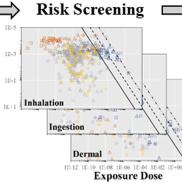
We present a list of Chemicals of Concern (CoCs) in plastic toys. We started from available studies reporting chemical composition of toys to group plastic materials, as well as to gather mass fractions and function of chemicals in these materials. Chemical emissions from plastic toys and subsequent human exposures were then estimated using a series of models and a coupled near-field and far-field exposure assessment framework. Comparing human doses with reference doses shows high Hazard Quotients of up to 387
Emerging Policy Issues: Chemicals in products
Community of practice summary of discussions

Overview of the HHP Global Action Plan and way forward

The SAICM Secretariat, in partnership with the University of Cape Town, established a community of practice on Highly Hazardous Pesticides (HHPs) to foster discussions, exchange of best practices, and recommendations to address HHPs amongst relevant stakeholders. This is a summary of the discussion on Overview of the HHP Global Action Plan and way forward, which took place on 21 October 2020.Presenter: Dr Baogen Bu (FAO)Despite the success of many actions to eliminate Highly Hazardous Pesticides (HHPs), they continue to pose
Emerging Policy Issues: Highly Hazardous Pesticides
Community of practice summary of discussions

Brainstorming implementation of gender mainstreaming into national policies for the sound management of chemicals and waste
September 2020
copied to clipboard
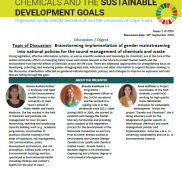
The Secretariat of the Strategic Approach to Chemicals Management (SAICM) and the University of Cape Town (UCT) have launched a Community of Practice (CoP) on Chemicals and SDGs to bring representatives from different sectors together and to create a learning network around issues related to addressing Chemicals and the Sustainable Development Goals (SDGs). This is a summary of the discussion on Brainstorming implementation of gender mainstreaming into national policies for the sound management of chemicals and waste, which took place
Community of practice summary of discussions

Awareness raising materials for lead in paint elimination

September 2020
copied to clipboard
The Secretariat of the Strategic Approach to Chemicals Management (SAICM) and the University of Cape Town (UCT) are launching a new Community of Practice (CoP) on Lead in Paint to bring representatives from different sectors together and to create a learning network around issues related to the elimination of Lead Paint. This is a summary of the discussion on Awareness raising materials for lead in paint elimination, which took place on 23 September 2020.Presenters: Elena Jardan (WHO), Evonne Marzouk (USEPA)
Emerging Policy Issues: Lead in paint
Community of practice summary of discussions

Mapping session of Chemicals in Products Globally

September 2020
copied to clipboard
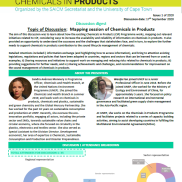
The SAICM Secretariat, in partnership with the University of Cape Town, established a community of practice on Chemicals in Products to bring representatives from different sectors together and to create a learning network around issues related to addressing Chemicals in Products (CiP). This is a summary of the discussion on Mapping session of Chemicals in Products Globally, which took place on 17 September 2020.Presenters: Sandra Avérous Monnery (UNEP), Wenjia Fan (UNEP)The aim of this discussion was to learn about how
Emerging Policy Issues: Chemicals in products
Community of practice summary of discussions

Examples and case studies on strategies for identifying HHPs from different perspectives

September 2020
copied to clipboard
The SAICM Secretariat, in partnership with the University of Cape Town, established a community of practice on Highly Hazardous Pesticides (HHPs) to foster discussions, exchange of best practices, and recommendations to address HHPs amongst relevant stakeholders. This is a summary of the discussion on Examples and case studies on strategies for identifying HHPs from different perspectives, which took place on 16 September 2020.Presenters: Dr Richard Brown (WHO), Dr Halshka Graczyk (ILO), Dr Keith Tyrell (PAN-UK), Dr Christoph Neumann (CropLife International)
Emerging Policy Issues: Highly Hazardous Pesticides
Avatar