639 resources found

Academic article

Alternative societal solutions to pharmaceuticals in the aquatic environment

by
ScienceDirect
|
September 2020
copied to clipboard
Environmental contamination with pharmaceuticals is widespread, inducing risks to both human health and the environment. This paper explores potential societal solutions to human and veterinary pharmaceuticals in the aquatic environment. To this end, we adopt transition research’s multi-level perspective framework, which allows us to understand the dynamics underlying pharmaceutical emissions and to recognize social and technical factors triggering change. The authors' qualitative analysis is based on data collected through literature research and interviews with actors from pharmaceutical industry, the health
Emerging Policy Issues: Pharmaceutical pollutants
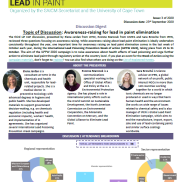
Community of practice summary of discussions

Awareness raising materials for lead in paint elimination

September 2020
copied to clipboard
The Secretariat of the Strategic Approach to Chemicals Management (SAICM) and the University of Cape Town (UCT) are launching a new Community of Practice (CoP) on Lead in Paint to bring representatives from different sectors together and to create a learning network around issues related to the elimination of Lead Paint. This is a summary of the discussion on Awareness raising materials for lead in paint elimination, which took place on 23 September 2020.Presenters: Elena Jardan (WHO), Evonne Marzouk (USEPA)
Emerging Policy Issues: Lead in paint
Community of practice summary of discussions

Mapping session of Chemicals in Products Globally

September 2020
copied to clipboard
The SAICM Secretariat, in partnership with the University of Cape Town, established a community of practice on Chemicals in Products to bring representatives from different sectors together and to create a learning network around issues related to addressing Chemicals in Products (CiP). This is a summary of the discussion on Mapping session of Chemicals in Products Globally, which took place on 17 September 2020.Presenters: Sandra Avérous Monnery (UNEP), Wenjia Fan (UNEP)The aim of this discussion was to learn about how
Emerging Policy Issues: Chemicals in products
Community of practice summary of discussions

Examples and case studies on strategies for identifying HHPs from different perspectives

September 2020
copied to clipboard
The SAICM Secretariat, in partnership with the University of Cape Town, established a community of practice on Highly Hazardous Pesticides (HHPs) to foster discussions, exchange of best practices, and recommendations to address HHPs amongst relevant stakeholders. This is a summary of the discussion on Examples and case studies on strategies for identifying HHPs from different perspectives, which took place on 16 September 2020.Presenters: Dr Richard Brown (WHO), Dr Halshka Graczyk (ILO), Dr Keith Tyrell (PAN-UK), Dr Christoph Neumann (CropLife International)
Emerging Policy Issues: Highly Hazardous Pesticides
Community of practice summary of discussions

Perspectives on addressing HHPs in the SAICM context

September 2020
copied to clipboard
The SAICM Secretariat, in partnership with the University of Cape Town, established a community of practice on Highly Hazardous Pesticides (HHPs) to foster discussions, exchange of best practices, and recommendations to address HHPs amongst relevant stakeholders. This is a summary of the discussion on Perspectives on addressing HHPs in the SAICM context, which took place on 19 August 2020.Presenter: Brenda Koekkoek (SAICM)In 2006 the United Nations Environment Programme (UNEP) launched the Strategic Approach to International Chemicals Management (SAICM), a multi-stakeholder
Emerging Policy Issues: Highly Hazardous Pesticides
Report

An Assessment Report on Issues of Concern: Chemicals and Waste Issues Posing Risks to Human Health and the Environment

by |
September 2020
copied to clipboard
Many countries and regions have set up regulatory and policy frameworks to achieve sound chemicals and waste management. In addition to national and regional efforts, the international community has taken concerted joint actions to address specific issues of concern, including chemicals that can be transported over long distances by wind and water, are transported through global trade in resources, products and waste, or are used or are present in many countries.Substantial progress has been made by the international community, including
Avatar