639 resources found

Policy document

A review of PFAS as a Chemical Class in the Textiles Sector - Policy Brief

For over a decade, under both SAICM and the Stockholm Convention on Persistent Organic Pollutants (POPs), the class of chemicals known as PFAS is gaining increasing international attention. Since 2009, chemicals in products have been identified as an Emerging Policy Issue and PFAS as an Issue of Concern by the SAICM. The textiles sector is currently considered in the SAICM context through the ‘Chemicals in Products Programme’, which focuses on four priority sectors: textiles, toys, building products and electronics. The
Report

Chemicals of concern in electronics: Review of legislative and regulatory approach

by |
February 2021
copied to clipboard
This UNEP report provides a comprehensive but not necessarily exhaustive overview of the various regulatory approaches for CoC in EEE. Further inputs from the international community are welcomed to complement the research, especially with regards to relevant regulations that are not yet captured in the report.Chemicals in products and hazardous substances within the life cycle of electrical and electronic products have been longstanding emerging policy issues under the Strategic Approach to International Chemicals Management (SAICM). To further advance these issues
Emerging Policy Issues: Chemicals in products
Report

Update on the Global Status of Legal Limits on Lead in Paint

by |
February 2021
copied to clipboard

The new 2020 Update on the Global Status of Legal Limits on Lead in Paint reports new laws, new tools, and new momentum on progress toward laws to eliminate lead paint in 2020. Available in English and Spanish, the Update also describes activity and results by region. As of 31 December 2020, 79 countries have confirmed that they have legally binding controls on lead in paint, which is 41% of all countries. Since October 2019, Colombia, Lebanon and Vietnam established

Emerging Policy Issues: Lead in paint
Topics: Policymaking
GSCF
Manuals and toolkits

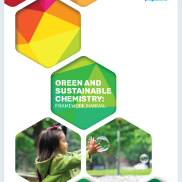
Green and Sustainable Chemistry: Framework Manual

The Framework Manual introduces, in a structured way, various facets of green and sustainable chemistry, with the intention to foster learning, reflection and scale up action based on a common global understanding of the concept. It features an organizing framework that unpacks various topics relevant for green and sustainable chemistry literature. The Manual is setting objectives and guiding considerations from green and sustainable chemistry, as well as an innovation and research framework are offered to stimulate stakeholder action at various levels and in different settings. Ultimately, the Manual seeks to promote innovation that unveils the full power of chemistry, and is compatible with, and supports implementation of global sustainable development goals and targets. The range of topics covered in the Manual have been identified following a review of the green and sustainable chemistry literature, the 2019 UNEP report on best practices in sustainable chemistry, and the second edition of the Global Chemicals Outlook (GCO-II). Resources permitting, the Framework Manual will be complemented by specific manuals, covering selected topics of interest to stakeholders. The Manual is structured alongside the elements of the conceptual framework “Advancing sustainability through green and sustainable chemistry” which was developed through a consultative process and is introduced below. Chapters 2, 3 and 4 address the question of: “Why” is green and sustainable chemistry needed and “What” does it aim to achieve, and in which specific innovation areas. Chapters 5, 6 and 7 focus on enabling tools and measures to advance green and sustainable chemistry (the “How”). These action-enabling elements range from promoting life cycle approaches, to strengthening research and innovation policies and programmes. An important cross-cutting topic is the need to scale up awareness raising and education initiatives at all levels that bring the green and sustainable chemistry agenda to potential actors, through formal and informal education.

Emerging Policy Issues: Chemicals in products
Policy document

Chemicals of Concern in electronics: List of Lists and Regulatory Frameworks

Chemicals in products and hazardous substances within the life cycle of electrical and electronic products have been longstanding emerging policy issues under the Strategic Approach to International Chemicals Management (SAICM). In order to track and control chemicals along the value chains of electrical and electronic products, stakeholders first must identify relevant chemicals to be addressed. Considering the complexity of the chemical world as well as the complexity of value chains in the electronics sector, this important step can be highly
Report

Summary report on Chemicals in Toys Policy in China

by |
March 2020
copied to clipboard
China is one of the largest producers, exporters and consumers of toy products in the world. In order to ensure the quality and safety of toys, and to promote the development of toys industry, China implements a series of related laws, regulations and standards, with many authorities participate in the supervision and management of toys industry.However, there are still gaps between China and the European Union in terms of the limits of chemicals in toys and the management of new
Emerging Policy Issues: Chemicals in products
Infographic

Interactive visualisation of the status of lead paint laws

by |
January 2020
copied to clipboard
The interactive map shows the status of national lead paint laws as provided by governments to UNEP and WHO, Secretariat of the Global Alliance to Eliminate Lead Paint. Information on an individual country’s lead paint law can be found by hovering over each country. The year indicates the year a country passed its lead paint law.This data visualization was prepared under the Global Environment Facility (GEF) full sized project 9771: Global best practices on emerging chemical policy issues of concern
Emerging Policy Issues: Lead in paint
Topics: Policymaking
Factsheets and brochures

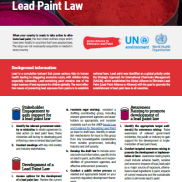
Suggested Steps for Establishing a Lead Paint Law

December 2019
copied to clipboard
This fact sheet outlines steps that have been helpful in countries that have adopted lead paint laws. The steps are not necessarily sequential or needed in every country.
Emerging Policy Issues: Lead in paint
Topics: Policymaking

Avatar