80 resources found

Infographic

Infographics on Highly Hazardous Pesticides

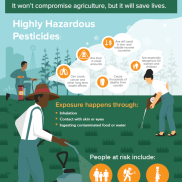
It's time to regulate Highly Hazardous Pesticides!It won’t compromise agriculture, but it will save lives.This document was prepared by WHO under the Global Environment Facility (GEF) full sized project 9771: Global best practices on emerging chemical policy issues of concern under the Strategic Approach to International Chemicals Management (SAICM). This project is funded by the GEF, implemented by UNEP and executed by the SAICM Secretariat. WHO acknowledges the financial contribution of the Global Environment Facility for the development, editing and
Emerging Policy Issues: Highly Hazardous Pesticides
Newsletter

UNEP Science Alerts - March 2019

by |
March 2020
copied to clipboard

UNEP's newsletter from March 2020 on scientific articles, research and knowledge on selected topics.TopicTitleChemicals and Waste / PollutionAdvancing environmental exposure assessment science to benefit society / A. Caplin et al. 2019. Nature.Assessment of air pollution caused by illegal e-waste burning to evaluate the human health risk / C. Gangwar et al. Environment International 125, Pages 191-199, 2019. ScienceDirect.A Comparison of hourly to annual air pollutant emissions: Implications for estimating acute exposure and public health risk / M. Stewart et al

Project document

Market Analysis of the paint industry in Indonesia (English / Bahasa)

December 2019
copied to clipboard
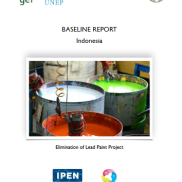
Elimination of Lead in Paint in Indonesia - Baseline Information - Indonesia’s paint marketIndonesia holds the first position as the biggest market in paint and coating in South East Asia with the 268 million population and high urbanization rate (57%). Indonesian paint and coating industry growth rate is 6% annually for the past five consecutive years. Paint and coating industry in Indonesia involves six multinational, four domestic, and large numbers of small-scale domestic producers, with the most demand from architectural
Emerging Policy Issues: Lead in paint
Topics: Policymaking
Policy document

SAICM texts and resolutions of the International Conference on Chemicals Management
September 2015
copied to clipboard
The new version of SAICM texts exists in English only and includes the resolutions adopted by ICCM at its first, second and third sessions. The older other language versions include only resolutions adopted by ICCM at its first session.New activities included in the Global Plan of ActionAt ICCM3 (17-21 September 2012), SAICM stakeholders agreed to the inclusion of new activities relating to the environmentally sound management of nanotechnologies and manufactured nanomaterials and hazardous substances within the life-cycle of electrical and
Report

Tackling informalityin e-waste management: The potential of cooperative enterprises

December 2014
copied to clipboard
The present paper is the product of a joint effort by the Sectoral Activities Depart-ment and the Cooperatives Unit of the International Labour Organization (ILO).This initiative supports the ILO’s commitment to promote forms of employment that safeguard the environment, eradicate poverty and promote social justice through sustainable enterprises and decent work, as reinforced by the International Labour Con-ference (ILC), at its 102nd session in June 2013. Electrical and electronic waste (e-waste) is currently the fastest growing waste stream, and it
Report

Environmental fate and behaviour of nanomaterials (2014) and Environmental assessment of nanomaterial use in Denmark (2015)

by
The Danish Environmental Protection Agency
|
July 2014
copied to clipboard

Both reports arose from the Danish project “NanoDEN”, commissioned by the Danish EPA.Environmental fate and behaviour of nanomaterials by Hartmann N, Skjolding L, Foss Hansen S, Gottschalk F, Baun A (2014)The report 1 provides an overview of the to date knowledge regarding processes relevant for environmental fate and behaviour of ENMs. Key environmental processes are identified, discussed and prioritized according to their relevance as inputs for fate modelling for ENMs. Furthermore, knowledge gaps are identified and prioritised with regard to

Emerging Policy Issues: Nanotechnology
Avatar