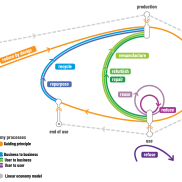
Circularity challenges the current economic model towards a sustainable future
Circular processes contributing to circularity can be grouped into 4 categories, from the most impactful to the least:
1. Reduce by design: reducing the amount of material used, particularly raw material, should be applied as an overall guiding principle from the earliest stages of design of products and services
2. From a user-to-user perspective: Refuse, Reduce and Re-use
3. From a user-to-business intermediary perspective: Repair, Refurbish and Remanufacture
4. From business-to-business: Repurpose and Recycle.
As Chemical Waste Manager I am working on Chemicals and Hazardous Waste Management problem solving skills.
I determine the compliance obligations of the environmental business and health -safety at work;
I also provide to companies the managerial,
I am coordinating UNEP’s work on eco-innovation and circularity in different sectors. Through this work I aim to help governments and businesses to identify key strategic actions and implement those – be it through integrated policy frameworks or through novel business strategies. A ground rule for the circular practices I promote through my work is that they should be implementing sound management of chemicals, and pay particular attention to chemicals of concerns, with the objective to reach a non-toxic, circular model. The end goal is that companies are able to offer more sustainable, non-toxic products and services to consumers –
I am a sustainable business consultant, researcher & cross-disciplinary strategist focusing on establishing the business case for sustainability by driving sustainable innovations in businesses and international organisations through a science based approach. With a PhD in Environmental Engineering on sustainable business model innovation perspectives (going beyond the circular economy) for the emerging electric vehicle battery second use industries, I was able to highlight shared sustainable value creations for multiple-stakeholders and thus I was able to prove the economically viable business case for sustainability in the electric vehicle industry. I apply my academic and industry background in business, environmental science, and
I work as a Programme Officer in UNEP in its Paris office. I manage projects in the areas of Life Cycle Thinking, Sustainable Consumption and Production and Circular Economy, to promote resource efficiency and pollution reduction in many sectors such as plastics, electronics, food and chemicals. In my current work, we develop methodologies and tools to quantify the environmental impacts of chemicals, to enable comparison and identification of alternatives.Feng holds a Doctorate Degree from Delft University of Technology in the Netherlands, on topics of eco-design and waste management of electronics products. Before joining UNEP, I worked as a researcher in
I am working on sustainable consumption and production and circularity in sectors such as plastics, electronics and textiles.Through my work I aim to ensure chemicals of concern are taken into consideration along the value chains of these sectors, which is also one of the pillars of UNEP's approach to promote circularity.I provide technical support to the GEF-funded project "Circular Economy approaches for the electronics sector in Nigeria". Under this project, I work with Nigerian partners and international stakeholders to promote environmentally sound treatment of hazardous chemicals in e-waste, as well as advocate best practices on the eco-design of electronic products.
As we strive towards a better world, we work to ensure chemistry’s contributions are realized. Chemistry can help us to understand, monitor, protect and improve the environment around us.
This policy brief summarizes some of the issues/options being floated for consideration by the INC negotiators, as well as two crosscutting challenges identified in the submissions that the instrument should address, namely significant information/data gaps and problematic aspects of trade.
Plastics are used across the economy and in diverse downstream sectors such as packaging, construction, transportation, healthcare, textiles, and electronics. Durable products, ranging from construction materials to medical devices make up nearly half of the global plastics market, while packaging products are the largest uses of single-use plastics. Some plastics contain chemicals that are considered to be harmful for health and the environment. Phthalates, poly-fluorinated chemicals, bisphenol A (BPA), brominated flame retardants and antimony trioxide are considered most harmful for
The Building Circularity Platform provides an understanding of the circularity concept, its scope and how it contributes to promoting sustainable consumption and production patterns. It also offers a wide range of resources and features stories illustrating how various stakeholders have successfully adopted circular approaches.