748 resources found

Report

Environmental fate and behaviour of nanomaterials (2014) and Environmental assessment of nanomaterial use in Denmark (2015)

by
The Danish Environmental Protection Agency
|
July 2014
copied to clipboard

Both reports arose from the Danish project “NanoDEN”, commissioned by the Danish EPA.Environmental fate and behaviour of nanomaterials by Hartmann N, Skjolding L, Foss Hansen S, Gottschalk F, Baun A (2014)The report 1 provides an overview of the to date knowledge regarding processes relevant for environmental fate and behaviour of ENMs. Key environmental processes are identified, discussed and prioritized according to their relevance as inputs for fate modelling for ENMs. Furthermore, knowledge gaps are identified and prioritised with regard to

Emerging Policy Issues: Nanotechnology
Academic article

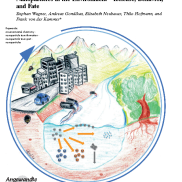
Spot the difference: engineered and natural nanoparticles in the environment—release, behavior, and fate

The production and use of nanoparticles leads to the emission of manufactured or engineered nanoparticles into the environment. Those particles undergo many possible reactions and interactions in the environment they are exposed to. These reactions and the resulting behavior and fate of nanoparticles in the environment have been studied for decades through naturally occurring nanoparticulate (1-100 nm) and colloidal (1-1000 nm) substances. The knowledge gained from these investigations is nowhere near sufficiently complete to create a detailed model of the
Emerging Policy Issues: Nanotechnology
Video

Safer Pharma | Pharmaceuticals in the environment (Russian) - Безопасное обращение с отходами лекарств

Лекарственные средства в окружающей среде являются глобальной проблемой - более 600 активных лекарственных веществ и их метаболитов обнаружены в окружающей среде во всем мире.Pharmaceuticals in the environment are a global problem – more than 600 pharmaceuticals and their metabolites have been found in the environment worldwide.They enter the environment (through water, soil, sludge, and organisms) at all stages of their life cycle and can end up in drinking water, and accumulate in fish, vegetables, and livestock.This aim of the Safer
Emerging Policy Issues: Pharmaceutical pollutants
Report

State of the Science of Endocrine Disrupting Chemicals - 2012

This document done by a group of experts for the United Nations Environment Programme and World Health Organization provides the global status of scientific knowledge on exposure to and effects of endocrine disrupting chemicals (EDCs).The work is based on the fact that endocrine systems are very similar across vertebrate species and that endocrine effects manifest themselves independently of species. The effects are endocrine system related and not necessarily species dependent. Effects shown in wildlife or experimental animals may also occur
Emerging Policy Issues: Endocrine-Disrupting Chemicals
Report

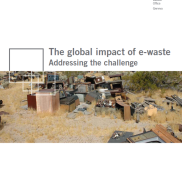
The global impact of e-waste: Addressing the challenge

December 2012
copied to clipboard
Electrical and electronic waste (e-waste) is currently the largest growing waste stream. It is hazardous, complex and expensive to treat in an environmentally sound manner, and there is a general lack of legislation or enforcement surrounding it.Today, most e-waste is being discarded in the general waste stream. Of the e-waste in developed countries that is sent for recycling, 80 per cent ends up being shipped (often illegally) to developing countries to be recycled by hundreds of thou-sands of informal workers
Report

Pharmaceuticals in drinking-water

This WHO technical report focuses on reviewing the risks to human health associated with exposure to trace concentrations of pharmaceuticals in drinking-water. Pharmaceuticals are synthetic or natural chemicals that can be found in prescription medicines, over-the-counter therapeutic drugs and veterinary drugs. Pharmaceuticals contain active ingredients that have been designed to have pharmacological effects and confer significant benefits to society. Traces of pharmaceuticals, typically at levels in the nanograms to low micrograms per litre range, have been reported in the water
Emerging Policy Issues: Pharmaceutical pollutants
Report

The impacts of endocrine disrupters on wildlife, people and their environments

The Weybridge+15 (1996-2011) technical report of the Europrean Environment Agency. Rates of endocrine diseases and disorders, such as some reproductive and developmental harm in human populations, have changed in line with the growth of the chemical industry, leading to concerns that these factors may be linked. For example, the current status of semen quality in the few European countries where studies have been systematically conducted, is very poor: fertility in approximately 40 % of men is impaired. There is also
Emerging Policy Issues: Endocrine-Disrupting Chemicals
Report

Report of the International workshop on hazardous substances within the life-cycle of electrical and electronic products, held in Vienna, from 29 to 31 March 2011

September 2011
copied to clipboard
Note by the secretariatThe secretariat has the honour to circulate, for the information of participants, the report of the International workshop on hazardous substances within the life-cycle of electrical and electronic products, held in Vienna, from 29 to 31 March 2011. The report, contained in the annex to the present note, has been transmitted by the secretariats of the Basel Convention on the Control of Transboundary Movements of Hazardous Wastes and Their Disposal and the Stockholm Convention on Persistent Organic
Avatar