748 resources found

Academic article

Endocrine disrupting compounds (EDCs) and pharmaceuticals and personal care products (PPCPs) in the aquatic environment: implications for the drinking water industry and global environmental health

by
IWA Publishing
|
February 2009
copied to clipboard
Endocrine disrupting compounds (EDCs) and pharmaceuticals and personal care products (PPCPs) are a group of chemical compounds with diverse physical and chemical properties. Recent studies have indicated undesired effects of EDCs and PPCPs at their reported trace concentrations. This paper reviews the current knowledge on the sources, properties, occurrence and health impacts of EDCs and PPCPs, and their removal from drinking water using ozonation and ozone/hydrogen peroxide-based advanced oxidation. The paper also examines the potential threats posed by these chemicals
Academic article

Occurrence, Treatment, and Toxicological Relevance of EDCs and Pharmaceuticals in Water

by
International Ozone Association
|
March 2008
copied to clipboard
Over the past decade a great amount of interest has arisen regarding the occurrence and fate of trace organic contaminants in the aquatic environment. Of particular concern are human hormones and pharmaceuticals, many of which are ubiquitous contaminants in conventional municipal wastewater treatment plant effluents when measured with ng/L detection limits. As analytical procedures and bioassay techniques become more readily available and increasingly sensitive, new contaminants will be discovered. The presence or absence of any chemical in a wastewater effluent
Policy document

SAICM Overarching Policy Strategy
by |
December 2006
copied to clipboard
The present Overarching Policy Strategy flows from the commitments expressed in the Dubai Declaration on International Chemicals Management developed in the context of the Rio Declaration, Agenda 21 and the Johannesburg Plan of Implementation.
Report

The Toxic Truth

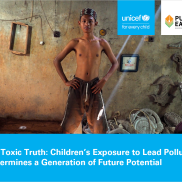
The Toxic Truth: Children’s Exposure to Lead Pollution Undermines a Generation of Future PotentialAround 1 in 3 children – up to 800 million globally – has blood lead levels at or above 5 micrograms per decilitre (µg/dL), a level that the World Health Organization and the United States Centers for Disease Control and Prevention have stated it requires global and regional interventions.This joint report by UNICEF and Pure Earth notes that lead is a potent neurotoxin that causes irreparable harm
Emerging Policy Issues: Lead in paint
Avatar