748 resources found

Academic article

Blood lead levels in low-income and middle-income countries: a systematic review

by
Elsevier
|
March 2021
copied to clipboard
Since the global phase-out of leaded petrol, reports have suggested that lead exposure remains substantial or is increasing in some low-income and middle-income countries (LMICs). However, few studies have attempted to systematically assess blood lead levels over the full range of LMICs. This study is aimed to describe values for blood lead level in LMICs.In this systematic review, PubMed was searched for studies published between Jan 1, 2010, and Oct 31, 2019, that reported blood lead levels in the 137
Emerging Policy Issues: Lead in paint
Community of practice summary of discussions

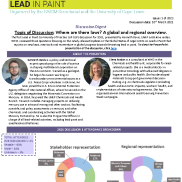
Where are there laws? A global and regional overview

The Secretariat of the Strategic Approach to Chemicals Management (SAICM) and the University of Cape Town (UCT) have established a Community of Practice (CoP) on Lead in Paint to bring representatives from different sectors together and to create a learning network around issues related to the elimination of Lead Paint. This is a summary of the discussion on Where are there laws? A global and regional overview, which took place on 10 March 2021.Presenters: Kenneth Davis (UNEP), Elena Jardan (WHO)The
Emerging Policy Issues: Lead in paint
Video

Gender equality to make mercury history

On International Women’s Day, the Secretariat of the Minamata Convention on Mercury launched a video on how women are more negatively impacted by mercury and what needs to be done to better protect, support and promote gender equality. watch the videoThe Minamata Convention tackles mercury throughout its entire life cycle, fighting gender issues every step of the way. This includes supporting gender-specific trainings and helping implement National Action Plans with a gender perspective -- with special focus on the problem
Emerging Policy Issues: Endocrine-Disrupting Chemicals
Policy document

Guidance on key considerations for the identification and selection of safer chemical alternatives

by |
March 2021
copied to clipboard
The aim of the guidance is to advance broader agreement on a general approach and criteria for the selection of safer alternatives, with a focus on chemical substitution. It is intended to advance a consistent understanding of the minimum requirements needed to determine whether a chemical alternative is safer than the priority chemical, product, or technology for substitution, independent of the entity performing the assessment or the alternatives assessment framework being used.The guidance focuses on minimum assessment criteria and recommended
Emerging Policy Issues: Chemicals in products
Video

ICCM5 Joint video message UNEP ED and German Minister for the Environment

Joint video message from Svenja Schulze, German Minister for the Environment, and Inger Andersen, Executive Director of the United Nations Environment Programme, on the Fifth session of the International Conference on Chemicals Management (ICCM5) that should have started this week in Bonn, and has been postponed because of the COVID-19 pandemic. Both call upon the international community to keep the momentum going to protect human health and the environment from the potential adverse impacts of chemicals and waste beyond 2020
Avatar