748 resources found

Project document

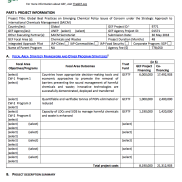
Project document: Global Best Practices on Emerging Chemical Policy Issues of Concern under the Strategic Approach to International Chemicals Management (SAICM)

Project document of Global Best Practices on Emerging Chemical Policy Issues of Concern under the Strategic Approach to International Chemicals Management (SAICM).
Academic article

Nanomaterials in the environment: Behavior, fate, bioavailability, and effects—An updated review

by
Wiley Online Library
|
April 2018
copied to clipboard
The present review covers developments in studies of nanomaterials (NMs) in the environment since our much cited review in 2008. We discuss novel insights into fate and behavior, metrology, transformations, bioavailability, toxicity mechanisms, and environmental impacts, with a focus on terrestrial and aquatic systems. Overall, the findings were that: 1) despite substantial developments, critical gaps remain, in large part due to the lack of analytical, modeling, and field capabilities, and also due to the breadth and complexity of the area
Emerging Policy Issues: Nanotechnology
Factsheets and brochures

OECD Work on Endocrine Disrupting Chemicals

by |
March 2018
copied to clipboard
The Organisation for Economic Co‑operation and Development (OECD) is a multi‑disciplinary inter governmental organisation, tracing its roots back to the post‑World War II Marshall Plan. Today, it comprises 35 member countries and the European Commission committed to democratic government and the market economy, with the major emerging economies increasingly engaged directly in the work.The Environment Directorate of the OECD helps countries design environmental policies that are both economically efficient and effective at achieving their environmental objectives.The Environment Directorate provides policy
Emerging Policy Issues: Endocrine-Disrupting Chemicals
Policy document

Gender and the sound management of chemicals and waste: Prepared for the SAICM intersessional process beyond 2020

A request was made at the first intersessional meeting for information on the relationship between women and chemical safety as it relates to emerging policy issues and issues of concern, covering in particular the period beyond 2020. The Bureau agreed at its May 2017 meeting for the secretariat to prepare a paper, for the second intersessional meeting, that reviews the broader concept of gender and the sound management of chemicals and waste, in line with the 2030 Agenda for Sustainable
Report

Gender and Chemicals: Questions, Issues and Possible Entry Points

The present paper was produced as part of the project: "Gender and Chemicals: Issues, Stakeholders, Strategies", conducted by the MSP Institute in 2017. We reviewed relevant literature and international policy making processes, and conducted 20 expert interviews between May and October 2017.
Manuals and toolkits

Handbook on Sustainable Public Procurement - Integration Sustainability Criteria into Public Procurement Procedures for Paints and Varnishes, Cleaning Products, Heat Insulation Materials

November 2017
copied to clipboard
Public Procurement is closely interconnected with an implementation of the sustainable development goals on the practice. Given priority to environmentally friendly products and environmentally safety services, which comply with green standards and rules, is an efficient tool in solving of many economic, environmental and social challenges at different levels.This handbook contains a basic information about benefits and advantages of the sustainable public procurement for government and public authorities; a step–by–step explanations how to transform a procurement process into sustainable one
Emerging Policy Issues: Chemicals in products
Report

Study on Knowledge Management and Information Sharing for the Sound Management of Industrial Chemicals

Knowledge and information sharing are critical components of the SAICM goal. Since the inception of SAICM, there have been advances in the availability and quality of chemical safety information. However, information gaps remain and there is a large discrepancy in the understanding of the number of chemicals in commerce amongst the various stakeholders. There is a need to draw upon experiences from various regulatory approaches that exist across the globe to have a better understanding and collective overview. The current
Avatar