46 resources found

E-learning

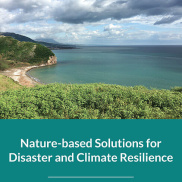
Massive Open Online Course on Nature-based Solutions for Disaster and Climate Resilience

by |
January 2021
copied to clipboard
Who is the course aimed at?Nature offers many solutions to reduce the impacts of disasters and climate change, such as protecting forests on steep slopes, maintaining sand dunes along coastline and wetlands to buffer excess rainwater. In this course, find out how people around the world are building resilience to disasters and climate change impacts through Nature-based Solutions.This course will help you understand how to apply these Nature-based Solutions that restore or protect natural or modified ecosystems and biodiversity and
Database

Special programme projects database
by |
January 2021
copied to clipboard

The Special Programme has successfully processed three rounds of applications since its inception in 2015. The Programme is currently funding projects from 42 countries. You can explore the projects through our Projects Database.Use the tool below to discover more about projects that have been funded by the Special Programme. It provides an overview of the activities each project has been undertaking to implement the Basel, Rotterdam and Stockholm Conventions, the Minamata Convention and SAICM. It also categorizes the objectives of

Database

Chemical Entities of Biological Interest

by
European Bioinformatics Institute
|
January 2021
copied to clipboard
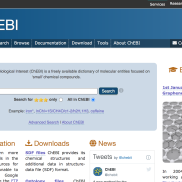
Chemical Entities of Biological Interest, also known as ChEBI is a chemical database and ontology of molecular entities focused on 'small' chemical compounds, that is part of the Open Biomedical Ontologies (OBO) effort at the European Bioinformatics Institute (EBI).The term "molecular entity" refers to any "constitutionally or isotopically distinct atom, molecule, ion, ion pair, radical, radical ion, complex, conformer, etc., identifiable as a separately distinguishable entity". The molecular entities in question are either products of nature or synthetic products which
Database

Chemical Awareness toolkit

What is CAt and where does all the data come from?The Chemical Awareness toolkit (CAt) is a free web application that provides rapid access to chemical information for product stewards, risk assessors, toxicologists, chemists, microbiologists, engineers, and other researchers. It includes screening tools that provide chemical information including toxicological hazards, environmental fate, persistence & bioaccumulation, occupational exposure limits, government regulations, and public perception.CAt utilizes an integrated database containing information from key lists provided by Verisk 3E, publicly available lists, databases
Emerging Policy Issues: Chemicals in products
E-learning

Massive Open Online Course on Marine Litter

UN Environment Programme and Open Universiteit have created a Massive Open Online Course (MOOC) on Marine Litter as a key activity of the Global Partnership on Marine Litter (you can join the GPML). It is also part of the Clean Seas Campaign. The course starts on October 26, 2020. It is free for all students and available in 10 different languages. You can still enroll until November 15. Register here!Marine litter is a global problem that affects every ocean of
Database

IOMC Toolbox

IOMC Toolbox for decision making in chemicals management The IOMC Toolbox has been redesigned to provide easier and more direct access to 8 management schemes, 6 toolkits, and more than 500 IOMC tools, guidance documents, and training materials. This new and improved platform enables users to access information with fewer steps and clicks.The IOMC Internet-based Toolbox for Decision Making in Chemicals Management (IOMC Toolbox) is aimed at countries who wish to address specific national issues regarding chemicals management.The IOMC Toolbox
E-learning

Earth School
Today, over 1.5 billion children are unable to go to school. Coronavirus’ impact goes beyond the health and economic crisis; it is also jeopardizing the education of students around the world.Teachers are scrambling to offer students lessons online and parents are desperate for activities that will keep their kids engaged and connected to the outside world.In response to this crisis, an unprecedented coalition of over fifty environmental and education experts are collaborating to launch The Earth School: 30 adventures for
E-learning

Updated course on the Minamata Convention on Mercury

Mercury is a heavy metal that occurs naturally but can also be released into air, water, and soil through anthropogenic activities such as mining, metal and cement production, and combustion of fossil fuels. It is highly toxic and persistent in the environment. It can be transported in the atmosphere great distances, and can enter the food chain and accumulate in flora and fauna.This free and self-paced course introduces you to the Minamata Convention on Mercury, which seeks to protect human
Avatar