72 resources found

Academic article

Artificial Intelligence for chemical risk assessment
by
Elsevier
|
February 2020
copied to clipboard
As the basis for managing the risks of chemical exposure, the Chemical Risk Assessment (CRA) process can impact a substantial part of the economy, the health of hundreds of millions of people, and the condition of the environment. However, the number of properly assessed chemicals falls short of societal needs due to a lack of experts for evaluation, interference of third party interests, and the sheer volume of potentially relevant information on the chemicals from disparate sources.In order to explore
Academic article

How to Get Beyond the Zero-Sum Game Mentality between State and Non-State Actors in International Environmental Governance
by
Columbia University
|
January 2020
copied to clipboard
This paper examines one specific theme of the democracy-environment interface of environmental governance: the participation of stakeholders in environmental policy formulation and implementation.After a short discussion of environmental governance, its main functions and challenges, the paper addresses the issue of stakeholder participation and the claim of a “democratic deficit” in international environmental governance. It stresses that while stakeholder involvement does not increase the democratic legitimacy, it may nevertheless increase the quality and through this the legitimacy of environmental policy processes
Academic article

Rethinking chemistry for a circular economy

by
ScienceDirect
|
January 2020
copied to clipboard
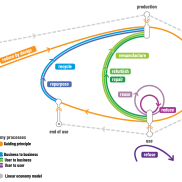
Earth is running out of resources needed for manufacturing materials such as chemicals, minerals, and petroleum. Thus, these components are available only at increasing economic and environmental costs. As an important contribution to a sustainable future, chemistry and its products must be adapted to a circular economy (CE)—a system aimed at eliminating waste, circulating and recycling products, and saving resources and the environment.Nearly 140,000 industrial chemicals are marketed worldwide, and new chemicals are becoming more complex (e.g., stereochemistry, functional groups)
Emerging Policy Issues: Chemicals in products
Website

Building Circularity Platform

The Building Circularity Platform provides an understanding of the circularity concept, its scope and how it contributes to promoting sustainable consumption and production patterns. It also offers a wide range of resources and features stories illustrating how various stakeholders have successfully adopted circular approaches.
Emerging Policy Issues: Chemicals in products
Website

Society of Environmental Toxicology and Chemistry Website

Website of SETAC, Society of Environmental Toxicology and ChemistrySETAC is a not-for-profit, worldwide professional organization composed of more than 5,300 individuals and institutions in over 90 countries dedicated to the study, analysis and solution of environmental problems, the management and regulation of natural resources, research and development and environmental education. SETAC’s mission is to support the development of principles and practices for protection, enhancement and management of sustainable environmental quality and ecosystem integrity.
Website

Nanotechnology at the German Environment Agency (UBA)

by
UBA
|
November 2019
copied to clipboard
The German Environment Agency (UBA) webpage on nanotechnology indicates its activities and opinions as well as research efforts with regard to adequate regulation and safety assessment of manufactured nanomaterials and highlights relevant topics, actors, programs and networks including providing relevant links. Current research supervised by UBA is presented and finalized research is published as reports at this webpage.
Emerging Policy Issues: Nanotechnology
Academic article

Preventing disease through healthy environments: exposure to lead: a major public health concern

November 2019
copied to clipboard
This WHO policy brief presents the consequences of lead exposure on human health and details its toxicity in the body system explaining why it is important to reduce the use and releases of lead, and to reduce environmental and occupational exposures, particularly for children and women of childbearing age.The policy brief also lists the sources of lead releases and contamination in industrial process, drinking water and domestic sources. The brief also gives guidelines for tolerable intake levels of lead and
Emerging Policy Issues: Lead in paint
Avatar