68 resources found

Factsheets and brochures

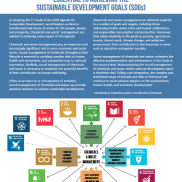
Chemicals and waste management: essential to achieving the Sustainable Development Goals (SDGs)

by |
October 2019
copied to clipboard
In adopting the 17 Goals of the 2030 Agenda for Sustainable Development, world leaders outlined a transformational course of action for the people, planet, and prosperity. Chemicals and waste management are related to achieving every aspect of this Agenda.Chemicals and waste management play an important and increasingly significant role in every economic and social sector. Sound management of chemicals throughout their lifecycle is essential to avoiding complex risks to human health and ecosystems, and substantial costs to national economies. Similarly
Factsheets and brochures

Lead poisoning and health

This factsheet compiles the latest information on the effects of lead on human health. It is presented in the 6 UN languages.The factsheet lists the Key Facts, and describes the Sources and routes of exposure, the Health effects of lead poisoning on children, and the WHO response. The factsheet also points to relevant related websites.
Emerging Policy Issues: Lead in paint
Policy document

Knowledge Management and Information Sharing for the Sound Management of Industrial Chemicals

«Knowledge and Information» is one of the five Strategic Objectives of SAICM.SAICM’s Overarching Policy Strategy recognizes that knowledge, information and public awareness are the foundations of sound decision-making, on the management of chemicals and products containing chemicals. However, the Policy Strategy also under-lines that there is a lack of clear, timely and appro-priate information easily accessible to local popula-tions about the health and safety effects of chemi-cals.It is for this reason, that knowledge and information sharing are critical components of
Factsheets and brochures

Pollinators and Pesticides - Keeping our bees safe

Pollination is the transfer of pollen between the male and female parts of flowers to enable fertilization and reproduction. The majority of cultivated and wild plants depend on animal vectors, known as pollinators, to transfer pollen. However, other means of pollen transfer such as self-pollination or wind-pollination are also important. Pollinators comprise a diverse group of animals dominated by insects, especially bees. More than 75% of the leading types of global good crops are visited by animal pollinators, such as
Emerging Policy Issues: Highly Hazardous Pesticides
Policy document

Revised Guidance Document 150 on Standardised Test Guidelines for Evaluating Chemicals for Endocrine Disruption

by |
September 2018
copied to clipboard
The OECD releases the Revised Guidance Document 150 on Standardised Test Guidelines for Evaluating Chemicals for Endocrine Disruption originally published in 2012 and updated in 2018 to reflect new and updated OECD test guidelines, as well as reflect on scientific advances in the use of test methods and assessment of the endocrine activity of chemicals. The document is intended to provide guidance for evaluating chemical using standardised test guidelines. Specific objectives include providing a description of the OECD conceptual framework
Emerging Policy Issues: Endocrine-Disrupting Chemicals
Policy document

Gender and the sound management of chemicals and waste

by |
September 2018
copied to clipboard
“Gender mainstreaming” is defined as a strategy for making both men and women’s concerns and experiences an integral part of policies and programmes in all political, economic and societal spheres.In practice, gender mainstreaming supports the contribution of men and women to society equally, through policies and programmes that address their specific needs. The Sustainable Development Goals (SDGs) of the 2030 Agenda aim to address inequalities among all population groups, especially women, children, and the impoverished. Directly addressing the links between
Emerging Policy Issues: Chemicals in products
Factsheets and brochures

OECD Work on Endocrine Disrupting Chemicals

by |
March 2018
copied to clipboard
The Organisation for Economic Co‑operation and Development (OECD) is a multi‑disciplinary inter governmental organisation, tracing its roots back to the post‑World War II Marshall Plan. Today, it comprises 35 member countries and the European Commission committed to democratic government and the market economy, with the major emerging economies increasingly engaged directly in the work.The Environment Directorate of the OECD helps countries design environmental policies that are both economically efficient and effective at achieving their environmental objectives.The Environment Directorate provides policy
Emerging Policy Issues: Endocrine-Disrupting Chemicals
Policy document

Gender and the sound management of chemicals and waste: Prepared for the SAICM intersessional process beyond 2020

A request was made at the first intersessional meeting for information on the relationship between women and chemical safety as it relates to emerging policy issues and issues of concern, covering in particular the period beyond 2020. The Bureau agreed at its May 2017 meeting for the secretariat to prepare a paper, for the second intersessional meeting, that reviews the broader concept of gender and the sound management of chemicals and waste, in line with the 2030 Agenda for Sustainable
Avatar