105 resources found

Academic article

Endocrine-disrupting chemicals: economic, regulatory, and policy implications

by
ScienceDirect
|
July 2020
copied to clipboard
Endocrine-disrupting chemicals (EDCs) substantially cost society as a result of increases in disease and disability but—unlike other toxicant classes such as carcinogens—have yet to be codified into regulations as a hazard category.This Series paper examines economic, regulatory, and policy approaches to limit human EDC exposures and describes potential improvements. In the EU, general principles for EDCs call for minimisation of human exposure, identification as substances of very high concern, and ban on use in pesticides. In the USA, screening and
Emerging Policy Issues: Endocrine-Disrupting Chemicals
Academic article

Life cycle based alternatives assessment (LCAA) for chemical substitution

by
Green Chemistry
|
July 2020
copied to clipboard
AbstractThe world faces an increasing need to phase out harmful chemicals and design sustainable alternatives across various consumer products and industrial applications. Alternatives assessment is an emerging field focusing on identifying viable solutions to substitute harmful chemicals. However, current methods fail to consider trade-offs from human and ecosystem exposures, and from impacts associated with chemical supply chains and product life cycles. To close this gap, we propose a life cycle based alternatives assessment (LCAA) framework for consistently integrating quantitative exposure
Academic article

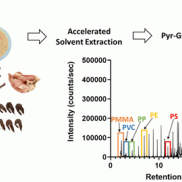
Quantitative Analysis of Selected Plastics in High-Commercial-Value Australian Seafood by Pyrolysis Gas Chromatography Mass Spectrometry

by
American Chemical Society
|
July 2020
copied to clipboard
Microplastic contamination of the marine environment is widespread, but the extent to which the marine food web is contaminated is not yet known. The aims of this study were to go beyond visual identification techniques and develop and apply a simple seafood sample cleanup, extraction, and quantitative analysis method using pyrolysis gas chromatography mass spectrometry to improve the detection of plastic contamination.This method allows the identification and quantification of polystyrene, polyethylene, polyvinyl chloride, polypropylene, and poly (methyl methacrylate) in the
Emerging Policy Issues: Chemicals in products
Report

Report of the 2019 International Lead poisoning Prevention Week

From 20 to 26 October 2019 the seventh International Lead Poisoning Prevention Week of action (ILPPW) took place in countries around the world. This report describes some of the activities held during the week. As with earlier years, the Global Alliance to Eliminate Lead Paint (the Lead Paint Alliance) provided a campaign resource package and a range of multilingual campaign materials. All the materials were made available from the World Health Organization (WHO) website.
Emerging Policy Issues: Lead in paint
Report

The Illegal Trade in Chemicals

This novel publication provides an overview of the knowledge gap and enforcement challenges in the illegal trade of toxic, hazardous and severely restricted chemicals, as well as in non-existing or low areas of chemical regulations.Chemicals surround us in our daily lives providing benefit to people and society. However, chemicals can contaminate all components of ecosystems and are implicated in a range of acute and chronic health problems. Though a range of guidelines now govern the trade in chemicals, many remain
Report

Sustainable Fashion? How companies provide sustainability information to consumers

by
HEJSupport International
|
March 2020
copied to clipboard
The new report “Sustainable Fashion? How companies provide sustainability information to consumers” by HEJSupport touches upon gaps in the current provision of product sustainability information to consumers, with the aim of suggesting a way forward which makes consumers a driving force able to shape the future of sustainable textiles.The report provides recommendations for business, policy makers and consumers.The sustainability of the fashion industry largely depends on the work of regulators and product manufacturers, including their suppliers. But very often the
Emerging Policy Issues: Chemicals in products
Academic article

Artificial Intelligence for chemical risk assessment

by
Elsevier
|
February 2020
copied to clipboard
As the basis for managing the risks of chemical exposure, the Chemical Risk Assessment (CRA) process can impact a substantial part of the economy, the health of hundreds of millions of people, and the condition of the environment. However, the number of properly assessed chemicals falls short of societal needs due to a lack of experts for evaluation, interference of third party interests, and the sheer volume of potentially relevant information on the chemicals from disparate sources.In order to explore
Academic article

How to Get Beyond the Zero-Sum Game Mentality between State and Non-State Actors in International Environmental Governance

by
Columbia University
|
January 2020
copied to clipboard
This paper examines one specific theme of the democracy-environment interface of environmental governance: the participation of stakeholders in environmental policy formulation and implementation.After a short discussion of environmental governance, its main functions and challenges, the paper addresses the issue of stakeholder participation and the claim of a “democratic deficit” in international environmental governance. It stresses that while stakeholder involvement does not increase the democratic legitimacy, it may nevertheless increase the quality and through this the legitimacy of environmental policy processes
Avatar