101 resources found

healthy_hospitals
Website

Healthy Hospitals

Full set of resources from the Healthy Hospitals program which includes:

  • Step-by-step resources that will make it simpler for any hospital or health care organization to design, implement, and measure the success of their chemical reduction efforts;
  • Guidance on healthier flooring, carpet and interiors products;
  • Links to criteria documents and lists of products that meet the HH goals.
Emerging Policy Issues: Chemicals in products
greenny
Website

GreenNY Specification: Adhesives

Green public procurement specification for general construction and flooring adhesives. The goal of the specification is to set a hierarchy of preferences for connecting materials together and to encourage the use of adhesives that have fewer health and environmental hazards in order to create a healthier indoor environment during both construction and building occupancy.

Emerging Policy Issues: Chemicals in products
sustainable-chemicals-strategy
Report

A chemicals strategy for a sustainable chemicals revolution

December 2022
copied to clipboard

Chemicals production and consumption is set to double by 2030, from a $5 trillion industry globally in 2017, with production set to increase, mainly in emerging economies. If chemicals production is doubled, chemical pollution must not double as a consequence – rather we should aim to significantly reduce it from current levels.

Current international attempts at the massive undertaking of addressing chemical pollution are not working. For the world to solve the major environmental and health challenges we face, there must be a sustainable chemicals revolution. We can only achieve this through senior-level engagement with the chemical sciences community through an authoritative, intergovernmental science-policy interface.

The Royal Society of Chemistry engaged with scientists in their community to develop the vision for a chemicals strategy, relevant to any nation in principle.  Four pillars were identified on which any chemicals strategy has to be based: education, innovation, circular economy and regulation. National governments must invest in these areas and create a responsible framework of action for chemicals management.

Emerging Policy Issues: Chemicals in products
Country: United Kingdom
T4%20size%20shutterstock
Website

OECD Substitution and Alternatives Assessment Toolbox

by |
December 2022
copied to clipboard

As interest in the substitution of harmful chemicals continues to grow in industry, NGOs and the public sector, organisations are seeking guidance on the conduction of alternatives assessment and for the selection of appropriate methods and tools. The OECD is responding to this need by developing guidance documents, sharing experiences through workshops and by collecting available resources.

Emerging Policy Issues: Chemicals in products
SIXCLASSES_LOGO
Website

Six Classes

December 2022
copied to clipboard

The Six Classes is a visionary program of the Green Science Policy Institute, whose aim is to reduce the use of harmful chemicals in consumer and other products. It focuses on entire classes or groups of chemicals of concern, rather than phasing out problematic chemicals one at a time.

This approach of tackling entire groups of chemicals is needed because more than 80,000 chemicals are used in the U.S. Many have not been well studied and their impacts on human and environmental health are not understood. Even so, some chemicals known to be harmful are commonly found in consumer products. Moreover, when a harmful chemical is phased out, often after years of research and advocacy, the replacement may be a “chemical cousin” with similar structure and potential for harm.

The Six Classes approach can prevent such “regrettable substitutions” and accelerate reductions in toxics use.

In its work on each of the Six Classes, the Green Science Policy Institute convenes scientific experts, motivates needed studies, and publishes research results in peer-reviewed journals. Its findings are communicated widely, as part of its work for science-based change and for moving towards safer chemicals and/or technologies. A key element of the approach is to bring together scientists and decision-makers from business, government, academia, and nonprofits to develop coordinated strategies for reducing the production and use of chemicals of concern.

Emerging Policy Issues: Chemicals in products
Circular_Economy_Electronics_Central_Eastern_Europe
Report

Toward a Circular Economy for the Electronics Sector in Central and Eastern Europe: Overview, Actions and Recommendations

by |
December 2022
copied to clipboard

This report provides an overview of the current status and conditions of the Circular Economy in the electronics value chain in the Central and Eastern Europe (CEE) region, identifies key areas of concern, provides appropriate recommendations, and proposes priority actions to improve circularity of the sector. The recommendations and roadmap focus on the individual life cycle stages of the electronics value chain, as well as on aspects that cut across the value chain. The transition towards a more circular electronics sector in Central and Easter Europe (CEE) would require a holistic and coordinated approach to progress toward a more circular electronics value chain in the CEE region.

This publication was prepared under the framework of the Global Environment Facility (GEF) full-sized project 9771: Global best practices on emerging chemical policy issues of concern under the Strategic Approach to International Chemicals Management (SAICM). This project is funded by the GEF, implemented by UNEP and executed by the SAICM Secretariat.

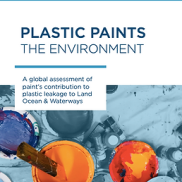
Plastic paints the Environment
Report

Plastic Paints the Environment

February 2022
copied to clipboard

This report provides a global assessment of the level of plastic paint leakage worldwide.

It is based on the baseline year 2019 with a global paint demand of 52 Mt, that included 19.5 Mt of plastics and distributed across different sectors: Architectural, Marine, Road Marking, General Industrial, Automotive and Industrial Wood and Others.

Emerging Policy Issues: Chemicals in products
Avatar