77 resources found

Infographic

Interactive country profiles

February 2020
copied to clipboard
ContextTo address the recognized deficiencies mentioned above, it’s essential to have a ‘chemicals ecosystem (SAICM ecosystem)’ in which relevant information can be shared transparently and easy to obtain. In this ‘chemicals ecosystem’, a holistic chemicals-information-sharing hub, serving as ‘database’ and ‘scanner’ on chemicals management, should be developed to provide connection on knowledge and information from a wide variety of sources and allow stakeholders to identify their gaps on the way towards the sound management of chemicals and waste. Last but
Report

Pharmaceutical Residues in Freshwater: Hazards and Policy Responses

by |
November 2019
copied to clipboard
Pharmaceutical Residues in Freshwater: Hazards and Policy ResponsesThis report calls for a better understanding of the effects of pharmaceutical residues in the environment, greater international collaboration and accountability distribution, and policy actions to prevent and remedy emerging concerns. Laboratory and field tests show traces of oral contraceptives causing the feminisation of fish and amphibians, and residues of psychiatric drugs altering fish behaviour. Antimicrobial resistance, linked to the overuse of antibiotics, has rapidly escalated into a global health crisis. Unless adequate
Report

Global Chemicals Outlook II: From Legacies to Innovative Solutions

by |
April 2019
copied to clipboard
The Global Chemicals Outlook II – From Legacies to Innovative Solutions: Implementing the 2030 Agenda for Sustainable Development, mandated by the UN Environment Assembly in 2016, seeks to alert policymakers and other stakeholders to the critical role of the sound management of chemicals and waste in sustainable development. It takes stock of global trends as well as progress made and gaps in achieving the global goal to minimize the adverse impacts from chemicals and waste by 2020.Part I of the
Emerging Policy Issues: Chemicals in products
Report

Gender & SAICM Beyond 2020: How to create a gender-just healthy planet

The present publication was produced as part of the project: "Gender and Chemicals - Together for a gender-just healthy planet", conducted by the MSP Institute in 2019.There is a number of gender aspects relevant to chemicals and chemicals and waste management. However, many of them are not receiving the attention they should in order to ensure the best possible decisions in policy-making and effective implementation.The goal of this report is to increase the integration of gender in international chemicals and
Report

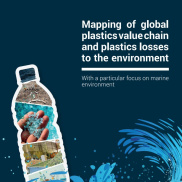
Mapping of Global Plastics Value Chain and Plastics Losses to the Environment: With a Particular Focus on Marine Environment

by |
November 2018
copied to clipboard
Plastics have become one of the most ubiquitous materials used globally, and global production has on average increased by about 9% per year since 1950.The plastic industry has become a major economic actor with revenue of about 1,722 billion Euros in 2015. The issue of plastics ending up in the oceans and harming marine lifeforms has been known since the 1970s. Research focusing on the impacts associated with exposure of organisms to marine micro and macroplastics has been ongoing for
Emerging Policy Issues: Chemicals in products
Report

Gender and Chemicals: Questions, Issues and Possible Entry Points

The present paper was produced as part of the project: "Gender and Chemicals: Issues, Stakeholders, Strategies", conducted by the MSP Institute in 2017. We reviewed relevant literature and international policy making processes, and conducted 20 expert interviews between May and October 2017.
Report

Study on Knowledge Management and Information Sharing for the Sound Management of Industrial Chemicals

Knowledge and information sharing are critical components of the SAICM goal. Since the inception of SAICM, there have been advances in the availability and quality of chemical safety information. However, information gaps remain and there is a large discrepancy in the understanding of the number of chemicals in commerce amongst the various stakeholders. There is a need to draw upon experiences from various regulatory approaches that exist across the globe to have a better understanding and collective overview. The current
Avatar