61 resources found

Academic article

How to Get Beyond the Zero-Sum Game Mentality between State and Non-State Actors in International Environmental Governance
by
Columbia University
|
January 2020
copied to clipboard
This paper examines one specific theme of the democracy-environment interface of environmental governance: the participation of stakeholders in environmental policy formulation and implementation.After a short discussion of environmental governance, its main functions and challenges, the paper addresses the issue of stakeholder participation and the claim of a “democratic deficit” in international environmental governance. It stresses that while stakeholder involvement does not increase the democratic legitimacy, it may nevertheless increase the quality and through this the legitimacy of environmental policy processes
Academic article

Rethinking chemistry for a circular economy

by
ScienceDirect
|
January 2020
copied to clipboard
Earth is running out of resources needed for manufacturing materials such as chemicals, minerals, and petroleum. Thus, these components are available only at increasing economic and environmental costs. As an important contribution to a sustainable future, chemistry and its products must be adapted to a circular economy (CE)—a system aimed at eliminating waste, circulating and recycling products, and saving resources and the environment.Nearly 140,000 industrial chemicals are marketed worldwide, and new chemicals are becoming more complex (e.g., stereochemistry, functional groups)
Emerging Policy Issues: Chemicals in products
Academic article

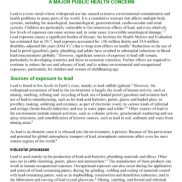
Preventing disease through healthy environments: exposure to lead: a major public health concern

November 2019
copied to clipboard
This WHO policy brief presents the consequences of lead exposure on human health and details its toxicity in the body system explaining why it is important to reduce the use and releases of lead, and to reduce environmental and occupational exposures, particularly for children and women of childbearing age.The policy brief also lists the sources of lead releases and contamination in industrial process, drinking water and domestic sources. The brief also gives guidelines for tolerable intake levels of lead and
Emerging Policy Issues: Lead in paint
Academic article

Antimicrobial pharmaceuticals in the aquatic environment - occurrence and environmental implications

by
ScienceDirect
|
November 2019
copied to clipboard
The environmental occurrence of antimicrobial pharmaceuticals and antibiotic resistant bacteria and antibiotic resistant genes has become a global phenomenon and a multifaceted threat. Integrated actions of many parties are needed to prevent further aggravation of the problem. Well-directed actions require clear understanding of the problem, which can be ensured by frequent revaluation of the existing knowledge and disseminating it among relevant audiences. The goal of this review paper is to discuss the occurrence and abundance of antimicrobial pharmaceuticals in the
Emerging Policy Issues: Pharmaceutical pollutants
Video

Be the change beyond 2020 for the sound management of chemicals and waste!

Curtain raising video of the third meeting of the intersessional process held at the United Nations Conference Centre in Bangkok, Thailand, from 1 to 4 October 2019. Regional meetings and technical briefings took place on 30 September 2019. These meetings support stakeholders in their efforts to elaborate the future arrangements of the Strategic Approach and the sound management of chemicals and waste beyond 2020 for consideration and adoption at the next session of the International Conference on Chemicals Management (ICCM5)
Video

Global Chemicals Outlook 2019

The Global Chemicals Outlook II – From Legacies to Innovative Solutions: Implementing the 2030 Agenda for Sustainable Development, mandated by the UN Environment Assembly in 2016, seeks to alert policymakers and other stakeholders to the critical role of the sound management of chemicals and waste in sustainable development. It takes stock of global trends as well as progress made and gaps in achieving the global goal to minimize the adverse impacts from chemicals and waste by 2020. The Global Chemicals
Avatar