61 resources found

Academic article

Endocrine-disrupting chemicals: economic, regulatory, and policy implications

by
ScienceDirect
|
July 2020
copied to clipboard
Endocrine-disrupting chemicals (EDCs) substantially cost society as a result of increases in disease and disability but—unlike other toxicant classes such as carcinogens—have yet to be codified into regulations as a hazard category.This Series paper examines economic, regulatory, and policy approaches to limit human EDC exposures and describes potential improvements. In the EU, general principles for EDCs call for minimisation of human exposure, identification as substances of very high concern, and ban on use in pesticides. In the USA, screening and
Emerging Policy Issues: Endocrine-Disrupting Chemicals
Academic article

Life cycle based alternatives assessment (LCAA) for chemical substitution

by
Green Chemistry
|
July 2020
copied to clipboard
AbstractThe world faces an increasing need to phase out harmful chemicals and design sustainable alternatives across various consumer products and industrial applications. Alternatives assessment is an emerging field focusing on identifying viable solutions to substitute harmful chemicals. However, current methods fail to consider trade-offs from human and ecosystem exposures, and from impacts associated with chemical supply chains and product life cycles. To close this gap, we propose a life cycle based alternatives assessment (LCAA) framework for consistently integrating quantitative exposure
Academic article

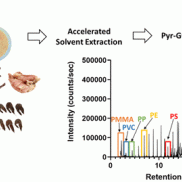
Quantitative Analysis of Selected Plastics in High-Commercial-Value Australian Seafood by Pyrolysis Gas Chromatography Mass Spectrometry

by
American Chemical Society
|
July 2020
copied to clipboard
Microplastic contamination of the marine environment is widespread, but the extent to which the marine food web is contaminated is not yet known. The aims of this study were to go beyond visual identification techniques and develop and apply a simple seafood sample cleanup, extraction, and quantitative analysis method using pyrolysis gas chromatography mass spectrometry to improve the detection of plastic contamination.This method allows the identification and quantification of polystyrene, polyethylene, polyvinyl chloride, polypropylene, and poly (methyl methacrylate) in the
Emerging Policy Issues: Chemicals in products
Academic article

Artificial Intelligence for chemical risk assessment

by
Elsevier
|
February 2020
copied to clipboard
As the basis for managing the risks of chemical exposure, the Chemical Risk Assessment (CRA) process can impact a substantial part of the economy, the health of hundreds of millions of people, and the condition of the environment. However, the number of properly assessed chemicals falls short of societal needs due to a lack of experts for evaluation, interference of third party interests, and the sheer volume of potentially relevant information on the chemicals from disparate sources.In order to explore
Video

SAICM Emerging Policy Issues Video

Have you ever noticed how many chemicals shape people’s daily lives? They keep homes sparkling clean, boost food production, and are included in virtually all manufactured goods surrounding you right now. Chemicals drive the economy but as we produce more than ever before, they have to deliver their benefits without damaging our health and environment.Toxic lead paint for example is still used in many regions of the world and Highly hazardous pesticides continue to poison agricultural workers and contaminate the
Video

SAICM Perflourinated Chemicals Video

Perflourinated Chemicals (PFCs) are the key ingredient in many stain, water and grease repellent coatings that make outdoor jackets water tight and frying pans non sticky. These chemicals consist of long molecules that contain carbon chains surrounded by fluorine. That bond between carbon and fluorine is incredibly tight. They interact so strongly with each other that the normal, inter-molecular forces, that cause substances to stick to each other, don’t stand a chance.While some types of PFCs are either safe or
Emerging Policy Issues: Perfluorinated Chemicals
Video

SAICM Environmentally Persistent Pharmaceuticals Pollutants Video

Pharmaceuticals are chemicals we specifically design to act on living cells. They regulate, in organisms, hormonal balance and the way it metabolizes its nutrients. Pharmaceuticals even change the way signals travel between cells. In order to work, many drugs have to resist the stomach’s acid environment, so the compounds can reach their destination inside the body. That’s why they are formulated to degrade very slowly or not at all. When active pharmaceuticals pass through our bodies and enter the environment
Emerging Policy Issues: Pharmaceutical pollutants
Video

SAICM Highly Hazardous Pesticides Video

We use a wide variety of chemical compounds to prevent living organisms from damaging crops and spreading diseases like malaria. These compounds are collectively termed pesticides. These days the majority of pesticides have low to moderate acute toxicity. But despite their many positive developments, there remain a small but significant group of Highly Hazardous Pesticides that cause illness and environmental damage.Not only because they are very toxic, but also because they remain active for a long time after being released
Emerging Policy Issues: Highly Hazardous Pesticides

Avatar