145 resources found

Report

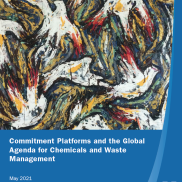
Commitment platforms and the global agenda for chemicals and waste management
Problem statementOne of functions of the of the Strategic Approach to International Chemicals Management (SAICM) is to call for appropriate action on emerging policy issues as they arise and to forge consensus on priorities for cooperative action as identified in the paragraph 24 of the Overarching Policy Strategy (OPS). In 2015, the Fourth International Conference on Chemicals Management (ICCM-4) initiated the development of the framework for sound management of chemicals and waste beyond 2020 that is envisaged to be adopted
Community of practice summary of discussions

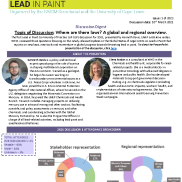
Where are there laws? A global and regional overview

The Secretariat of the Strategic Approach to Chemicals Management (SAICM) and the University of Cape Town (UCT) have established a Community of Practice (CoP) on Lead in Paint to bring representatives from different sectors together and to create a learning network around issues related to the elimination of Lead Paint. This is a summary of the discussion on Where are there laws? A global and regional overview, which took place on 10 March 2021.Presenters: Kenneth Davis (UNEP), Elena Jardan (WHO)The
Emerging Policy Issues: Lead in paint
Community of practice summary of discussions

Industry initiative and information sharing on chemicals in products in the supply chain

February 2021
copied to clipboard
The SAICM Secretariat, in partnership with the University of Cape Town, established a community of practice on Chemicals in Products to bring representatives from different sectors together and to create a learning network around issues related to addressing Chemicals in Products (CiP). This is a summary of the discussion on Industry initiative and information sharing on chemicals in products in the supply chain, which took place on 18 February 2021.Presenter: Timo Unger (Hyundai)As engineer for Recycling Technology by training, Timo
Emerging Policy Issues: Chemicals in products
Database

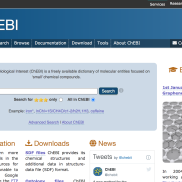
Chemical Entities of Biological Interest

by
European Bioinformatics Institute
|
January 2021
copied to clipboard
Chemical Entities of Biological Interest, also known as ChEBI is a chemical database and ontology of molecular entities focused on 'small' chemical compounds, that is part of the Open Biomedical Ontologies (OBO) effort at the European Bioinformatics Institute (EBI).The term "molecular entity" refers to any "constitutionally or isotopically distinct atom, molecule, ion, ion pair, radical, radical ion, complex, conformer, etc., identifiable as a separately distinguishable entity". The molecular entities in question are either products of nature or synthetic products which
Database

Chemical Awareness toolkit

What is CAt and where does all the data come from?The Chemical Awareness toolkit (CAt) is a free web application that provides rapid access to chemical information for product stewards, risk assessors, toxicologists, chemists, microbiologists, engineers, and other researchers. It includes screening tools that provide chemical information including toxicological hazards, environmental fate, persistence & bioaccumulation, occupational exposure limits, government regulations, and public perception.CAt utilizes an integrated database containing information from key lists provided by Verisk 3E, publicly available lists, databases
Emerging Policy Issues: Chemicals in products
Factsheets and brochures

Case studies on the implementation of the WHO Chemicals Road Map

The World Health Organization is publishing a series of national case studies on the implementation of the WHO Chemicals Road map, which was adopted in World Health Assembly Decision 70(23).The case studies were developed by different Member States, including members of the Global Chemicals and Health Network. They illustrate the role the health sector plays in the sound management of chemicals, recognizing the need for multi-sectoral cooperation at a national level.The case studies concentrate on different actions of the road
Avatar