21 resources found

Academic article

Preventing disease through healthy environments: exposure to lead: a major public health concern

November 2019
copied to clipboard
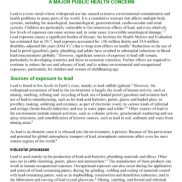
This WHO policy brief presents the consequences of lead exposure on human health and details its toxicity in the body system explaining why it is important to reduce the use and releases of lead, and to reduce environmental and occupational exposures, particularly for children and women of childbearing age.The policy brief also lists the sources of lead releases and contamination in industrial process, drinking water and domestic sources. The brief also gives guidelines for tolerable intake levels of lead and
Emerging Policy Issues: Lead in paint
Website

International Lead Poisoning Prevention Week (ILPPW)

The International Lead Poisoning Prevention Week of action (ILPPW) takes place every year at the end of October. The objectives of the campaign are to raise awareness about health effects of lead poisoning; highlight countries and partners' efforts to prevent particularly childhood lead poisoning; and urge further action to eliminate lead paint through regulatory action at country level.The campaign website presents a multilingual campaign resource package, including posters, flyers, infographics, graphics and web banners in various formats, including an editable
Emerging Policy Issues: Lead in paint
Factsheets and brochures

Lead poisoning and health

This factsheet compiles the latest information on the effects of lead on human health. It is presented in the 6 UN languages.The factsheet lists the Key Facts, and describes the Sources and routes of exposure, the Health effects of lead poisoning on children, and the WHO response. The factsheet also points to relevant related websites.
Emerging Policy Issues: Lead in paint
Factsheets and brochures

Pollinators and Pesticides - Keeping our bees safe

Pollination is the transfer of pollen between the male and female parts of flowers to enable fertilization and reproduction. The majority of cultivated and wild plants depend on animal vectors, known as pollinators, to transfer pollen. However, other means of pollen transfer such as self-pollination or wind-pollination are also important. Pollinators comprise a diverse group of animals dominated by insects, especially bees. More than 75% of the leading types of global good crops are visited by animal pollinators, such as
Emerging Policy Issues: Highly Hazardous Pesticides
Infographic

Lead infographics

by |
September 2016
copied to clipboard
What are the sources of lead in the environment? Where can you find lead? Who is at risk? How are children exposed to lead? What can you do? Did you know? - Part 1 Did you know? - Part 2 Celebrating our achievements
Emerging Policy Issues: Lead in paint
Video

We're almost there. Let's get there together

SAICM - International Conference on Chemicals Management - Curtain raiser from UN Environment on Vimeo.

Avatar