125 resources found

Video

SAICM Emerging Policy Issues Video
Have you ever noticed how many chemicals shape people’s daily lives? They keep homes sparkling clean, boost food production, and are included in virtually all manufactured goods surrounding you right now. Chemicals drive the economy but as we produce more than ever before, they have to deliver their benefits without damaging our health and environment.Toxic lead paint for example is still used in many regions of the world and Highly hazardous pesticides continue to poison agricultural workers and contaminate the
Academic article

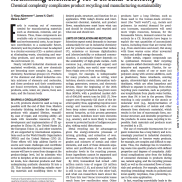
Rethinking chemistry for a circular economy

by
ScienceDirect
|
January 2020
copied to clipboard
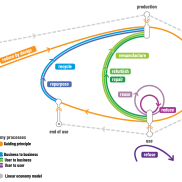
Earth is running out of resources needed for manufacturing materials such as chemicals, minerals, and petroleum. Thus, these components are available only at increasing economic and environmental costs. As an important contribution to a sustainable future, chemistry and its products must be adapted to a circular economy (CE)—a system aimed at eliminating waste, circulating and recycling products, and saving resources and the environment.Nearly 140,000 industrial chemicals are marketed worldwide, and new chemicals are becoming more complex (e.g., stereochemistry, functional groups)
Emerging Policy Issues: Chemicals in products
Website

Building Circularity Platform

The Building Circularity Platform provides an understanding of the circularity concept, its scope and how it contributes to promoting sustainable consumption and production patterns. It also offers a wide range of resources and features stories illustrating how various stakeholders have successfully adopted circular approaches.
Emerging Policy Issues: Chemicals in products
Database

Database of IOMC activities in countries

The database of IOMC activities in countries provides an overview of where individual IOMC organizations are working on chemicals issues in countries.The entries relate to country-specific activities and not normative or general activities applicable to many countries, such as the development of guidelines. Information from the Secretariat of the Basel, Rotterdam and Stockholm Conventions is included as the Secretariat is an observer to the IOMC.
Policy document

Challenges for a Sustainable Chemicals and Materials Policy: The Need for Transformation in the Global Context

by |
December 2019
copied to clipboard
Over the past few years the use of natural resources and the production of chemicals have increased dramatically – and a further increase is forecast. Whereas earlier the main focus was on local effects on health and the environment, in the meantime it has become clear that current ways of dealing with natural resources, chemicals and products manufactured from chemicals are threatening the biosphere as a whole.In 2009 and 2015 scientists introduced the concept of planetary boundaries. As part of
Factsheets and brochures

SAICM Factsheet
by |
November 2019
copied to clipboard
The ChallengeThe Strategic Approach To International Chemicals Management (SAICM) mandate expires in 2020, long before we will reach the target of minimizing the health and environmental impacts of chemicals throughout their lifecycle. Overall progress has been uneven and there is still a significant need for development and implementation of effective chemical and waste management policies and practices around the globe.What We DoSAICM provides a valuable multi-stakeholder forum to discuss and address the many challenges facing the adoption and implemen-tation of
Academic article

Preventing disease through healthy environments: exposure to lead: a major public health concern

November 2019
copied to clipboard
This WHO policy brief presents the consequences of lead exposure on human health and details its toxicity in the body system explaining why it is important to reduce the use and releases of lead, and to reduce environmental and occupational exposures, particularly for children and women of childbearing age.The policy brief also lists the sources of lead releases and contamination in industrial process, drinking water and domestic sources. The brief also gives guidelines for tolerable intake levels of lead and
Emerging Policy Issues: Lead in paint
Avatar