91 resources found

WHO Chemical Risk Assessment Network Virtual Meeting
 88 institutions from 50 Member States participate in the WHO Chemical Risk Assessment Network.
date: 10 June 2020
location: virtual
www: https://www.who.int/news-room/detail/01-06-2020-who-chemical-risk-assessment-network-virtual-meeting
https://www.who.int/activities/working-together-through-the-who-chemical-risk-assessment-network

EU Chemicals Legislation Finder Enables Companies to Track Legal Obligations
video tutorial helps users find chemicals with the EUCLEF.
Companies will also be able to ask questions about EU chemicals legislation covered by EUCLEF through a dedicated regulatory support service. The EU Programme for Competitiveness of Enterprises and SMEs is funding the online service. [EU Chemicals Legislation Finder] [ECHA Press Release]

COVID-19 Impacts on the Global Environmental Agenda: SAICM and ICCM5
ICCM5 was scheduled to take place in October 2020. Due to the COVID-19 pandemic, the session has been rescheduled to take place from 5-9 July 2021, in Bonn, Germany.
Speakers for the 19 May online dialogue will include:
- Nalini SHARMA, Head, SAICM Secretariat
- Manal AZZI, Senior Specialist on Occupational Safety and Health. International Labour Organization
- Carolyn VICKERS Head, Chemical Safety and Health Unit World Health Organization
- Valentina SIERRA, Permanent Mission of Uruguay to the UN in Geneva (ICCM5 Bureau)
- Giulia CARLINI, Staff Attorney, Environmental Health Program, Center for International Environmental Law
- Monika GAIL MACDEVETTE, Chief, Chemicals and Health Branch, UNEP
date: 19 May 2020
location: virtual
www: https://genevaenvironmentnetwork.org/19may2020.html
SAICM Brief Previews Chemicals Management Needs Beyond 2020
The Strategic Approach to International Chemicals Management (SAICM) published a policy brief on lessons learned since 2006

SAICM Resource Facilitates Networking among Chemicals Policy Experts
online platform that provides news and resources on chemicals of concern. Users can learn about emerging policy issues and their linkages with the 2030 Agenda for Sustainable Development.
The 'Chemicals Without Concern' website brings together documents, reports, case studies, infographics, videos, and other resources to provide a coherent knowledge resource on chemicals policy. The SAICM Secretariat welcomes submissions of relevant content.
The website also includes a section for individuals working on chemicals policy issues to register and network with other “people working for a healthier environment.” This database seeks to engage and connect individuals and organizations involved with chemicals management.
The website was developed under the framework of the Global Environment Facility (GEF) project on Global Best Practices on Emerging Chemical Policy Issues of Concern under SAICM, executed by the SAICM Secretariat. The site is currently in beta stage, and feedback is welcomed.
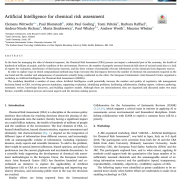
Artificial Intelligence for chemical risk assessment
Interactive country profiles