81 resources found

SAICM UCT CiP CoP 2022 Digest Compilation
Community of practice summary of discussions

Community of Practice on Chemicals in Products - 2022 Digest Compilation

by |
January 2023
copied to clipboard

The SAICM Secretariat, in partnership with the University of Cape Town, established a Community of Practice (CoP) on Chemicals in Products to bring representatives from different sectors together and to create a learning network around issues related to addressing Chemicals in Products (CiP). This is a compilation of summaries of the discussions, which took place in 2022.

Emerging Policy Issues: Chemicals in products
SAICM_UCT HHP CoP Discussion 3 2022 Digest
Community of practice summary of discussions

Rights-based approach to Highly Hazardous Pesticides (HHPs) management

by |
January 2023
copied to clipboard

The SAICM Secretariat, in partnership with the University of Cape Town, established a community of practice on Highly Hazardous Pesticides (HHPs) to foster discussions, exchange of best practices, and recommendations to address HHPs amongst relevant stakeholders. This is a summary of the discussion on Rights-based approach to Highly Hazardous Pesticides (HHPs) management, which took place on 30 November 2022.

Presenters: Baskut Tuncak (TURI), Peter Hurst, Laurent Gaberell (Public Eye)

Emerging Policy Issues: Highly Hazardous Pesticides
SAICM_UCT HHP CoP Discussion 4 Digest
Community of practice summary of discussions

The importance of farmer and farmer organisations’ perspectives on Highly Hazardous Pesticides

by |
December 2022
copied to clipboard

The SAICM Secretariat, in partnership with the University of Cape Town, established a community of practice on Highly Hazardous Pesticides (HHPs) to foster discussions, exchange of best practices, and recommendations to address HHPs amongst relevant stakeholders. This is a summary of the discussion on The importance of farmer and farmer organisations' perspectives on Highly Hazardous Pesticides, which took place on 12 December 2022.

Presenters: Prof. Hanna-Andrea Rother (UCT), Andrew Ardington (RegenAg SA)

Emerging Policy Issues: Highly Hazardous Pesticides
SAICMUCT CDSG CoP Discussion 4 2022 digest
Community of practice summary of discussions

Environmental Injustice Issues to Consider for Chemical Risk

by |
November 2022
copied to clipboard

The Secretariat of the Strategic Approach to Chemicals Management (SAICM) and the University of Cape Town (UCT) have launched a Community of Practice (CoP) on Chemicals and SDGs to bring representatives from different sectors together and to create a learning network around issues related to addressing Chemicals and the Sustainable Development Goals (SDGs). This is a summary of the discussion on Environmental Injustice Issues to Consider for Chemical Risk, which took place on 23 November 2022.

Presenters: Rico Euripidou (groundWork)

SAICM UCT LiP CoP Discussion 4 digest_16.11.2022
Community of practice summary of discussions

Compliance with Lead Paint Laws

by |
November 2022
copied to clipboard

The Secretariat of the Strategic Approach to Chemicals Management (SAICM) and the University of Cape Town (UCT) have established a Community of Practice (CoP) on Lead in Paint to bring representatives from different sectors together and to create a learning network around issues related to the elimination of Lead Paint. This is a summary of the discussion on Compliance with Lead Paint Laws, which took place on 16 November 2022.

Presenters: Steve Wolfson (US EPA), Dr Faridah Hussein Were (University of Nairobi), University of Nairobi (Department of Environment and Natural Resources in the Philippines), Isabel Artagaveytia (Uruguayan Ministry of Environment)

Emerging Policy Issues: Lead in paint
SAICMUCT CDSG CoP Discussion 3 2022 digest
Community of practice summary of discussions

Plastic pollution: ideas for addressing chemicals in plastics

by |
October 2022
copied to clipboard

The Secretariat of the Strategic Approach to Chemicals Management (SAICM) and the University of Cape Town (UCT) have launched a Community of Practice (CoP) on Chemicals and SDGs to bring representatives from different sectors together and to create a learning network around issues related to addressing Chemicals and the Sustainable Development Goals (SDGs). This is a summary of the discussion on Plastic pollution: ideas for addressing chemicals in plastics, which took place on 19 October 2022.

Presenters: Brenda Koekkoek (UNEP), Jost Dittkrist (UNEP), Dr. Eeva Leinala (OECD), Mochamad Adi Septiono (Nexus3 Foundation)

gender-case-studies-cover
Case studies

Women Leaders: Addressing Chemicals and Waste Issues

by
IPEN ,
|
June 2022
copied to clipboard

People of all gender identities must have the same rights and opportunities to participate fully in their communities, free from the health threats posed by toxic chemicals. It is especially important to understand the factors that put women at risk from chemical health threats.

The IPEN report “Women Leaders: Addressing Chemicals and Waste Issues” highlights women’s leadership through ten organizations from around the world working to address chemical health threats. The report was developed within the framework of the United Nations Environment Program and its Global Environment Facility (GEF), under the Strategic Approach to International Chemicals Management (SAICM), executed by the SAICM Secretariat. It was produced with support from the Swedish Government.

Women face greater risks from chemical exposures and experience higher rates of adverse health outcomes because of their physiology, different types of occupational exposures, and differential exposures to chemicals, including from personal care and household products. Women are also exposed to chemicals — such as endocrine disrupting chemicals, lead in paint, and chemicals in toys — that pose health threats during pregnancy and to their developing children.

These toxic exposures can lead to serious health problems that impact women’s lives and their opportunities to participate in their communities fully and equally. This is especially so for women in low-income communities who are often managing multiple pathways for toxic exposures and multiple obstacles to gender equality.

Women cannot be empowered nor gender equality achieved while exposures to hazardous chemicals put them at risk for cancer, chronic illnesses, infertility, and damage to their nervous systems.

In 2015, the United Nations Member States adopted the 2030 Agenda for Sustainable Development, which includes 17 Sustainable Development Goals (SDGs). “Gender Equality” is one of the goals (Goal 5) and the SDGs also recognize that gender equality is a prerequisite for reaching most of the other goals. Reducing and eliminating chemical exposures will also be essential for achieving all of the 17 goals.

The stories that follow highlight women across the globe who are leading work in their communities, nations, and internationally for stronger protections from harmful chemicals. Supporting their work and the work of countless other women who are leading similar efforts will be critical for achieving the SDGs.

Tarkett-Case-Study
Case studies

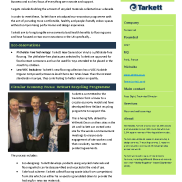
Tarkett Sustainable Flooring Case Study

November 2019
copied to clipboard

Tarkett have introduced an eco-innovation programme with the aim of providing more comfortable, healthy and people-friendly indoor spaces without compromising performance and design experience. Key initiatives include:

  • Phthalate free technology in their New Generation Vinyl flooring;
  • Low VOC emissions in flooring;
  • ReStart Takeback and Recycling Programme, and use of recycled materials in new products.
Emerging Policy Issues: Chemicals in products
Avatar