45 resources found

Database

Chemical Entities of Biological Interest

by
European Bioinformatics Institute
|
January 2021
copied to clipboard
Chemical Entities of Biological Interest, also known as ChEBI is a chemical database and ontology of molecular entities focused on 'small' chemical compounds, that is part of the Open Biomedical Ontologies (OBO) effort at the European Bioinformatics Institute (EBI).The term "molecular entity" refers to any "constitutionally or isotopically distinct atom, molecule, ion, ion pair, radical, radical ion, complex, conformer, etc., identifiable as a separately distinguishable entity". The molecular entities in question are either products of nature or synthetic products which
Database

Chemical Awareness toolkit

What is CAt and where does all the data come from?The Chemical Awareness toolkit (CAt) is a free web application that provides rapid access to chemical information for product stewards, risk assessors, toxicologists, chemists, microbiologists, engineers, and other researchers. It includes screening tools that provide chemical information including toxicological hazards, environmental fate, persistence & bioaccumulation, occupational exposure limits, government regulations, and public perception.CAt utilizes an integrated database containing information from key lists provided by Verisk 3E, publicly available lists, databases
Emerging Policy Issues: Chemicals in products
Database

IOMC Toolbox

IOMC Toolbox for decision making in chemicals management The IOMC Toolbox has been redesigned to provide easier and more direct access to 8 management schemes, 6 toolkits, and more than 500 IOMC tools, guidance documents, and training materials. This new and improved platform enables users to access information with fewer steps and clicks.The IOMC Internet-based Toolbox for Decision Making in Chemicals Management (IOMC Toolbox) is aimed at countries who wish to address specific national issues regarding chemicals management.The IOMC Toolbox
Database

EU Chemicals Legislation Finder
EU Chemicals Legislation Finder (EUCLEF) gives you an overview of the European Union’s legislation on chemicals. You can search for information on your substances, find applicable laws and check what obligations you may have.For each piece of legislation below, you can find a summary of all the relevant information, including the scope, obligations, exemptions, regulatory activities and lists of impacted substances, together with links to the full legal texts in all EU languages.EUCLEF is funded by the EU Programme for
Project document

Market Analysis of the Coating Industry in China

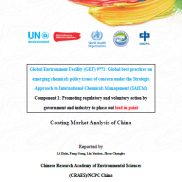
China is a major producer of paints which supplies a considerable share of paints in the world. Key paint production hot spots were identified as Guangdong, Shanghai, Jiangsu, Hunan and Shandong provinces and cities. The cost of removing existing decorative lead paint from surfaces in homes, schools, and other buildings is significant. By comparison, the cost for eliminating the use of lead compounds in new decorative paints is low and alternatives to lead additives are available for all types of
Emerging Policy Issues: Lead in paint
Topics: Policymaking
Project document

Baseline paint market study in Ecuador (English / Spanish)

The World Health Organization (WHO) with the United Nations Environment Program (UNEP) has launched the initiative called "Global Alliance to Eliminate Lead Paint" whose goal is to phase-out the manufacture and sale of paintings that contain lead thereby reducing the exposition to this metal and eliminating its risks and effects on the population.In Ecuador, CEER is the technical executor of the project “Lead-free paints”, carried out with the technical support of the Cleaner Production Centre of Serbia, experts from the
Emerging Policy Issues: Lead in paint
Topics: Policymaking
Project document

Baseline Information for the Lead Paint Country Situation in Nigeria

Lead in Nigerian paints is another route of lead into the environment and exposure can be caused as a result of inhalation or ingestion especially in children. In 2008, SRADeV Nigeria under the auspices of International Pollutants Elimination Network (IPEN) collected and analyzed decorative paints produced and/or marketed in Nigeria. All the sampled paint brands were found to contain lead higher than 90ppm, in fact up to an alarming level of 129,837ppm in one case. At that time, there were
Emerging Policy Issues: Lead in paint
Topics: Policymaking
Database

Database of IOMC activities in countries

The database of IOMC activities in countries provides an overview of where individual IOMC organizations are working on chemicals issues in countries.The entries relate to country-specific activities and not normative or general activities applicable to many countries, such as the development of guidelines. Information from the Secretariat of the Basel, Rotterdam and Stockholm Conventions is included as the Secretariat is an observer to the IOMC.
Avatar