87 resources found

sustainable-chemicals-strategy
Report

A chemicals strategy for a sustainable chemicals revolution

December 2022
copied to clipboard

Chemicals production and consumption is set to double by 2030, from a $5 trillion industry globally in 2017, with production set to increase, mainly in emerging economies. If chemicals production is doubled, chemical pollution must not double as a consequence – rather we should aim to significantly reduce it from current levels.

Current international attempts at the massive undertaking of addressing chemical pollution are not working. For the world to solve the major environmental and health challenges we face, there must be a sustainable chemicals revolution. We can only achieve this through senior-level engagement with the chemical sciences community through an authoritative, intergovernmental science-policy interface.

The Royal Society of Chemistry engaged with scientists in their community to develop the vision for a chemicals strategy, relevant to any nation in principle.  Four pillars were identified on which any chemicals strategy has to be based: education, innovation, circular economy and regulation. National governments must invest in these areas and create a responsible framework of action for chemicals management.

Emerging Policy Issues: Chemicals in products
Country: United Kingdom
Circular_Economy_Electronics_Central_Eastern_Europe
Report

Toward a Circular Economy for the Electronics Sector in Central and Eastern Europe: Overview, Actions and Recommendations

by |
December 2022
copied to clipboard

This report provides an overview of the current status and conditions of the Circular Economy in the electronics value chain in the Central and Eastern Europe (CEE) region, identifies key areas of concern, provides appropriate recommendations, and proposes priority actions to improve circularity of the sector. The recommendations and roadmap focus on the individual life cycle stages of the electronics value chain, as well as on aspects that cut across the value chain. The transition towards a more circular electronics sector in Central and Easter Europe (CEE) would require a holistic and coordinated approach to progress toward a more circular electronics value chain in the CEE region.

This publication was prepared under the framework of the Global Environment Facility (GEF) full-sized project 9771: Global best practices on emerging chemical policy issues of concern under the Strategic Approach to International Chemicals Management (SAICM). This project is funded by the GEF, implemented by UNEP and executed by the SAICM Secretariat.

gender-case-studies-cover
Case studies

Women Leaders: Addressing Chemicals and Waste Issues

by
IPEN ,
|
June 2022
copied to clipboard

People of all gender identities must have the same rights and opportunities to participate fully in their communities, free from the health threats posed by toxic chemicals. It is especially important to understand the factors that put women at risk from chemical health threats.

The IPEN report “Women Leaders: Addressing Chemicals and Waste Issues” highlights women’s leadership through ten organizations from around the world working to address chemical health threats. The report was developed within the framework of the United Nations Environment Program and its Global Environment Facility (GEF), under the Strategic Approach to International Chemicals Management (SAICM), executed by the SAICM Secretariat. It was produced with support from the Swedish Government.

Women face greater risks from chemical exposures and experience higher rates of adverse health outcomes because of their physiology, different types of occupational exposures, and differential exposures to chemicals, including from personal care and household products. Women are also exposed to chemicals — such as endocrine disrupting chemicals, lead in paint, and chemicals in toys — that pose health threats during pregnancy and to their developing children.

These toxic exposures can lead to serious health problems that impact women’s lives and their opportunities to participate in their communities fully and equally. This is especially so for women in low-income communities who are often managing multiple pathways for toxic exposures and multiple obstacles to gender equality.

Women cannot be empowered nor gender equality achieved while exposures to hazardous chemicals put them at risk for cancer, chronic illnesses, infertility, and damage to their nervous systems.

In 2015, the United Nations Member States adopted the 2030 Agenda for Sustainable Development, which includes 17 Sustainable Development Goals (SDGs). “Gender Equality” is one of the goals (Goal 5) and the SDGs also recognize that gender equality is a prerequisite for reaching most of the other goals. Reducing and eliminating chemical exposures will also be essential for achieving all of the 17 goals.

The stories that follow highlight women across the globe who are leading work in their communities, nations, and internationally for stronger protections from harmful chemicals. Supporting their work and the work of countless other women who are leading similar efforts will be critical for achieving the SDGs.

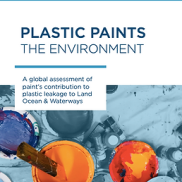
Plastic paints the Environment
Report

Plastic Paints the Environment

February 2022
copied to clipboard

This report provides a global assessment of the level of plastic paint leakage worldwide.

It is based on the baseline year 2019 with a global paint demand of 52 Mt, that included 19.5 Mt of plastics and distributed across different sectors: Architectural, Marine, Road Marking, General Industrial, Automotive and Industrial Wood and Others.

Emerging Policy Issues: Chemicals in products
Report

Chemicals of concern in electronics: Review of legislative and regulatory approach

by |
February 2021
copied to clipboard
This UNEP report provides a comprehensive but not necessarily exhaustive overview of the various regulatory approaches for CoC in EEE. Further inputs from the international community are welcomed to complement the research, especially with regards to relevant regulations that are not yet captured in the report.Chemicals in products and hazardous substances within the life cycle of electrical and electronic products have been longstanding emerging policy issues under the Strategic Approach to International Chemicals Management (SAICM). To further advance these issues
Emerging Policy Issues: Chemicals in products
Report

Update on the Global Status of Legal Limits on Lead in Paint

by |
February 2021
copied to clipboard

The new 2020 Update on the Global Status of Legal Limits on Lead in Paint reports new laws, new tools, and new momentum on progress toward laws to eliminate lead paint in 2020. Available in English and Spanish, the Update also describes activity and results by region. As of 31 December 2020, 79 countries have confirmed that they have legally binding controls on lead in paint, which is 41% of all countries. Since October 2019, Colombia, Lebanon and Vietnam established

Emerging Policy Issues: Lead in paint
Topics: Policymaking
Report

Summary report on Chemicals in Toys Policy in China

by |
March 2020
copied to clipboard
China is one of the largest producers, exporters and consumers of toy products in the world. In order to ensure the quality and safety of toys, and to promote the development of toys industry, China implements a series of related laws, regulations and standards, with many authorities participate in the supervision and management of toys industry.However, there are still gaps between China and the European Union in terms of the limits of chemicals in toys and the management of new
Emerging Policy Issues: Chemicals in products
EIT_RM_PARADE_Hazardous_substances_in_construction_Final_2019
Report

Hazardous Substances in Construction Products and Materials

December 2019
copied to clipboard

This guidance document aims to give an overview of potential hazardous substances that might occur in construction products and when appearing as waste need attention during renovation and demolition activities. Focus in this guideline is on hazardous substances regulated by EU or international agreements or national legislation.

Although the present legislation restricts the use of many hazardous substances in new building products, there is a considerable concern for compounds present in old construction products, since their presence in construction and demolition waste may limit the recyclability of the material and potentially cause waste management problems. One group of substances that has recently received attention are persistent organic pollutants (POP substances) such as e.g. some brominated flame retardants.

Important characteristic of the construction and building products is the relatively long life span. Because of long lifespan the restricted substances will enter the waste stream many decades after a ban has been placed on their use and they can therefore be found in renovation or demolition waste for a long time. Many of these substances provide important functionality in a wide range of products, e.g. flame retardants.

Besides hazardous substances also degradation in composition and quality aspects (e.g. mould) of construction products needs to be considered.

This document is part of the pre-demolition overall guidance document developed in the PARADE project.

Emerging Policy Issues: Chemicals in products
Avatar