6 resources found

DG Environment
Report

The use of PFAS and fluorine-free alternatives in textiles, upholstry, carpets, leather and apparel

This study, commissioned by DG Environment for the European Commission and produced by Wood and Ramboll.  The objective was to assess the use of PFASs and fluorine-free alternatives in textiles, upholstry, carpets, leather and apparel, including specific focus on volumes of use, technical function, and emissions.

Non-fluorine alternatives considered were hydrocarbons, silicones, dendrimers, polyurethane, nanomaterials, and alternative technologies.  The study makes recommendations for policy, including a REACH restriction on the placing on the market and use of these products that contain any PFAS, and a listing under the Stockholm Convention.  It is also recommended in the report that a restriction could be combined with voluntary industry measures and provisions in public procurement to encourage substitution of PFAS before mandatory legislation is introduced.

Lead_Paint_Guide
Manuals and toolkits

Lead Paint Reformulation Technical Guidelines

The Lead Paint Reformulation Technical Guidelines have developed by the United Nations Environment Programme (UNEP) and guided by the Global Alliance to Eliminate Lead Paint. The document provide a comprehensive starting point for all stakeholders to learn more about paint reformulation and best practices. They offer general information on processes and provide a step-by-step approach to reformulation, indicating where to find relevant information such as alternative raw materials and additional details such as standards for testing and in-depth case studies.The

Emerging Policy Issues: Lead in paint
Topics: Policymaking
GenChemRoadMap_Workbook_cover
Manuals and toolkits

The Gender and Chemicals Road Map + Workbook

The road map lays out actions and provides guidance on how to fully integrate gender in national chemicals management. These steps are meant to give support and direction to actors engaged in national chemicals management, especially SAICM National Focal Points. The accompanying workbook helps to prioritize and plan your activities step by step. Additionally, SAICM Focal Points and other stakeholders might be at different stages of capacity development, and priority actions and objectives will differ depending on the individual national context - the workbook, therefore, allows you to develop your specific process of integrating gender.

Report

Update on the Global Status of Legal Limits on Lead in Paint

by |
February 2021
copied to clipboard

The new 2020 Update on the Global Status of Legal Limits on Lead in Paint reports new laws, new tools, and new momentum on progress toward laws to eliminate lead paint in 2020. Available in English and Spanish, the Update also describes activity and results by region. As of 31 December 2020, 79 countries have confirmed that they have legally binding controls on lead in paint, which is 41% of all countries. Since October 2019, Colombia, Lebanon and Vietnam established

Emerging Policy Issues: Lead in paint
Topics: Policymaking
2212521_SAICM_GEF9771_LIP_TechGuide_cover
Manuals and toolkits

Reformulation is Entirely Possible: Summary of the Lead Paint Reformulation Technical Guidelines and How to Use this Information

This document summarizes information from the Lead Paint Reformulation Technical Guidelines, the findings and recommendations of the reformulation pilot demonstrations, and two case studies of paint manufacturers which have reformulated paint products. This summary is also intended to highlight how the information from the Guidelines can be used by different stakeholders involved in the phasing out of lead paint.The full set of technical guidelines can be accessed here.The guidelines were made possible under a global project funded by the Global

Emerging Policy Issues: Lead in paint
Topics: Policymaking
Manuals and toolkits

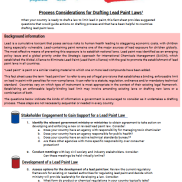
Process Considerations for Drafting Lead Paint Laws

In response to questions received by the Global Alliance to Eliminate Lead Paint on roadmaps for developing regulations on lead content in paint, the Alliance offers the following process considerations. Questions are illustrative, indicating the kinds of information a government might consider as it undertakes each component of a drafting process.
Emerging Policy Issues: Lead in paint
Topics: Policymaking

Avatar