4 resources found

DG Environment
Report

The use of PFAS and fluorine-free alternatives in textiles, upholstry, carpets, leather and apparel

This study, commissioned by DG Environment for the European Commission and produced by Wood and Ramboll.  The objective was to assess the use of PFASs and fluorine-free alternatives in textiles, upholstry, carpets, leather and apparel, including specific focus on volumes of use, technical function, and emissions.

Non-fluorine alternatives considered were hydrocarbons, silicones, dendrimers, polyurethane, nanomaterials, and alternative technologies.  The study makes recommendations for policy, including a REACH restriction on the placing on the market and use of these products that contain any PFAS, and a listing under the Stockholm Convention.  It is also recommended in the report that a restriction could be combined with voluntary industry measures and provisions in public procurement to encourage substitution of PFAS before mandatory legislation is introduced.

Report

Update on the Global Status of Legal Limits on Lead in Paint

by |
February 2021
copied to clipboard

The new 2020 Update on the Global Status of Legal Limits on Lead in Paint reports new laws, new tools, and new momentum on progress toward laws to eliminate lead paint in 2020. Available in English and Spanish, the Update also describes activity and results by region. As of 31 December 2020, 79 countries have confirmed that they have legally binding controls on lead in paint, which is 41% of all countries. Since October 2019, Colombia, Lebanon and Vietnam established

Emerging Policy Issues: Lead in paint
Topics: Policymaking
Website

Lead levels in paint around the world

by
IPEN ,
|
March 2019
copied to clipboard
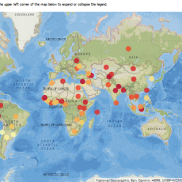
This interactive map provides country-specific data on lead paint levels around the world. Lead in paint is a major source of lead exposure for children globally. Since 2009, more than 100 studies from 59 countries have shown that lead paints are still widely sold in low- and middle-income countries. IPEN-affiliated NGOs conducted the majority of these studies, comprising more than 3,300 solvent-based paints. Many of these paints contained very high levels of lead above 10,000 parts per million (ppm) of
Emerging Policy Issues: Lead in paint
Topics: Policymaking
Website

Economic Costs of Childhood Lead Exposure in Low- & Middle-Income Countries

by
New-York University - Division of Environmental Pediatrics
|
September 2014
copied to clipboard
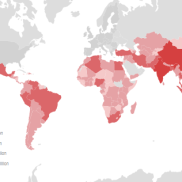
This interactive map reflects the results of research by New-York University that estimates the economic costs linked to childhood lead exposure in low- and middle-income countries. Information as average lead level, cost for countries and population at risk under the age of five are available for selected countries.Exposure to lead has a permanent negative impact on children's developing brains. One impact is a reduction in intelligence quotient (IQ), which can be correlated with decreases in lifetime earning potential. Lead exposure
Emerging Policy Issues: Lead in paint
Topics: Policymaking

Avatar