8 resources found

DG Environment
Report

The use of PFAS and fluorine-free alternatives in textiles, upholstry, carpets, leather and apparel

This study, commissioned by DG Environment for the European Commission and produced by Wood and Ramboll.  The objective was to assess the use of PFASs and fluorine-free alternatives in textiles, upholstry, carpets, leather and apparel, including specific focus on volumes of use, technical function, and emissions.

Non-fluorine alternatives considered were hydrocarbons, silicones, dendrimers, polyurethane, nanomaterials, and alternative technologies.  The study makes recommendations for policy, including a REACH restriction on the placing on the market and use of these products that contain any PFAS, and a listing under the Stockholm Convention.  It is also recommended in the report that a restriction could be combined with voluntary industry measures and provisions in public procurement to encourage substitution of PFAS before mandatory legislation is introduced.

Report

Update on the Global Status of Legal Limits on Lead in Paint

by |
February 2021
copied to clipboard

The new 2020 Update on the Global Status of Legal Limits on Lead in Paint reports new laws, new tools, and new momentum on progress toward laws to eliminate lead paint in 2020. Available in English and Spanish, the Update also describes activity and results by region. As of 31 December 2020, 79 countries have confirmed that they have legally binding controls on lead in paint, which is 41% of all countries. Since October 2019, Colombia, Lebanon and Vietnam established

Emerging Policy Issues: Lead in paint
Topics: Policymaking
Project document

Market Analysis of the Coating Industry in China

China is a major producer of paints which supplies a considerable share of paints in the world. Key paint production hot spots were identified as Guangdong, Shanghai, Jiangsu, Hunan and Shandong provinces and cities. The cost of removing existing decorative lead paint from surfaces in homes, schools, and other buildings is significant. By comparison, the cost for eliminating the use of lead compounds in new decorative paints is low and alternatives to lead additives are available for all types of
Emerging Policy Issues: Lead in paint
Topics: Policymaking
Project document

Baseline paint market study in Ecuador (English / Spanish)

The World Health Organization (WHO) with the United Nations Environment Program (UNEP) has launched the initiative called "Global Alliance to Eliminate Lead Paint" whose goal is to phase-out the manufacture and sale of paintings that contain lead thereby reducing the exposition to this metal and eliminating its risks and effects on the population.In Ecuador, CEER is the technical executor of the project “Lead-free paints”, carried out with the technical support of the Cleaner Production Centre of Serbia, experts from the
Emerging Policy Issues: Lead in paint
Topics: Policymaking
Project document

Baseline Information for the Lead Paint Country Situation in Nigeria

Lead in Nigerian paints is another route of lead into the environment and exposure can be caused as a result of inhalation or ingestion especially in children. In 2008, SRADeV Nigeria under the auspices of International Pollutants Elimination Network (IPEN) collected and analyzed decorative paints produced and/or marketed in Nigeria. All the sampled paint brands were found to contain lead higher than 90ppm, in fact up to an alarming level of 129,837ppm in one case. At that time, there were
Emerging Policy Issues: Lead in paint
Topics: Policymaking
Project document

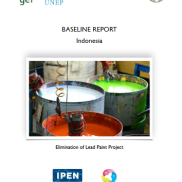
Market Analysis of the paint industry in Indonesia (English / Bahasa)

December 2019
copied to clipboard
Elimination of Lead in Paint in Indonesia - Baseline Information - Indonesia’s paint marketIndonesia holds the first position as the biggest market in paint and coating in South East Asia with the 268 million population and high urbanization rate (57%). Indonesian paint and coating industry growth rate is 6% annually for the past five consecutive years. Paint and coating industry in Indonesia involves six multinational, four domestic, and large numbers of small-scale domestic producers, with the most demand from architectural
Emerging Policy Issues: Lead in paint
Topics: Policymaking
Project document

National Baseline Survey of Paint Market in Peru

United Nations Environment Programme (UNEP) and the World Health Organization (WHO) have established the joint initiative Global Alliance to Eliminate Lead Paint (Lead Paint Alliance) to prevent children’s exposure to lead from paints containing lead and to minimize occupational exposures to lead paints. The broad objective of the Alliance is to promote a phase-out of the manufacture and sale of paints containing lead and eventually eliminate the risks from such paint.CER/Grupo GEA implements the Component 1 “Promoting regulatory and voluntary
Emerging Policy Issues: Lead in paint
Topics: Policymaking
Project document

National baseline information on lead paint in Jordan

September 2019
copied to clipboard
The World Health Organization (WHO) with the United Nations Environment Program (UNEP) has launched the initiative called "Global Alliance to Eliminate Lead Paint" whose goal is to phase-out the manufacture and sale of paintings that contain lead thereby reducing the exposition to this metal and eliminating its risks and effects on the population.In Jordan there are 77 factories for the production of paints, there are laws and standard to regulate the paint manufacturing in Jordan and to reduce the use
Emerging Policy Issues: Lead in paint
Topics: Policymaking

Avatar