4 resources found

DG Environment
Report

The use of PFAS and fluorine-free alternatives in textiles, upholstry, carpets, leather and apparel

This study, commissioned by DG Environment for the European Commission and produced by Wood and Ramboll.  The objective was to assess the use of PFASs and fluorine-free alternatives in textiles, upholstry, carpets, leather and apparel, including specific focus on volumes of use, technical function, and emissions.

Non-fluorine alternatives considered were hydrocarbons, silicones, dendrimers, polyurethane, nanomaterials, and alternative technologies.  The study makes recommendations for policy, including a REACH restriction on the placing on the market and use of these products that contain any PFAS, and a listing under the Stockholm Convention.  It is also recommended in the report that a restriction could be combined with voluntary industry measures and provisions in public procurement to encourage substitution of PFAS before mandatory legislation is introduced.

Report

Update on the Global Status of Legal Limits on Lead in Paint

by |
February 2021
copied to clipboard

The new 2020 Update on the Global Status of Legal Limits on Lead in Paint reports new laws, new tools, and new momentum on progress toward laws to eliminate lead paint in 2020. Available in English and Spanish, the Update also describes activity and results by region. As of 31 December 2020, 79 countries have confirmed that they have legally binding controls on lead in paint, which is 41% of all countries. Since October 2019, Colombia, Lebanon and Vietnam established

Emerging Policy Issues: Lead in paint
Topics: Policymaking
Factsheets and brochures

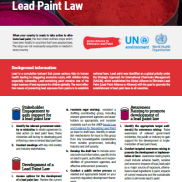
Suggested Steps for Establishing a Lead Paint Law

December 2019
copied to clipboard
This fact sheet outlines steps that have been helpful in countries that have adopted lead paint laws. The steps are not necessarily sequential or needed in every country.
Emerging Policy Issues: Lead in paint
Topics: Policymaking
Factsheets and brochures

Market Analysis of the paint industry in Colombia (Draft / Spanish only)

Las pinturas se han convertido en parte esencial del estilo de vida de la sociedad moderna, el color de ellas es apetecido por sus funciones estéticas, decorativas, de protección para productos y hasta en usos como códigos de seguridad, sin embargo, su producción y uso plantea aun muchos retos en los cuales se viene trabajando tanto a nivel mundial como local.Los países más industrializados prohibieron desde hace más de 40 años el uso de pinturas con plomo. Colombia aún carece
Emerging Policy Issues: Lead in paint
Topics: Policymaking

Avatar