6 resources found

gender-case-studies-cover
Case studies

Women Leaders: Addressing Chemicals and Waste Issues

by
IPEN ,
|
June 2022
copied to clipboard

People of all gender identities must have the same rights and opportunities to participate fully in their communities, free from the health threats posed by toxic chemicals. It is especially important to understand the factors that put women at risk from chemical health threats.

The IPEN report “Women Leaders: Addressing Chemicals and Waste Issues” highlights women’s leadership through ten organizations from around the world working to address chemical health threats. The report was developed within the framework of the United Nations Environment Program and its Global Environment Facility (GEF), under the Strategic Approach to International Chemicals Management (SAICM), executed by the SAICM Secretariat. It was produced with support from the Swedish Government.

Women face greater risks from chemical exposures and experience higher rates of adverse health outcomes because of their physiology, different types of occupational exposures, and differential exposures to chemicals, including from personal care and household products. Women are also exposed to chemicals — such as endocrine disrupting chemicals, lead in paint, and chemicals in toys — that pose health threats during pregnancy and to their developing children.

These toxic exposures can lead to serious health problems that impact women’s lives and their opportunities to participate in their communities fully and equally. This is especially so for women in low-income communities who are often managing multiple pathways for toxic exposures and multiple obstacles to gender equality.

Women cannot be empowered nor gender equality achieved while exposures to hazardous chemicals put them at risk for cancer, chronic illnesses, infertility, and damage to their nervous systems.

In 2015, the United Nations Member States adopted the 2030 Agenda for Sustainable Development, which includes 17 Sustainable Development Goals (SDGs). “Gender Equality” is one of the goals (Goal 5) and the SDGs also recognize that gender equality is a prerequisite for reaching most of the other goals. Reducing and eliminating chemical exposures will also be essential for achieving all of the 17 goals.

The stories that follow highlight women across the globe who are leading work in their communities, nations, and internationally for stronger protections from harmful chemicals. Supporting their work and the work of countless other women who are leading similar efforts will be critical for achieving the SDGs.

Lead_Paint_Guide
Manuals and toolkits

Lead Paint Reformulation Technical Guidelines

The Lead Paint Reformulation Technical Guidelines have developed by the United Nations Environment Programme (UNEP) and guided by the Global Alliance to Eliminate Lead Paint. The document provide a comprehensive starting point for all stakeholders to learn more about paint reformulation and best practices. They offer general information on processes and provide a step-by-step approach to reformulation, indicating where to find relevant information such as alternative raw materials and additional details such as standards for testing and in-depth case studies.The

Emerging Policy Issues: Lead in paint
Topics: Policymaking
2212521_SAICM_GEF9771_LIP_TechGuide_cover
Manuals and toolkits

Reformulation is Entirely Possible: Summary of the Lead Paint Reformulation Technical Guidelines and How to Use this Information

This document summarizes information from the Lead Paint Reformulation Technical Guidelines, the findings and recommendations of the reformulation pilot demonstrations, and two case studies of paint manufacturers which have reformulated paint products. This summary is also intended to highlight how the information from the Guidelines can be used by different stakeholders involved in the phasing out of lead paint.The full set of technical guidelines can be accessed here.The guidelines were made possible under a global project funded by the Global

Emerging Policy Issues: Lead in paint
Topics: Policymaking
Manuals and toolkits

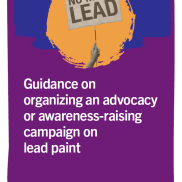
Guidance on organizing an advocacy or awareness-raising campaign on lead paint

This document has been developed as part of a project to accelerate progress towards the establishment of legally binding controls on the manufacture, sale, distribution, import and use of lead paint in countries, funded by the Global Environment Facility (GEF) and executed by the Secretariat of the Strategic Approach to International Chemicals Management (SAICM). It is a contribution to the work of the Global Alliance to Eliminate Lead Paint (the Lead Paint Alliance). The Lead Paint Alliance is a voluntary
Emerging Policy Issues: Lead in paint
Manuals and toolkits

Brief guide to analytical methods for measuring lead in blood (Second edition)

Lead is a toxic metal whose widespread use has caused extensive environmental contamination and health problems in many parts of the world. Lead is a cumulative toxicant that affects multiple body systems, including the neurological, haematological, gastrointestinal, cardiovascular, musculoskeletal and renal systems. Long-term effects include increased risk of hypertension, ischaemic heart disease and renal disease. Children are particularly vulnerable to the neurotoxic effects of lead, and even low levels of exposure can impair cognitive development and cause behavioural disorders. These
Emerging Policy Issues: Lead in paint
Manuals and toolkits

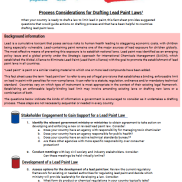
Process Considerations for Drafting Lead Paint Laws

In response to questions received by the Global Alliance to Eliminate Lead Paint on roadmaps for developing regulations on lead content in paint, the Alliance offers the following process considerations. Questions are illustrative, indicating the kinds of information a government might consider as it undertakes each component of a drafting process.
Emerging Policy Issues: Lead in paint
Topics: Policymaking
Avatar