5 resources found

Circular_Economy_Electronics_Central_Eastern_Europe
Report

Toward a Circular Economy for the Electronics Sector in Central and Eastern Europe: Overview, Actions and Recommendations

by |
December 2022
copied to clipboard

This report provides an overview of the current status and conditions of the Circular Economy in the electronics value chain in the Central and Eastern Europe (CEE) region, identifies key areas of concern, provides appropriate recommendations, and proposes priority actions to improve circularity of the sector. The recommendations and roadmap focus on the individual life cycle stages of the electronics value chain, as well as on aspects that cut across the value chain. The transition towards a more circular electronics sector in Central and Easter Europe (CEE) would require a holistic and coordinated approach to progress toward a more circular electronics value chain in the CEE region.

This publication was prepared under the framework of the Global Environment Facility (GEF) full-sized project 9771: Global best practices on emerging chemical policy issues of concern under the Strategic Approach to International Chemicals Management (SAICM). This project is funded by the GEF, implemented by UNEP and executed by the SAICM Secretariat.

Lead_Paint_Guide
Manuals and toolkits

Lead Paint Reformulation Technical Guidelines

The Lead Paint Reformulation Technical Guidelines have developed by the United Nations Environment Programme (UNEP) and guided by the Global Alliance to Eliminate Lead Paint. The document provide a comprehensive starting point for all stakeholders to learn more about paint reformulation and best practices. They offer general information on processes and provide a step-by-step approach to reformulation, indicating where to find relevant information such as alternative raw materials and additional details such as standards for testing and in-depth case studies.The

Emerging Policy Issues: Lead in paint
Topics: Policymaking
Policy document

Model Law and Guidance for Regulating Lead Paint

by
UNEP ,
|
July 2018
copied to clipboard

UN Environment, in cooperation with World Health Organization, United States Environment Protection Agency and other partners, has developed a model law and guidance in order to assist countries in establishing and implementing regulation on lead paint.The purpose of this guidance is to assist countries to enact new laws (or to modify their existing laws) to establish a single regulatory limit on the total lead content in paints. The guidance describes the key elements of effective and enforceable legal requirements. It

Emerging Policy Issues: Lead in paint
Topics: Policymaking
2212521_SAICM_GEF9771_LIP_TechGuide_cover
Manuals and toolkits

Reformulation is Entirely Possible: Summary of the Lead Paint Reformulation Technical Guidelines and How to Use this Information

This document summarizes information from the Lead Paint Reformulation Technical Guidelines, the findings and recommendations of the reformulation pilot demonstrations, and two case studies of paint manufacturers which have reformulated paint products. This summary is also intended to highlight how the information from the Guidelines can be used by different stakeholders involved in the phasing out of lead paint.The full set of technical guidelines can be accessed here.The guidelines were made possible under a global project funded by the Global

Emerging Policy Issues: Lead in paint
Topics: Policymaking
Manuals and toolkits

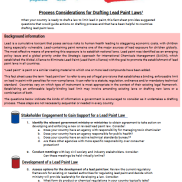
Process Considerations for Drafting Lead Paint Laws

In response to questions received by the Global Alliance to Eliminate Lead Paint on roadmaps for developing regulations on lead content in paint, the Alliance offers the following process considerations. Questions are illustrative, indicating the kinds of information a government might consider as it undertakes each component of a drafting process.
Emerging Policy Issues: Lead in paint
Topics: Policymaking

Avatar